
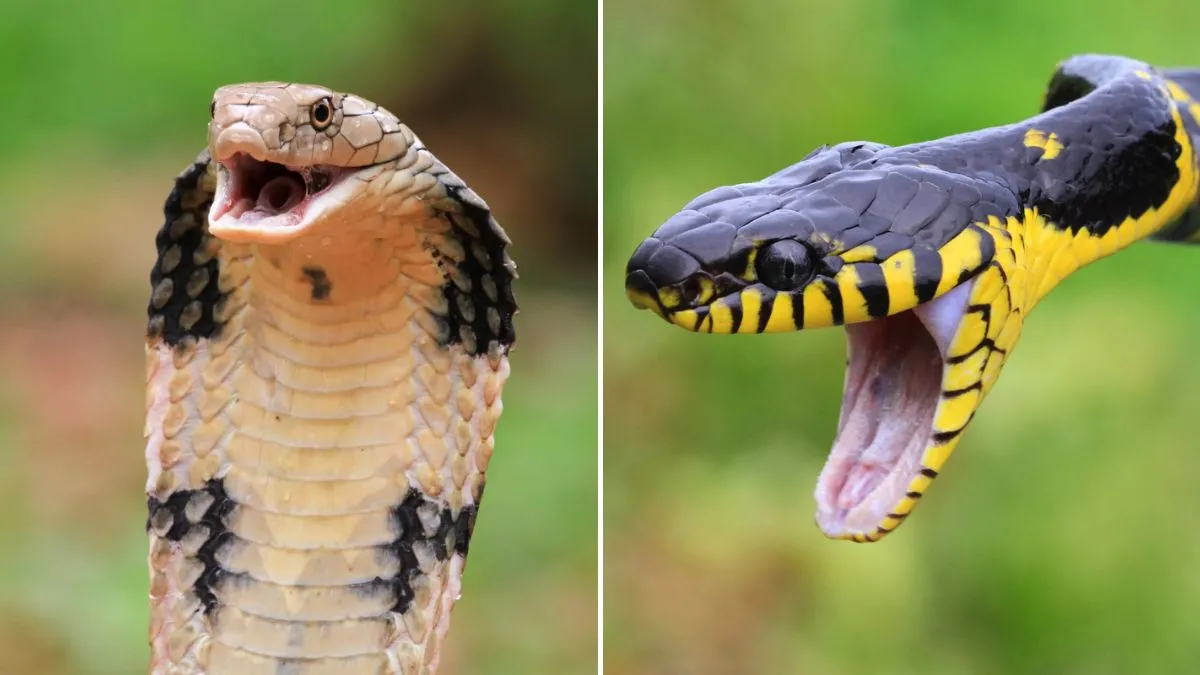
In many parts of Andhra Pradesh and Telangana, spotting snakes near homes is not exactly unusual. Areas with thick greenery, climbing plants, garbage piles or nearby water sources tend to attract them more often. And during summer, the chances go up even further because snakes actively search for cooler places and water.
People react differently when they suddenly see one. Some try to catch the snake and release it into forest areas. Some panic and run. Others end up getting bitten, which can quickly become dangerous depending on the type of venom involved. In India, different venomous snakes carry different kinds of toxins, and the effects on the human body can vary quite a bit.
Cobra venom affects the nervous system
Cobra venom mainly targets the nervous system and is classified as a neurotoxin. Once it enters the body, it starts interfering with the signals travelling between the brain and muscles.
The biggest danger comes when the muscles linked to breathing stop functioning properly. The lungs struggle to work, breathing becomes difficult and in severe cases, the person may die due to suffocation.
Cobras are found in large numbers across India. In many regions, they are also worshipped culturally, which is one reason they are commonly seen around human settlements. But despite that familiarity, they remain highly venomous and should be treated with extreme caution.
Hemotoxic venom damages blood and organs
Some snakes carry haemotoxic venom, which works very differently from cobra venom.
Instead of attacking the nervous system, this type of poison affects blood clotting. In some cases, the blood stops clotting normally. In others, it clots abnormally. Both situations are dangerous.
This venom can damage tissues internally and trigger bleeding inside the body. Blood may start leaking into internal organs, increasing the risk of kidney failure, heart complications and other organ damage.
In India, haemotoxic venom is commonly associated with snakes like Russell’s Viper and Saw-scaled Viper.
What happens if two venomous snakes bite together?
If a person is bitten by two different venomous snakes at the same time, the body can come under severe stress very quickly.
One venom may begin shutting down the respiratory system while the other starts damaging blood circulation and internal organs. The impact becomes much more intense.
Usually, snake venom takes some time to spread through the body. But when two different venoms enter together, that process can speed up significantly. Because of that, the chances of recovery may become very low without urgent treatment.
How treatment is usually given after snake bites
Doctors often use something called “polyvalent anti-venom” when treating snake bites, especially if the exact snake species is unknown or if multiple bites are suspected.
This injection acts against the venom of the four major venomous snakes commonly found in India, including cobra, viper and two major blood-related venomous snake species. It has helped prevent many snakebite deaths across the country.
After a snake bite, two things matter a lot: how much venom entered the body and how quickly the patient reaches a hospital.
Because of that, medical treatment should never be delayed. Anyone bitten by a snake should be taken to the nearest hospital immediately for proper care and emergency treatment.
Disclaimer: Tips and suggestions mentioned in the article are for general information purposes only and should not be construed as professional medical advice.
