
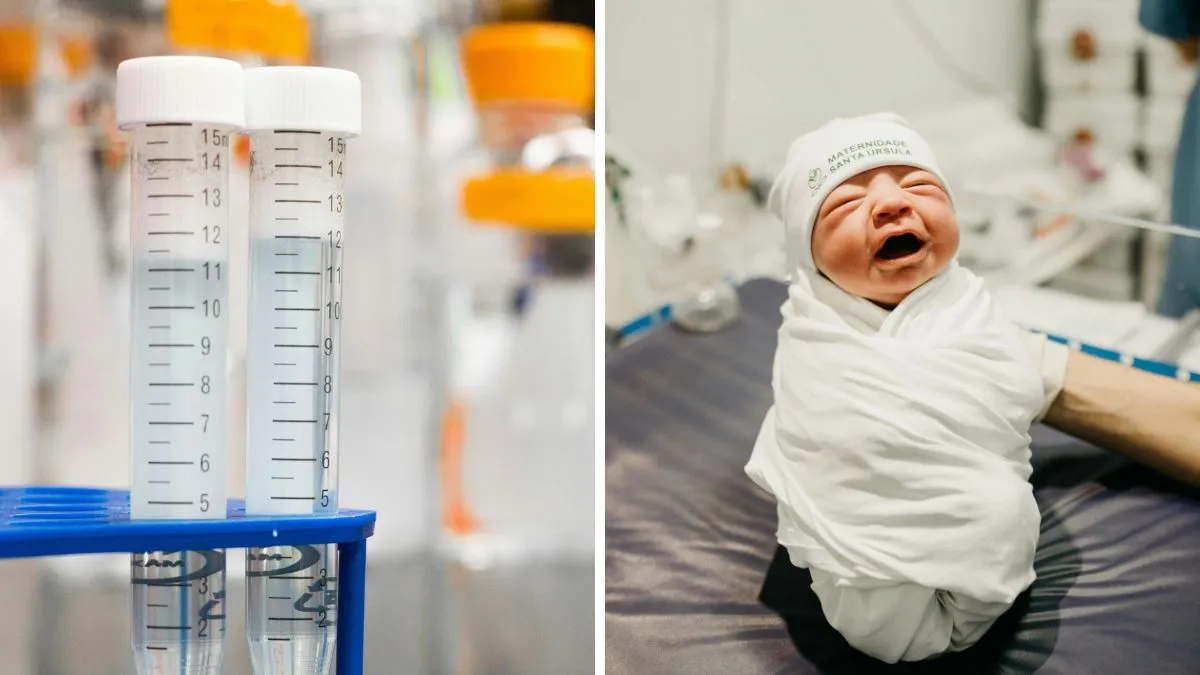
In a development that reads like science fiction, researchers have successfully turned human skin cells into functioning eggs. A team of US scientists has developed a "proof-of-concept" technique. According to the research published in the journal Nature Communications, the technique has the potential to one day help infertile people have their own biological children.
The method, though experimental, may revolutionise fertility medicine someday. It provides hope for older women, cancer survivors who have been left infertile, and even same-sex couples hoping for biological offspring. But it also poses profound scientific and ethical challenges.
How did scientists do it?
Researchers began with skin fibroblasts, the same type of cell that helps heal cuts. Using a cocktail of transcription factors and a supportive lab environment designed to mimic the ovary, they nudged these cells back into a more “youthful” state.
The process, called in vitro gametogenesis, involves stripping the skin cells of their identity and guiding them to take on the role of eggs. Along the way, the cells undergo epigenetic resets — wiping and rewriting the biological instructions that control how DNA is read.
In parallel experiments reported by The Guardian and ABC News, scientists also experimented with transplanting nuclei into donor egg shells, a process sometimes called mitomeiosis, to split chromosomes correctly. The goal is to produce eggs with exactly 23 chromosomes, ready for fertilisation.
What’s the success rate?
The short answer: very low.
- Out of 82 lab-created egg cells, fewer than 10% developed to early embryo-like structures by day six.
- Many showed chromosomal abnormalities, meaning they wouldn’t be viable.
- None progressed beyond the earliest stage of development.
These results are a proof-of-concept, not a working fertility technique. Scientists emphasise it will take at least a decade of refinement before this could ever be considered for clinical use.
Why this matters
If perfected, this breakthrough could reshape the way we think about fertility:
- For older women, it could bypass the decline in egg reserves that comes with age.
- For cancer survivors: those who were left infertile due to chemotherapy may be able to produce eggs from their own skin cells.
- For same-sex male couples: in theory, a partner's skin cells could be converted into eggs, to be fertilised with the other's sperm to produce a genetically related child.
It would also limit the use of donor eggs, providing more independence for individuals receiving fertility treatment.
Challenges and ethical questions
Despite the excitement, there are serious hurdles:
- Chromosome errors remain a huge barrier. Healthy, normal eggs are rare in these experiments.
- Efficiency is extremely low, raising concerns about safety and practicality.
- Ethics and law questions are yet to be answered. Creating human gametes in the lab touches on sensitive issues, from embryo research limits to potential misuse.
Experts warn that without strict oversight, the technology could outpace society’s readiness to handle its implications.
The science proves it can be done, but the path to doing it safely and ethically is long. For people struggling with infertility, these studies spark hope, but also a reminder that breakthroughs in the lab take years of testing before they become part of real-world medicine.
The research is a glimpse into what’s possible: a future where fertility is no longer limited by age, biology, or circumstance, but expanded by science, if we’re ready to meet the challenges it brings.
Disclaimer: Tips and suggestions mentioned in the article are for general information purposes only and should not be construed as professional medical advice. Always consult your doctor or a dietician before starting any fitness programme or making any changes to your diet.
