
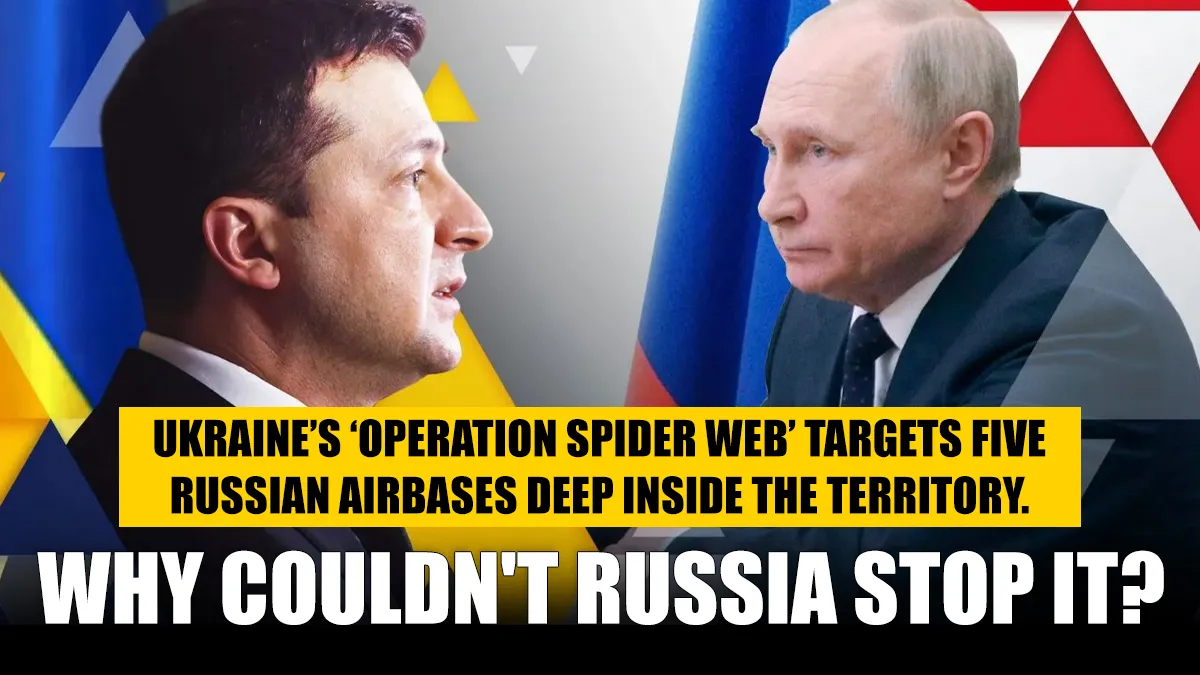
In one of the most audacious attacks since the war began, Ukraine launched what it claimed was its largest drone strike on Russian soil on June 1, hitting five major airbases and reportedly destroying over 40 fighter jets. The operation, named "Spider Web", was touted by Ukrainian President Volodymyr Zelenskyy as a success that targeted high-value strategic bombers inside Russia — over 4,000 km from the Ukrainian border.
The attack, reportedly orchestrated by Ukraine's SBU intelligence agency, targeted airbases in Belaya (eastern Siberia), Dyagilevo (Ryazan region), Ivanovo Severny (Ivanovo), Olenya (Murmansk), and Ukrainka (Amur region). However, the scale and success of the strike have raised a critical question: How did Russia, equipped with some of the world's most advanced air defence systems like the S-400 and S-500, fail to prevent the assault?
Low-altitude launches from within Russia made detection difficult
According to retired Indian Lieutenant General Vishnu Chaturvedi, the Russian air defence network did not technically "fail". Rather, it was bypassed. The drones were reportedly launched not from across the border or via aerial routes, but from within Russia itself — possibly from hidden containers mounted on trucks. With a significantly shorter distance to cover, the drones reached their targets within seconds or minutes, giving Russian forces little time to react.

Notably, the drones flew at extremely low altitudes, beneath the radar detection range of long-range systems like the S-400, which are designed to intercept high-altitude and long-distance threats. An estimated 117 drones were launched in the operation, overwhelming local defences and allowing multiple strikes to succeed.
S-400 not at fault, but intelligence failures loom large
Lt Gen Chaturvedi emphasised that the failure was not of the S-400 system, but of Russian intelligence. Ukraine had reportedly been planning the operation for over a year, transporting the drones into Russia, possibly via Kazakhstan. Yet Russian agencies failed to detect the threat.
"The S-400 system is highly capable of intercepting targets up to 400 km away, including missiles and high-flying drones. But it was never designed for low-altitude, close-range strikes launched from inside its own territory," he said.
Not the first time Ukraine struck S-400 units
This is not the first instance of Ukrainian drones breaching Russian defences. Between August 2023 and 2024, Ukraine managed to destroy multiple S-400 systems, including their radar batteries. However, Chaturvedi notes that this does not imply a weakness in the system itself. Contributing factors could include operator inexperience, deployment errors, or a lack of layered defences supporting the S-400 — something India, for example, has ensured in its own deployments.
Miscalculation and retaliation: What's next?
Chaturvedi warned that Russia is unlikely to let the June 1 attack go unanswered. "President Putin will retaliate with force. Kyiv and Sumy could face intensified strikes," he said, adding that President Zelenskyy's dependence on Western support has come at a heavy cost. "Zelenskyy has turned a once-thriving nation into a war zone. Even if Ukraine emerges from the conflict, it will take 15-20 years to rebuild its institutions and economy," he said.
While Russia, too, has suffered in the prolonged war, the drone strike and Russia's inability to prevent it have shifted attention to the growing vulnerability of even the most advanced militaries when faced with asymmetric, low-cost aerial warfare.