
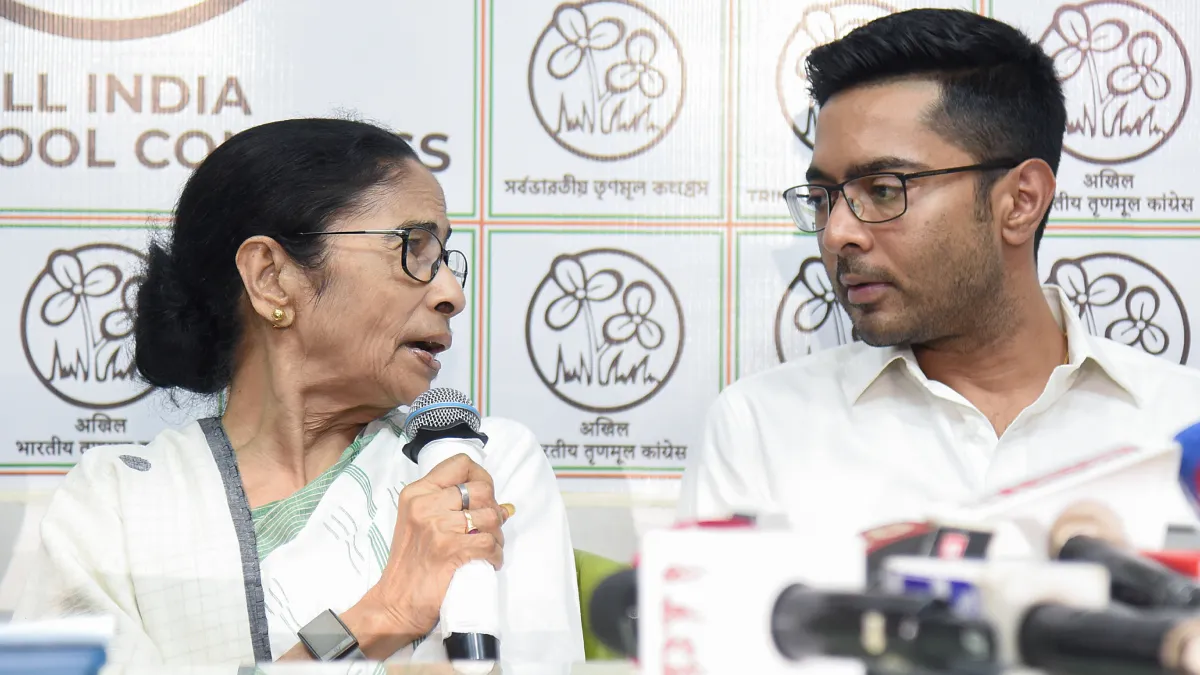
Mamata Banerjee's Trinamool Congress (TMC) suffered its gravest crisis in its 28-year history after 57 rebel MLAs split the party and elected expelled leader Ritabrata Banerjee as Leader of Opposition in the West Bengal Assembly on Wednesday, securing recognition from Speaker Rathindra Bose and effectively wresting control of the party's legislature wing.
The rebellion marks the first formal split within the party founded by Mamata Banerjee in 1998 and comes barely weeks after the TMC's crushing defeat in the West Bengal Assembly elections.
The dissident camp crossed the two-thirds threshold required under the anti-defection law, allowing it to seek recognition as a separate legislative bloc. With the TMC holding 80 MLAs, the legal threshold stood at 54 legislators; the rebel group claimed support from 58 and two additional.
The immediate response from the party leadership underscored the seriousness of the challenge. Within hours, the TMC dissolved all organisational committees and frontal wings across the state in what was widely viewed as an attempt to reassert control over a rapidly fragmenting organisation.
More significantly, the split has revived speculation over whether discontent within the organisation could spill over into Parliament, where several senior MPs have already expressed dissatisfaction with the party's functioning over the past few months.
If true, the ripples into the MP camp could weaken the party and hand an opportunity to the ruling NDA. Here are some of the evident instances where TMC MPs have either quit the party and spoken openly against the leadership, further fuelling the buzz of another split.
Signs of unrest were visible long before the split
Several prominent MPs and leaders had publicly aired grievances regarding the party's internal functioning, candidate selection process and organisational structure following the electoral defeat.
Kakoli Ghosh Dastidar
Among the most significant developments was the resignation of veteran MP Dastidar from all organisational positions within the party. A four-time Lok Sabha MP and long-time Mamata loyalist, Dastidar stepped down after publicly expressing disappointment with the leadership and raising concerns over the party's internal functioning. She also attended an administrative meeting chaired by Chief Minister Suvendu Adhikari despite objections from the party leadership, further fuelling speculation about widening cracks within the organisation.
The Barasat MP's differences with the party had also become visible in Parliament. She sought permission from Lok Sabha Speaker Om Birla to file a complaint against fellow TMC MP Kalyan Banerjee, accusing him of misogyny and repeated verbal abuse. The episode exposed tensions within the parliamentary wing and highlighted dissatisfaction among some senior leaders.
Sukhendu Sekhar Roy
In the Rajya Sabha, senior MP Sukhendu Sekhar Roy emerged as one of the sharpest internal critics of the party's functioning. Roy publicly questioned the state of internal democracy within the TMC, alleged institutionalised corruption and criticised the growing influence of political consultancy firm IPAC in organisational decision-making.
His remarks were particularly striking because of his long association with Mamata Banerjee. Roy warned that the party risked disintegration if it failed to honestly assess the reasons behind its electoral defeat and undertake course correction.
Shantanu Sen
Former minister and Rajya Sabha MP Shantanu Sen also resigned as the party's national spokesperson in May, citing the need to respect the people's verdict. His exit from a key organisational role was viewed as another sign of dissatisfaction among senior leaders.
The unease has not been confined to veteran leaders alone. Youth leaders such as Saayoni Ghosh and several elected representatives have maintained a noticeably lower public profile since the election defeat, while other MPs and senior functionaries have increasingly avoided taking public ownership of organisational decisions.
Deepak Dev Adhikari
Actor-turned-politician and MP Deepak Adhikari, popularly known as Dev, further fuelled speculation after making remarks expressing confidence in the incoming BJP-led government and calling for an end to political hostility and misinformation. While he has not indicated any intention to leave the party, his comments were interpreted by many observers as reflecting a changing political mood within sections of the TMC leadership.
Several reports suggest that much of the resentment within the party is directed not at Mamata Banerjee personally but at the growing influence of her nephew Abhishek Banerjee and the concentration of decision-making authority within a small leadership circle. Even many dissidents continue to express respect for Mamata while criticising the party's internal structure.
Advantage for NDA?
The most immediate political impact of the split is being felt in West Bengal, where the BJP has already emerged as the dominant force after the assembly election. However, the consequences could extend to Parliament if organisational instability leads to further resignations, defections or reduced coordination among TMC MPs.
This could bring an advantage in disguise for the BJP and the ruling NDA in terms of votes for the passage of bills if the Opposition loses strength.
The NDA government failed to secure the required two-thirds majority in the Lok Sabha to pass the Constitution (One Hundred and Thirty First Amendment) Bill, commonly known as the Delimitation Bill. The proposed legislation seeks to redraw parliamentary constituencies and increase the Lok Sabha's maximum strength from 543 to 850 seats.
During the vote, the INDIA bloc presented a united front, with 230 MPs voting against the bill. The opposition camp included members from the Congress, the DMK, the Left Front, the RJD, the AAP, the SP, and the TMC, while the NDA mustered 298 votes - insufficient to meet the constitutional threshold required for passage.
The TMC's 28 Lok Sabha MPs and the DMK's 22 MPs played a significant role in bolstering the opposition's numbers. Several opposition parties argued that linking the expansion of the Lok Sabha to the implementation of the Women's Reservation Act was problematic and expressed concerns that a fresh delimitation exercise could diminish the political influence of southern states that have recorded slower population growth.
