
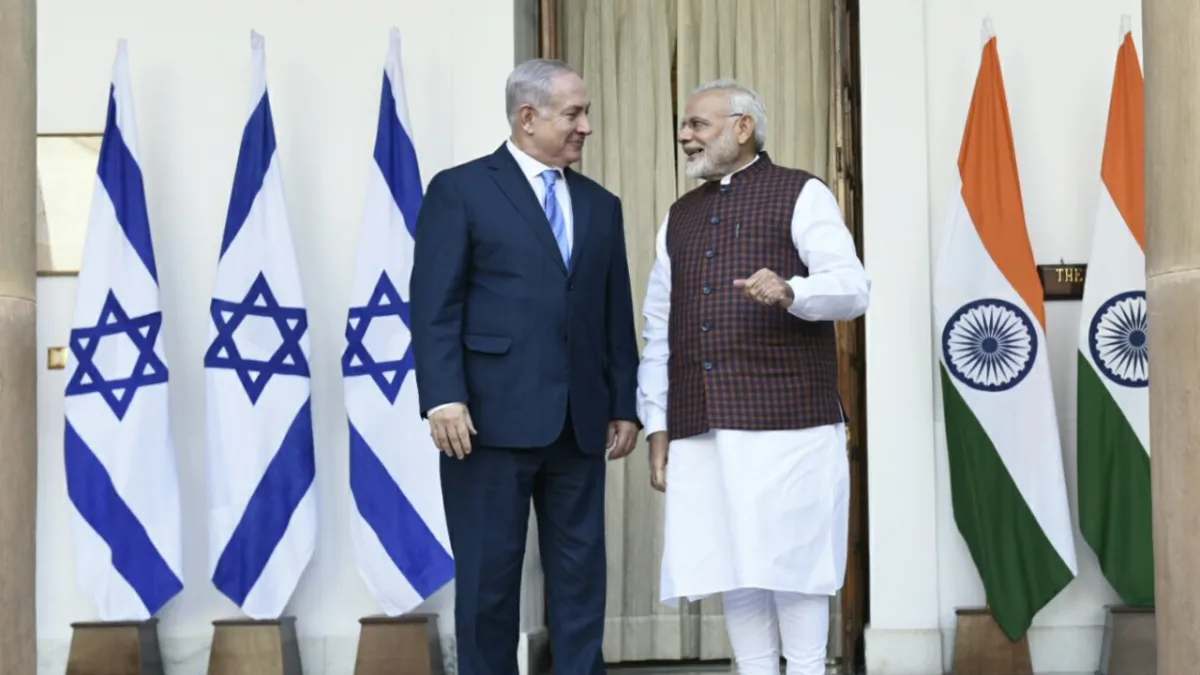
A host of strategic and defence decisions will be taken for India as Prime Minister Narendra Modi lands in Israel today for a two-day visit during which he will hold detailed discussions with Israel's Benjamin Netanyahu on a wide range of bilateral and regional issues.
Ahead of the visit, Netanyahu described Modi as a "dear friend" and underscored the deepening strategic convergence between the 2 countries. In a post on X, the Israeli prime minister said that at the opening of a Cabinet meeting he had spoken about the “historic visit” of his Indian counterpart. Referring to ties between the 2 nations as a “powerful alliance between 2 global leaders”, Netanyahu said India and Israel are working closely together in innovation, security and on a shared strategic vision for the region and beyond.
In the same remarks, Netanyahu also outlined plans for what he called a “Hexagon of Alliances”, a proposed network of allied countries in or around West Asia that would collectively stand against what he termed “radical” adversaries.
Hexagon of Alliances
According to Netanyahu, the Hexagon of Alliances is envisioned as a 6 sided framework bringing together countries from within and around West Asia. He indicated that India, Greece and Cyprus would be among the core participants, alongside other unnamed Arab, African and Asian nations that share similar strategic concerns.
According to The Times of Israel, Netanyahu said: "In the vision I see before me, we will create an entire system, essentially a hexagon of alliances around or within West Asia." He added that the intention is to establish an axis of countries that see eye to eye on regional realities, challenges and long-term goals.
He further explained that this bloc would stand in opposition to what he described as radical axes in the region, including the radical Shia axis, which he claimed Israel has already struck hard, as well as what he referred to as an emerging radical Sunni axis. However, he did not provide further clarification on which actors he was referring to in that context.
How the proposed alliance would work
According to a PTI report, the proposed alliance would resemble broader connectivity and cooperation initiatives such as the India Middle East Europe Economic Corridor, or IMEC, which seeks to strengthen economic development by enhancing trade links and infrastructure connectivity between India, the Middle East and Europe.
Netanyahu suggested that the Hexagon of Alliances would coordinate across 3 primary pillars: economic cooperation, diplomatic alignment and security collaboration. The idea, he indicated, is to institutionalise coordination among like-minded states in order to create a more structured and resilient regional framework.
Under the economic pillar, member countries would aim to expand trade, technology partnerships and infrastructure connectivity. On the diplomatic front, they would seek to align positions on key regional and global issues. In terms of security, the bloc would look to deepen intelligence sharing, defence cooperation and coordinated responses to shared threats.
Why the Hexagon of Alliances is significant
Netanyahu has framed the proposed grouping as a strategic counterweight to Iran and its network of regional allies and proxies, often described as the resistance axis. By building a coalition of states with shared threat perceptions, Israel appears to be seeking to reshape the regional balance through structured partnerships rather than ad hoc alignments.
"All of these nations share a different perception, and our cooperation can yield great results and, of course, ensure our resilience and our future," Netanyahu said, emphasising the long-term strategic logic behind the initiative.
As Modi prepares for what Netanyahu has termed a historic visit, the proposal for a Hexagon of Alliances adds a new dimension to India-Israel ties and signals an attempt to formalise broader regional cooperation in a period of heightened geopolitical flux.
