
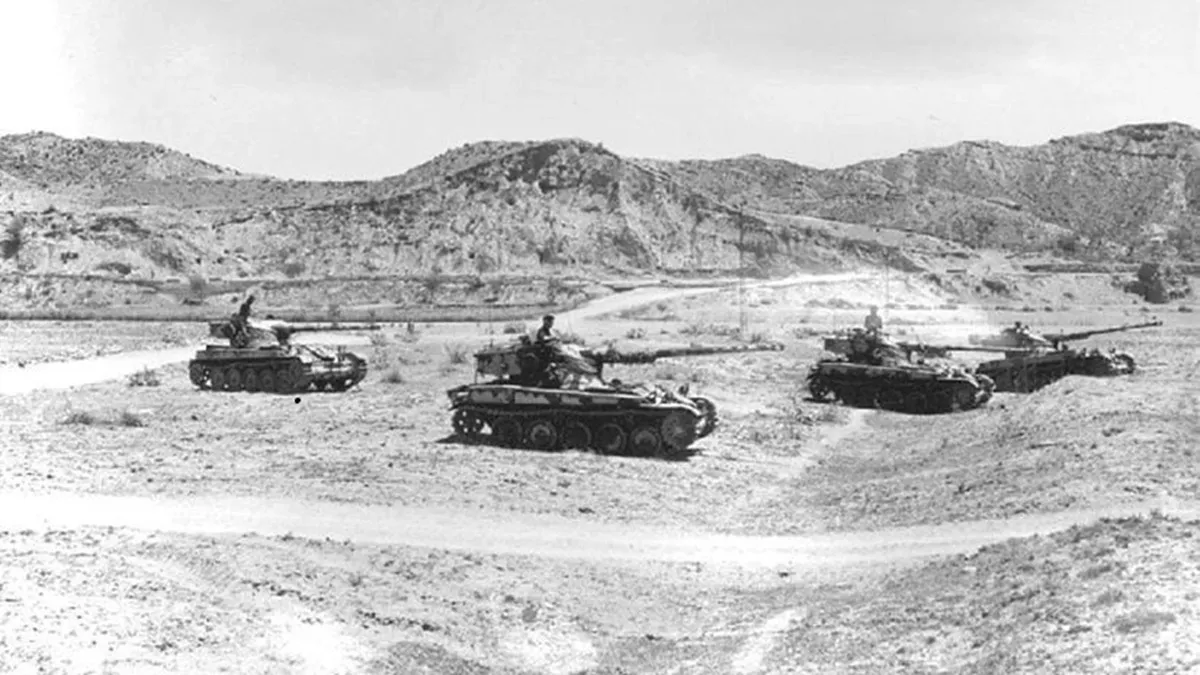
Operation Gibraltar remains one of the most audacious yet disastrous military misadventures undertaken by Pakistan. Launched in August 1965, it was a covert plan designed to infiltrate Jammu and Kashmir with armed Pakistani troops disguised as locals and incite a mass uprising against Indian rule. Instead of achieving its intended objective, the operation backfired spectacularly, setting off the 1965 India-Pakistan War that reshaped the subcontinent's military and political landscape.
Historical background
After India's independence in 1947 and the first Kashmir war that ended in 1948, Pakistan remained dissatisfied with the status of Jammu and Kashmir. The region was a constant point of friction with Pakistan aiming to annex it through both military and covert means. By the early 1960s, Pakistan's leadership believed India was weakened following the 1962 war with China. They assumed that Kashmiri Muslims were ready to revolt if given external support. This miscalculation formed the basis of Operation Gibraltar. The plan was conceived under the leadership of Pakistan's then-President Ayub Khan and the Pakistan Army, with the belief that India would not respond with full-scale military retaliation.
Execution of the plan
Operation Gibraltar involved sending thousands of Pakistani soldiers, irregulars, and infiltrators across the Line of Control (then called the Ceasefire Line). Disguised as local insurgents, their mission was to disrupt Indian administration, sabotage infrastructure and incite an armed rebellion against India in Kashmir. As per the information, the infiltrators were organised into various groups named after historical Islamic conquerors such as Salahuddin and Ghaznavi. They carried weapons, explosives and propaganda material, expecting to find widespread support from the Kashmiri population.
Reasons for failure
The operation failed almost immediately due to several strategic miscalculations:
- Lack of local support: Contrary to Pakistan's assumptions, Kashmiri Muslims did not rise in rebellion. Many locals even informed Indian authorities about the infiltrators.
- Indian military response: India quickly identified the infiltration and launched counter-operations to flush out Pakistani forces.
- Poor planning: The Pakistani army had underestimated India's ability and willingness to retaliate.
- Intelligence failures: Pakistan misread the political climate in Kashmir and overestimated its ability to control the narrative.
These failures exposed the operation which also left Pakistan diplomatically isolated and militarily vulnerable.
How Operation Gibraltar triggered the 1965 war
The detection of infiltrators by Indian forces in Kashmir escalated tensions rapidly. India responded with strong military action and crossed the Line of Control to target Pakistani positions. This soon spread into a full-fledged conflict across the western front. The war lasted from September 6 to September 23, 1965, and saw intense battles in Punjab, Kashmir and Rajasthan. Both nations suffered heavy casualties and military losses. The conflict ended after the United Nations brokered a ceasefire on September 23, 1965.
The result of the 1965 war
While Pakistan aimed to wrest Kashmir from India, the war ended in a stalemate, with a ceasefire brokered by the United Nations. India successfully defended its territories, while Pakistan failed to achieve its objectives. The Tashkent Agreement, signed in January 1966 under Soviet mediation, restored status quo borders but left the core issue of Kashmir unresolved. The war had long-lasting consequences as it dented Pakistan's military reputation massively, strengthened India's position in Kashmir and set the stage for future conflicts between the two neighbours.
India-Pakistan relations after post-Operation Sindoor
Nearly six decades later, the shadow of Operation Gibraltar continues to loom over India-Pakistan relations. Tensions spiked once again after terrorists killed 26 civilians in the April 22 Pahalgam terror attack in Jammu and Kashmir. Following this, India's response came on May 7 with Operation Sindoor, where the armed forces carried out precision missile strikes on terror hubs in Bahawalpur -- a stronghold of Jaish-e-Mohammad. New Delhi has consistently underlined that talks with Pakistan cannot resume until cross-border terrorism ends. The cycle of hostility echoes the past, with Pakistan relying on infiltration and India responding with decisive military action. While diplomatic engagement remains stalled, India's position today is markedly stronger with far greater international backing compared to 1965.
ALSO READ: Indo-Pak 1965 war ended on September 23: When India captured around 1,800 sq km of Pakistani land
