
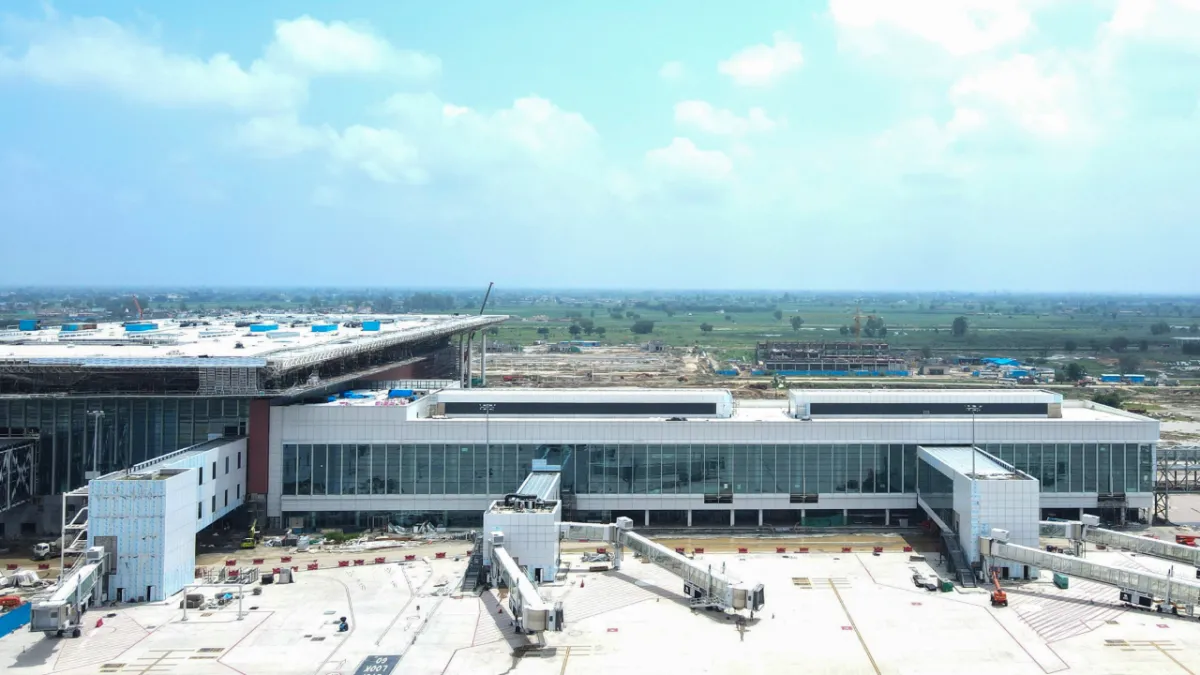
The upcoming Noida International Airport at Jewar in Uttar Pradesh's Gautam Buddh Nagar district is likely to be inaugurated this year, marking a major milestone in India’s aviation infrastructure. Touted as one of the country’s largest greenfield airports, it is expected to significantly boost air connectivity for Delhi-NCR and western Uttar Pradesh, while also easing congestion at the Indira Gandhi International Airport in Delhi.
Commercial flight operations are expected to commence within about 45 days of the inauguration, likely by mid-December. The initial phase of the project is being completed on a fast track to enable early operations and establish Jewar as an alternate aviation hub for the region.
Jewar airport to see 1.2 crore footfall annually
In its first phase, the airport will feature a single runway and a state-of-the-art passenger terminal capable of handling around 1.2 crore passengers annually. Built with sustainability and scalability in mind, the design incorporates advanced facilities to ensure smooth passenger flow and efficient operations.
The long-term vision for Jewar Airport is even more ambitious. Future expansion phases are planned to increase capacity to nearly 70 million passengers per year, supported by multiple runways and cargo terminals. Once fully operational, it will be among the largest airports in Asia, comparable to global aviation hubs in terms of capacity and scale.
Located about 75 kilometres from New Delhi along the Yamuna Expressway, the airport enjoys excellent road connectivity and is positioned to serve not only the National Capital Region (NCR) but also parts of western Uttar Pradesh and neighbouring states. The location has been strategically chosen to facilitate both passenger and freight movement across north India.
Leading domestic airlines such as IndiGo and Akasa Air have already confirmed plans to begin operations from Jewar, signalling strong industry confidence in its potential. The airport is expected to play a key role in decongesting Delhi’s existing air traffic, boosting tourism, and supporting regional economic development through improved logistics and employment opportunities.
How Noida International Airport will transform air connectivity
- With the existing Indira Gandhi International Airport (IGI) in Delhi handling massive traffic, Jewar offers a much-needed second major civil aviation gateway for the NCR. Analysts say the twin-airport model will enable more flights, more direct international routes and improved slot availability.
- Many parts of NCR, including Noida, Greater Noida, and western Uttar Pradesh, will benefit from a much closer major airport. This reduces travel time for flyers in those regions and aligns with planned infrastructure improvements (roads, expressways). For example, enhanced signage and expressway link works ahead of the opening.
- In its first phase, Jewar will connect at least 10 domestic cities. With cargo infrastructure and later phases planned, it also sets up to serve long-haul international flights. The runway and terminal design incorporate low-visibility landing capability (CAT-III) helping operations during North India’s frequent fog season.
- The airport is positioned not just for passenger traffic but as a logistics hub. The location, scale and infrastructure being built mean that cargo operations will grow significantly, strengthening trade and industrial connectivity in northern India.
- Beyond aviation, the airport acts as a growth engine for the surrounding region, jobs, real-estate investment, tourism, business travel and supply-chain clustering are all expected to rise. Government statements point to Jewar becoming a key pillar of Uttar Pradesh’s infrastructure ambitions
- While last-mile transport links (metro, rapid rail) are planned, they may lag the airport opening; effective access from Delhi and wider NCR is key.
- Travel time and cost to reach Jewar-airport relative to the IGI Airport in Delhi will influence how passengers adopt it.
Also read: Jewar Airport inauguration: A look at the mega project's timeline, delays and milestones
