
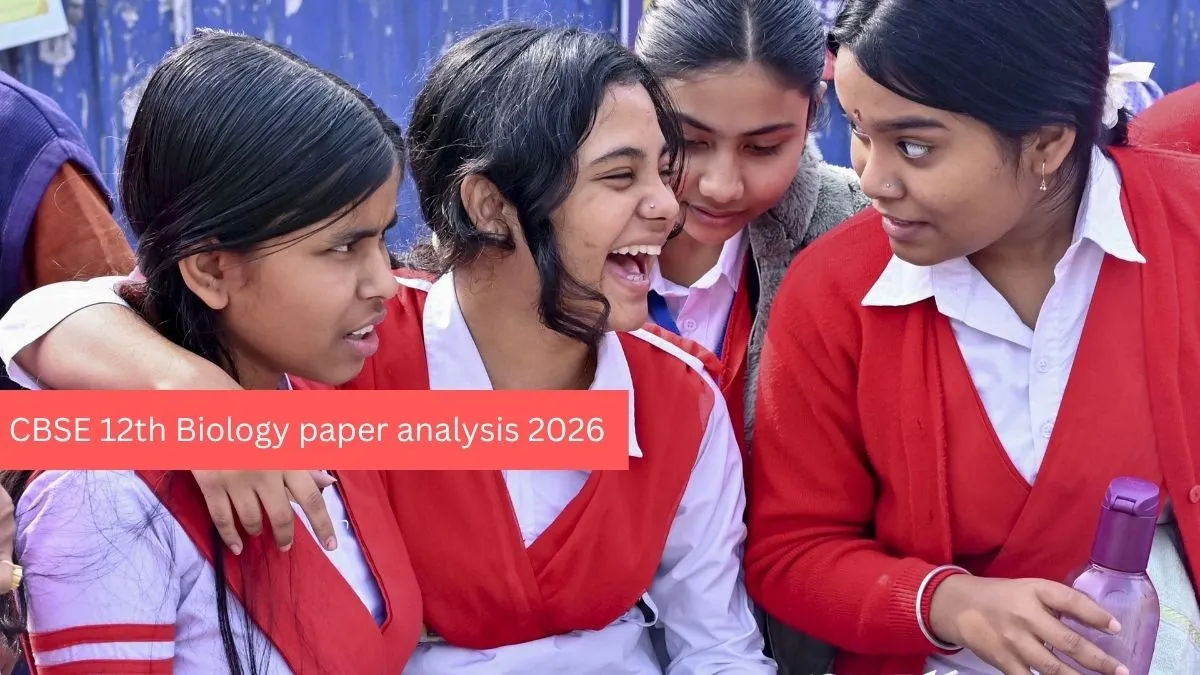
The Central Board of Secondary Education (CBSE) conducted the Class 12 Biology exam today, March 27. As per the students, the CBSE 12th Biology paper was moderately easy, the questions were repeated from previous years' papers.
According to Sujata, PGT Biology, KIIT World School, Gurugram, "the paper was balanced and student-friendly, prioritizing conceptual clarity over rote memorization. Several questions were repeated from Previous Year Questions (PYQs), rewarding consistent practice.
Section A (MCQs): Very direct and factual; designed for quick scoring.
Sections B & C: Remained standard and easy, covering fundamental textbook processes.
Sections D & E: These were the "differentiator" sections. They shifted toward conceptual application, requiring a deep, integrated understanding of biological mechanisms rather than simple definitions."
S Hema Malini, PGT at JAIN International Residential School, Bengaluru - "The Class 12 Biology exam was quite balanced overall and felt fair for students who had prepared well from NCERT. The paper covered almost the entire syllabus, with questions coming from all the major units like reproduction, genetics, biotechnology, and ecology. Because of this, there wasn’t too much weight given to any single chapter, which made the paper feel well-distributed.
Most of the questions were direct and easy to understand. Many of them were based on basic concepts, definitions, and standard processes that we usually study from the textbook. Students who had revised NCERT properly would have found it easier to attempt these questions without much confusion. Even the diagram-based questions were familiar and not very complicated.
The social or application-based questions were also quite straightforward. They didn’t require too much deep thinking or analysis, but rather a clear understanding of concepts. This helped in saving time and allowed students to write answers more confidently. It felt like the paper was designed more to check understanding rather than to confuse students.
However, there were one or two questions that felt a bit tricky, especially at the beginning. These questions needed careful reading, and some students might have found them slightly confusing at first. But once understood properly, they were manageable. Apart from these few questions, the rest of the paper was quite smooth.
Time management was not a big issue in this exam. Since most questions were direct, students were able to complete the paper on time. Many even got extra time to revise their answers. Those who practiced writing beforehand would have found it even easier.
Overall, the Biology exam can be considered moderate in difficulty. It was neither too easy nor too tough. It was a fair paper that mainly focused on NCERT concepts, with just a few slightly tricky questions to test understanding. Students who prepared consistently and focused on basics would have been able to perform well”.
Shaifali Singh, PGT- Biology, Global Indian International School, Noida - "The Class 12 Biology examination was designed to test the analytical and problem-solving skills for the students, and I must say that our students have done a commendable job in solving the problems with utmost precision and accuracy.
The Class 12 Biology examination Level was average . It consist of few tricky questions which is always as usual involve multiple concepts.The paper had a good mix of MCQs, short answer questions, and long answer questions, which allowed the students to demonstrate their knowledge and problem-solving.
Assertion reasoning questions are easy and Case based study questions are based on practical life applications based. Overall the Biology paper was a balanced paper.
The students have shown an exceptional understanding of the subject and have performed exceptionally well, which is a testimony to their hard work and dedication towards their studies”.
Ashok Kumar, PGT Biology, Silverline Prestige School - "the paper followed a well-structured format that aligned perfectly with the 2025-26 session sample papers. The 70-mark paper, lasting three hours, as moderate and highly balanced. While 30 per cent internal choices provided flexibility, the paper was notably conceptual and thinking-based, shifting away from rote memorization toward a deeper application of the NCERT curriculum.
Direct questions were easily accessible, yet the competency-based segments remained average in difficulty, requiring analytical clarity. Although case study questions were straightforward, the Multiple Choice Questions (MCQs) were considered tricky, demanding precise logic. Students exited the centers with happy, satisfied faces, having completed the paper comfortably within the time limit. Overall, the exam rewarded those with a strong grasp of the CBSE curriculum, emphasizing that future preparation must focus on an integrated, logic-driven understanding rather than simple factual recall."
Praneet Mungali, a dedicated educationist and Trustee at the Sanskriti Group of Schools, Pune - "the paper was of moderate difficulty level and largely student-friendly. Most of the questions were directly based on NCERT content, making it easier for well-prepared students to attempt confidently .The paper mainly focused on conceptual clarity except few tricky questions.Students appeared satisfied with their performance and came out of the exam hall smiling, indicating that the paper was balanced and fair."
Gurpreet Kaur, PGT Biology, Satya School, Gurugram - "The paper followed the NCERT framework closely, with a strong emphasis on conceptual clarity rather than rote learning. Multiple-choice questions were mostly straightforward, though a few required careful thinking—especially those from genetics, molecular biology, and evolution.
Sections involving menstrual cycle, DNA composition, and transcription tested fundamental understanding, while questions on biotechnology and ecology were direct and scoring for well-prepared students. The long-answer section included standard questions such as monohybrid crosses and biodiversity, which were expected and manageable.
A notable highlight was the inclusion of application-based and reasoning questions, encouraging analytical thinking. However, some students may have found parts of molecular biology slightly tricky due to close options and conceptual depth."
Mukesh Khatri, Teaching Faculty - Senior Years (Shiv Nadar School Gurgaon) - "The question paper was well-aligned with the prescribed syllabus and reflected the NCERT curriculum standards. The paper was balanced, assessing conceptual understanding and application skills. Some MCQs were challenging, requiring mathematical abilities, while diagram-based questions and case studies were well-integrated. Overall, the paper seemed familiar, with no unexpected questions, making it accessible to students who had prepared thoroughly from the prescribed textbooks. The mix of question types effectively tested students' accuracy, critical thinking, and time management skills."
