
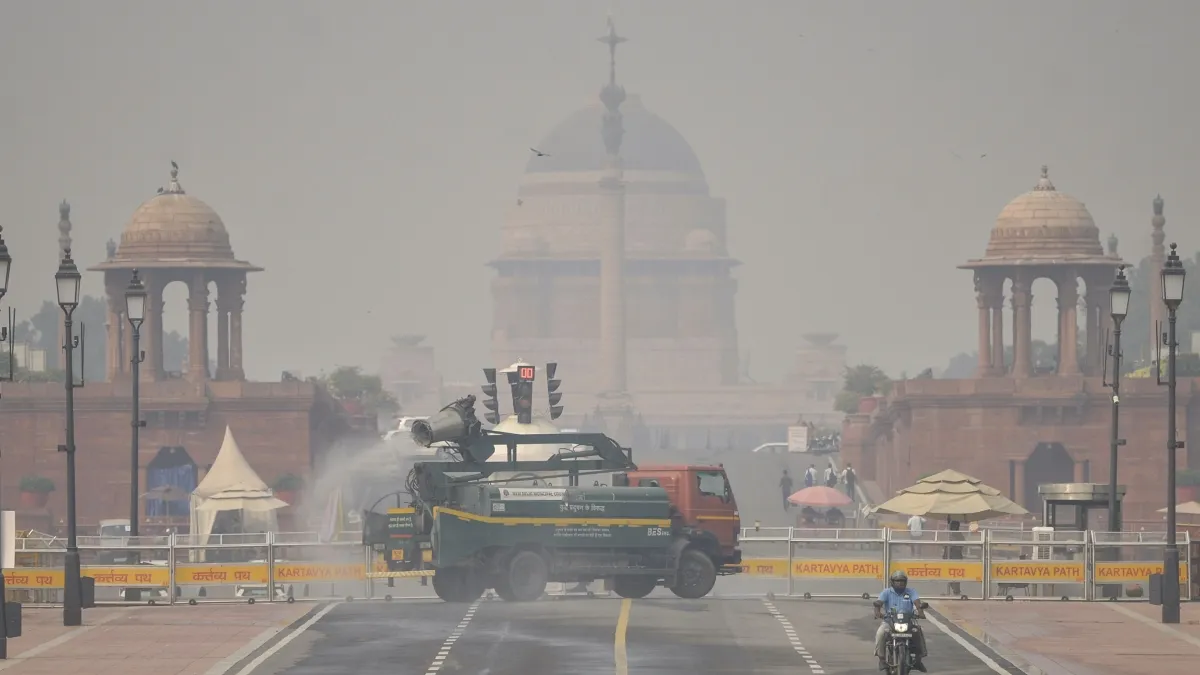
Delhi witnessed a sharp deterioration in air quality following Diwali, with PM2.5 levels surging to their highest in five years, according to an analysis of Central Pollution Control Board (CPCB) data. The average PM2.5 concentration reached 488 micrograms per cubic metre in the 24 hours after Diwali, more than three times the pre-festival level of 156.6 micrograms per cubic metre.
The analysis, covering the period from 2021 to 2025, showed that PM2.5 values consistently spiked during Diwali night and early the next morning, with the 2025 post-Diwali reading of 488 micrograms per cubic metre being the most polluted period since 2021.
What was last year's PM2.5 level?
The data shows that in previous years, average PM2.5 levels rose from 163.1 to 454.5 in 2021, from 129.3 to 168 in 2022, from 92.9 to 319.7 in 2023, and from 204 to 220 in 2024.
The study by research and advisory group Climate Trends attributed the surge mainly to local emissions from firecrackers, stagnant winds of less than one metre per second and temperature inversion that traps pollutants close to the surface.
The high concentration of PM2.5 is due to local firecracker emissions across different parts of Delhi. Wind speed was extremely low, leaving no scope for dispersion, said S K Dhaka, professor at Rajdhani College, University of Delhi.
He added that even "so-called" green firecrackers contributed significantly to particulate buildup and there was a need to check their quality and composition.
Air quality worsens in several parts of Haryana, Punjab
Air pollution levels worsened across Haryana on Tuesday, with many areas, including Gurugram, recording "very poor" air quality, while most parts of neighbouring Punjab remained in the "poor" category, according to the CPCB.
According to the 24-hour average AQI, which is reported at 4 pm everyday, Jind recorded an AQI of 421 and Dharuhera in Rewari of 412 (both in the severe category).
According to the Central Pollution Control Board, Narnaul recorded an AQI of 390, Rohtak 376, Gurugram 370, Bahadurgarh 368, Sirsa 353, Manesar 320, while Charkhi Dadri recorded an AQI of 353.
The air quality in many other parts of Haryana was poor. The AQI recorded in Faridabad was 268, Ambala 234, Ballabgarh 297, Fatehabad 266, Kaithal 273, Karnal 266, Kurukshetra 230, Panipat 216, Sonipat 287, while in Yamunanagar, it was 287.
In Punjab, according to the 24-hour average AQI, it was recorded at 224 in Amritsar, 247 in Jalandhar, 271 in Ludhiana , while in Patiala it was 206. Chandigarh, the common capital of the two states, recorded an AQI of 147 (moderate).
An AQI between zero and 50 is considered 'good', 51 and 100 'satisfactory', 101 and 200 'moderate', 201 and 300 'poor', 301 and 400 'very poor', 401 and 450 'severe' and above 450 'severe plus'.
Reason for rise in pollution
Unfavourable meteorological conditions, combined with vehicular emissions, paddy-straw burning, firecrackers, and other local pollution sources, contribute to hazardous air quality levels in Delhi-NCR during winters.
The capital's air quality has consistently fallen into the "severe" category (air quality index above 400) after Diwali for most of the past decade, despite court bans on firecrackers and repeated advisories from authorities.
Doctors say breathing Delhi's air during such episodes is equivalent to smoking about 10 cigarettes a day. Prolonged exposure to such high levels of pollution can cause or worsen asthma, bronchitis, and chronic obstructive pulmonary disease and significantly raise the risk of heart disease.
(With PTI inputs)
Also Read: Delhi air quality plummets morning after Diwali: These are the 10 most polluted areas in the city
Also Read: Delhi-NCR air quality worsens to 'very poor' category; here's the AQI morning after Diwali
