
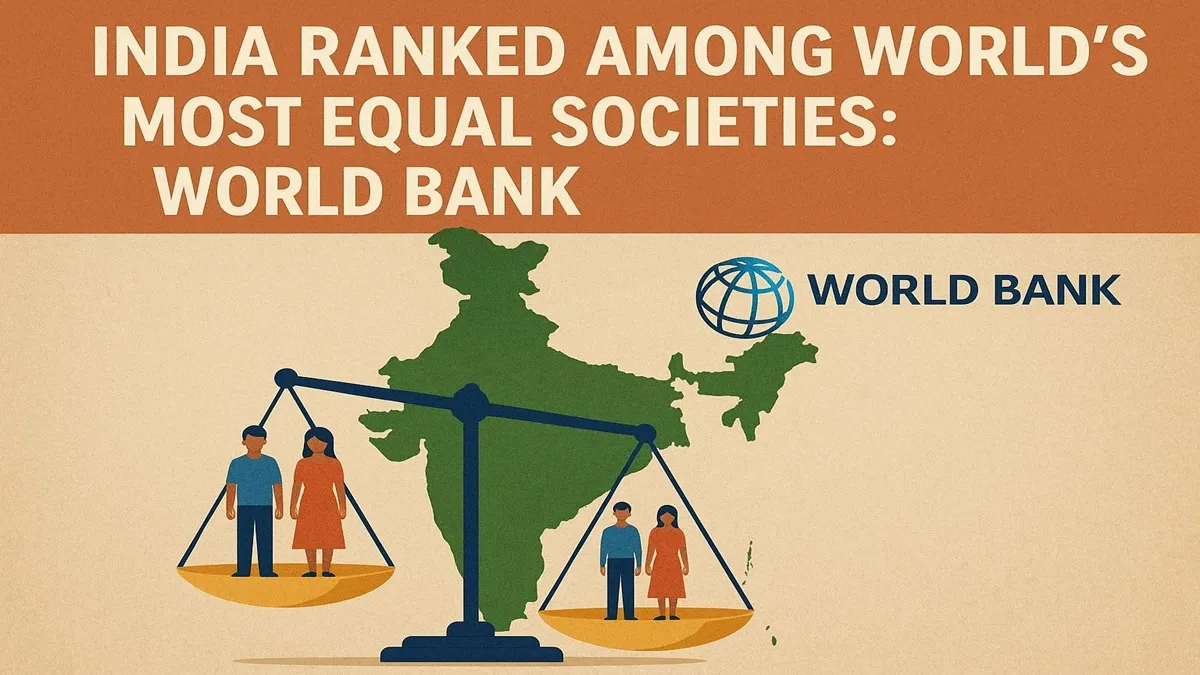
India has been ranked as one of the most income-equal societies globally, securing the fourth position in the World Bank’s latest Gini Index rankings. With a score of 25.5, India now stands just behind the Slovak Republic, Slovenia, and Belarus, surpassing several advanced economies in income equality.
Gini index reflects rising income equality
The Gini Index is a widely accepted measure of income distribution, where a lower score indicates greater equality. India’s score of 25.5 marks significant progress from 28.8 in 2011. In comparison, China stands at 35.7, the United States at 41.8, and all G7 and G20 countries trail India in this regard.
Sharp drop in poverty levels
According to the World Bank’s Spring 2025 Poverty and Equity Brief, India has made substantial headway in poverty reduction. Between 2011 and 2023, 171 million people were lifted out of extreme poverty, with the poverty rate falling from 16.2% to just 2.3%, based on the global threshold of USD 2.15 per day.

Policy focus driving equitable growth
Government efforts to promote inclusive growth have played a pivotal role in enhancing equality. A statement from the Ministry of Social Welfare attributed this success to consistent policy interventions targeting poverty reduction, financial inclusion, and direct welfare support.
Flagship schemes empowering the masses
Several central government schemes have underpinned this transformation-
- PM Jan Dhan Yojana: Over 55 crore bank accounts opened, ensuring widespread financial inclusion.
- Aadhaar: India’s digital identity program now covers 142 crore individuals, enabling Direct Benefit Transfers (DBT) that saved Rs 3.48 lakh crore by March 2023.
- Ayushman Bharat: Provided health coverage of Rs 5 lakh per family, with over 41 crore health cards issued.
- Stand-Up India: Supports SC/ST and women entrepreneurs through access to loans and mentoring.
- PM Vishwakarma Yojana: Assists traditional artisans with financial and skill-based support.
- PMGKAY (Pradhan Mantri Garib Kalyan Anna Yojana): India’s food security scheme has reached over 80 crore beneficiaries.
A model of equitable development
India’s climb in income equality rankings reflects a broader economic model aimed at inclusive and sustainable development. By focusing on the poor and marginalised, the country has demonstrated how growth can be effectively aligned with equity.