
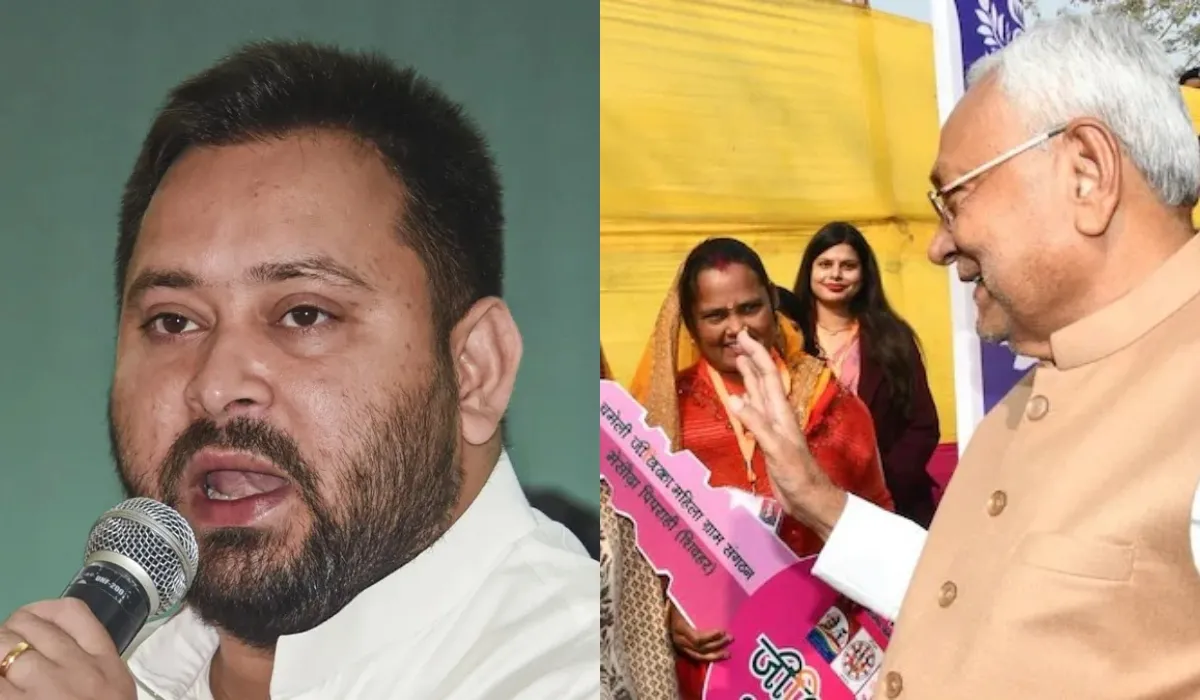
In the ongoing Bihar Assembly Elections 2025, trends show the NDA (National Democratic Alliance) is comfortably ahead, with projections of winning between 180-190 seats, far surpassing the majority mark of 122 seats. Meanwhile, the Mahagathbandhan (Grand Alliance) led by RJD is trailing with fewer than 60 seats in the current trends. This shift highlights the stark truth about Tejashwi Yadav’s promises, particularly his bold pledge to provide 3 crore government jobs to combat unemployment in Bihar. The results reveal the gap between Tejashwi’s high-profile promises and the reality of voter support.
Tejashwi Yadav's 'Every home a government job' promise falls short
Tejashwi Yadav, the Chief Ministerial candidate for the Mahagathbandhan, centred his entire campaign on tackling unemployment. His flagship promise was to provide a government job in every home, with plans to introduce laws specifically aimed at creating jobs. He even conducted social media campaigns and the "Yuva Sankalp Yatra" to mobilise the youth vote. Tejashwi claimed that Bihar's youth voted against Nitish Kumar’s government for the past 20 years, and now they were turning to his party for job security. However, these promises seem to have failed to resonate as strongly with voters as anticipated, and NDA’s popularity among women voters appears to have sealed his fate.
Same vote share, but fewer seats for RJD
Despite securing a similar vote share as in previous elections, Tejashwi's RJD is poised to lose significant ground. In the 2020 Bihar Assembly elections, RJD secured 23% of the vote, which was the same vote share it garnered in 2025, but the seat count is sharply different. In 2020, RJD won 75 seats with a 23% vote share, while now, with similar support, the party is on track to win just 30 seats. The main reason behind this discrepancy lies in the changing voting patterns and the dynamics of voter preferences in 2025.
Women's vote surge and NDA's victory
One of the key factors contributing to RJD’s setback is the dramatic rise in female voter turnout. In this election, 67% of eligible voters cast their ballots, but what stands out is that 71.6% of women participated in the voting process, compared to just 62.8% of men. This 9% difference indicates that women voters overwhelmingly supported the NDA alliance. Issues like security, self-employment, and programs like "Jeevika Didis" resonated deeply with women, and they gave their support to the NDA in large numbers. In contrast, the youth vote, while still strong for RJD, was not enough to overcome the women’s decisive support for the NDA.
The bigger picture
In conclusion, despite having a similar vote share as in the past, Tejashwi Yadav’s promises of government jobs and youth empowerment failed to inspire as many voters as needed to secure a victory. On the other hand, the NDA’s focused outreach to women voters, particularly through security measures and livelihood programs, seems to have been the deciding factor in the 2025 elections. As trends continue to unfold, Tejashwi's RJD is set to face a substantial setback, while the NDA edges closer to a strong victory.
