
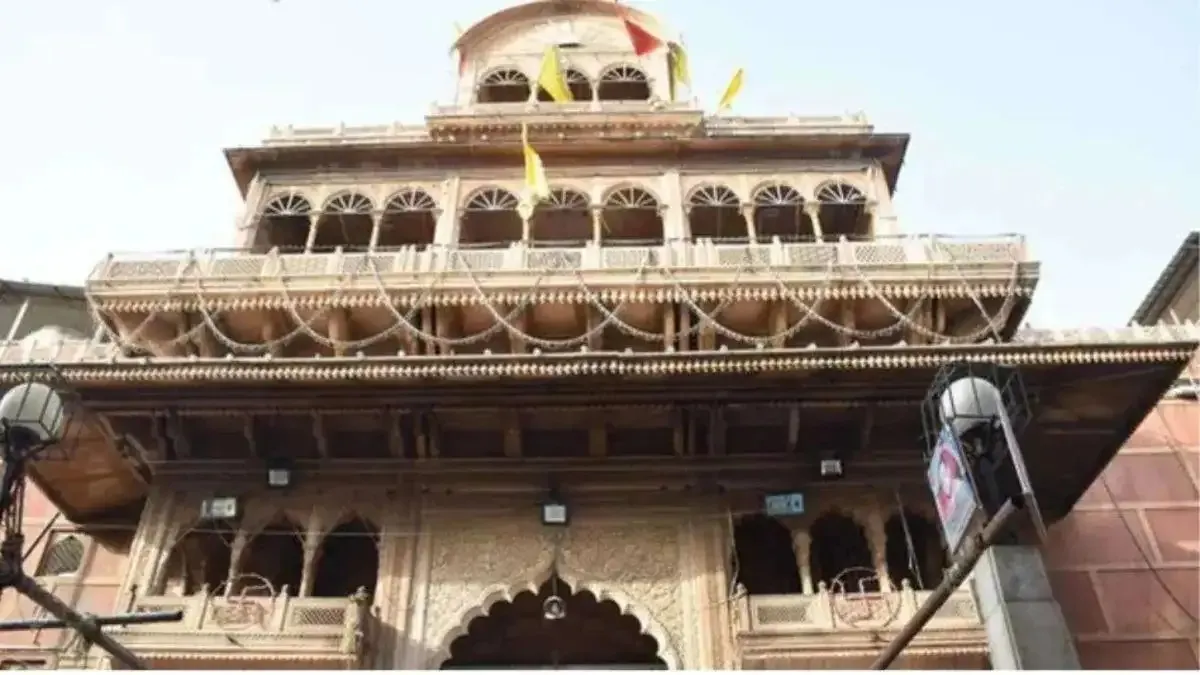
Recent reports about the so-called “treasure” of Banke Bihari Temple in Uttar Pradesh's Vrindavan have reignited public curiosity. However, sources connected to the temple clarify that the place examined by the High-Power Committee is not the true treasure chamber at all. Contrary to popular belief, the real wealth of Banke Bihari is not hidden in ancient vaults but safely stored in modern bank lockers.
A glimpse back to 1971
The true history of the temple’s treasure dates back to 1971 when the original vault of Banke Bihari was first opened. Whatever valuables were discovered at that time- gold, silver, ornaments, and cash- were securely deposited in a bank locker. Interestingly, one ceremonial staff (or chhadi) could not fit inside the locker due to its size, so it remained within the temple’s treasure room. This single detail led to decades of mythmaking around the idea of an untouched “hidden hoard” still resting beneath the temple.
How the real treasure moved to banks?
Members of the Goswami families, who are hereditary sevayats (caretakers) of the temple, recall that until around 1990, the temple saw relatively few visitors and modest offerings. There were times when even daily worship rituals and offerings faced challenges due to limited funds.
However, as devotional tourism expanded in the 1990s, crowds began to surge and with them came a flow of donations- gold, silver, jewelry, and cash. The temple committee soon formalized the donation system. Since then, every donation received through offering 'boxes' (gullak ) is properly recorded and transferred to the bank. Today, the bank accounts, not dusty vaults, house the tangible wealth of Banke Bihari.
“The bank is today’s treasure”
Anand Vallabh Goswami, a member of the Banke Bihari Sevayat family, confirms that the real treasure of the deity lies entirely within the banking system. Every coin and every precious ornament donated in devotion ultimately strengthens that divine reserve. In his words, “What people call the treasure isn’t empty, but it’s not buried in the temple anymore. The true treasure of Banke Bihari now lies in the bank.”
Treasures of faith: What lies in Banke Bihari’s historic vault?
Acharya Prahlad Goswami, the temple historian, recalls that when the Banke Bihari treasure was opened in 1971, a large collection of valuables was carefully catalogued and deposited with the State Bank of India. Due to its size, the chest was not placed in an ordinary locker but secured inside the bank’s strong room. Among the remarkable pieces discovered was a necklace made of engraved emeralds, once presented by the queen of the ancient Vidyanchal kingdom nearly 300 years ago. According to tradition, Thakurji himself adorned this exquisite ornament, which features a dancing peacock design surrounded by diamonds and topaz.
The inventory also included ceremonial items used during the Radha Ashtami procession- such as two staffs, two lances, two ceremonial fans, and a royal parasol. There was also a silver 'Sahastra-phani Sheshnag' (serpent with a thousand hoods), a 'siyar singi' (jackal horn charm), and a sacred urn filled with nine precious gems. Historical records of royal land grants, including those from Emperor Akbar, who donated 25 bighas of land, and several kings of Jaipur and other regions, were also found. Goswami notes that the temple’s vault was twice breached, in 1926 and 1936, resulting in the loss of several valuable items. Yet, he stresses, a significant portion of the original treasure remains safely sealed within the bank’s custody.''
Call for transparency: Committee seeks access to 1971 treasure records
Dinesh Goswami, a member of the High-Power Committee, stated that everything recovered from the Banke Bihari temple’s treasure in 1971 remains sealed within the bank. However, the committee currently has no detailed record of those items. The original inventory prepared at the time is also believed to be stored with the bank. Goswami emphasized that the committee has been consistently demanding complete transparency- urging that every artifact belonging to Banke Bihari Ji be made public. Even the temple office, he added, no longer possesses the 1971 list detailing the treasure’s contents.
