
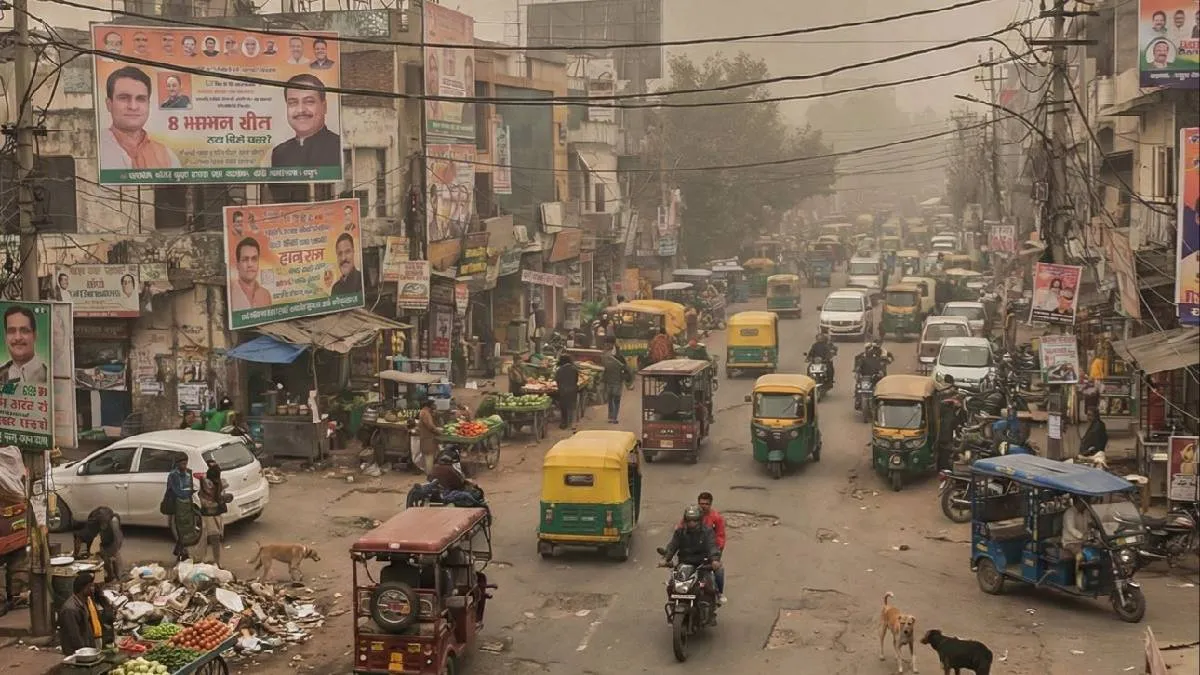
Google Gemini was in the spotlight last year when it rolled out its much-talked-about “nano banana” feature, which allowed users to generate highly realistic AI images. Recently, the chatbot has once again found itself trending after an X user (formerly Twitter) who goes by username Abhishek (@ImAbhishek7_) shared an image generated by Gemini using a simple prompt: “imagine of a busy street in North India during peak hours”.
What Gemini generated from the prompt
According to the image shared by the user, Gemini generated a scene featuring numerous auto-rickshaws and e-rickshaws moving along a road filled with potholes. The image also showed stray dogs, vegetable carts, motorcycles with pillion riders without helmets, and piles of garbage scattered along the street.
In addition, the scene included political hoardings placed on building terraces. The image also depicted high-rise buildings covered in haze, giving the overall visual a dusty, congested urban feel.
Social media users question the prompt
The post quickly attracted several comments, with many users questioning whether Gemini had genuinely generated the image based solely on the prompt asking it to imagine a busy North Indian street during peak hours.
One user in the comments claimed that the original poster had specifically instructed Gemini to include elements such as haze, potholes, and political banners of the BJP. To support this claim, the user shared screenshots of Gemini using the same prompt.
In the image shared by the commenter, the AI-generated output did not include potholes, political hoardings, stray dogs, or garbage dumps. However, it still featured stray cattle, auto-rickshaws, cycle rickshaws, street vendors, dust and motorcycle riders without helmets.
Our test with the same Gemini prompt
We also tested the same prompt on Google Gemini. The image generated during our test was free from potholes and political hoardings, but it did include street vendors, taxis, motorcycles without helmets, litter on the streets, old buildings, haze and overhead wires.

Why Gemini generates such images
AI image-generation models like Gemini are trained on large datasets of visual images. Algorithms play a crucial role in this process, acting as a set of rules that guide machine learning models and neural networks. These systems learn from input data and then generate new, original images based on patterns they have learned from those datasets.
ALSO READ: Grok’s new feature set to create sensation: Get answers without typing