
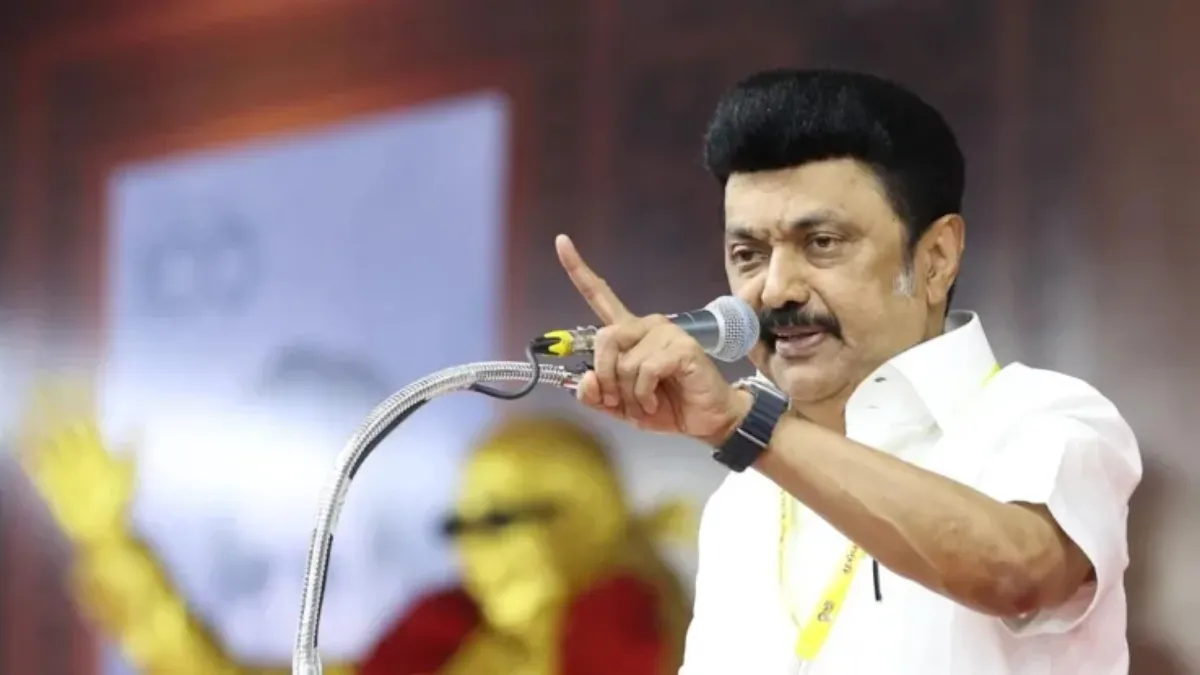
Amid the ongoing controversy over Hindi imposition, Tamil Nadu Chief Minister M.K. Stalin on Tuesday stated that the state is "ready" for "another language war." Addressing reporters after chairing a Cabinet meeting, Stalin expressed concerns over the potential reduction of Tamil Nadu's representation in the Lok Sabha following the delimitation process. He revealed plans for an all-party meeting on March 5 to discuss the issue, inviting political parties registered with the Election Commission of India.
Stalin emphasised that Tamil Nadu’s successful implementation of family planning programs, which resulted in population control, could lead to the state losing eight Lok Sabha seats. He explained that the delimitation process, which would be based on population, could cause Tamil Nadu's seat count to drop from 39 to just 31, a move he called an infringement on the state's rights and its voice in Parliament.
In his statement, Stalin called for unity among political parties, urging them to set aside political differences and speak collectively on the matter. He argued that reducing Tamil Nadu's representation in Parliament would weaken the state’s voice, especially when dealing with important issues like central funding, the National Education Policy (NEP), and the National Eligibility cum Entrance Test (NEET).
When asked about the potential for discussions regarding the controversial three-language policy, which has sparked tension between the Tamil Nadu government and the central government, Stalin responded by saying the state needed adequate representation in Parliament to raise concerns on such issues. He also stated that the Centre's actions might be "sowing the seeds for another language war," a reference to the state's historic anti-Hindi agitation in 1965.
The ruling DMK has consistently opposed the three-language policy and accused the BJP-led government of attempting to impose Hindi on Tamil Nadu, a claim that the Centre has denied. Stalin’s statement highlights the growing tension between the state and the central government over language and representation concerns.
(Inputs from PTI)
