
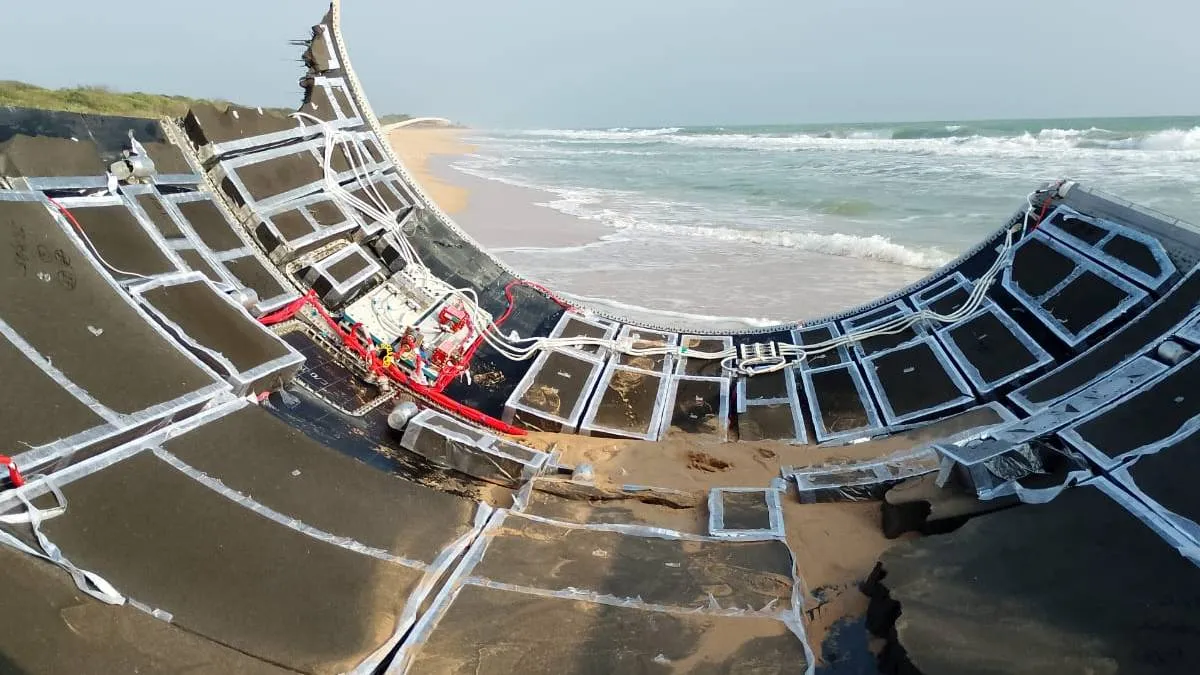
A large piece of suspected Indian rocket debris has been spotted on the eastern coast of Sri Lanka. This discovery comes just days after India launched its heaviest payload into Low Earth Orbit (LEO) via the LVM3 rocket. The recovery of the fragments has sparked both security concerns and public curiosity across the island.
Discovery near Trincomalee
The debris was recovered along the Malai Munthal sea stretch near Trincomalee, specifically close to the coastal town of Sampur. Experts suspect the fragment is a portion of the payload fairing, the protective shell that houses satellites, which typically detaches during the rocket's ascent. Following the discovery, Sri Lankan naval officials were deployed to secure the site under instructions from the Sampur police division.
See pics here:
The mechanics of debris
Rockets are designed to shed various stages and components during their journey to space. While these discarded parts are intended to fall into pre-designated "drop zones" in the ocean, environmental factors such as ocean currents and wind can cause fragments to drift toward inhabited shores. This is not the first occurrence of its kind; debris from previous Indian launches has occasionally washed up in the waters of Sri Lanka and the Maldives.
As of now, the Indian Space Research Organisation (ISRO) has not issued a formal public statement regarding the discovery in Sri Lanka.
Context of the LVM3 mission
The debris is suspected to be linked to ISRO's recent successful launch of the Bluebird Block-2 communications satellites, developed by the US-based firm AST SpaceMobile. The 43.5-meter tall LVM3 (formerly the GSLV Mk III) is India’s premier heavy-lift vehicle, featuring a sophisticated three-stage architecture:
- Solid Boosters: Two S200 boosters provide the massive initial thrust required for liftoff.
- Core Stage: A liquid-propellant stage that maintains momentum through the middle phase of flight.
- Cryogenic Stage: An advanced upper stage designed for the precise injection of payloads into orbit.
During this specific mission, the flight sequence lasted approximately 15 minutes. Following a successful ascent, the Bluebird Block-2 separated from the launch vehicle to begin its complex deployment process in orbit.
