
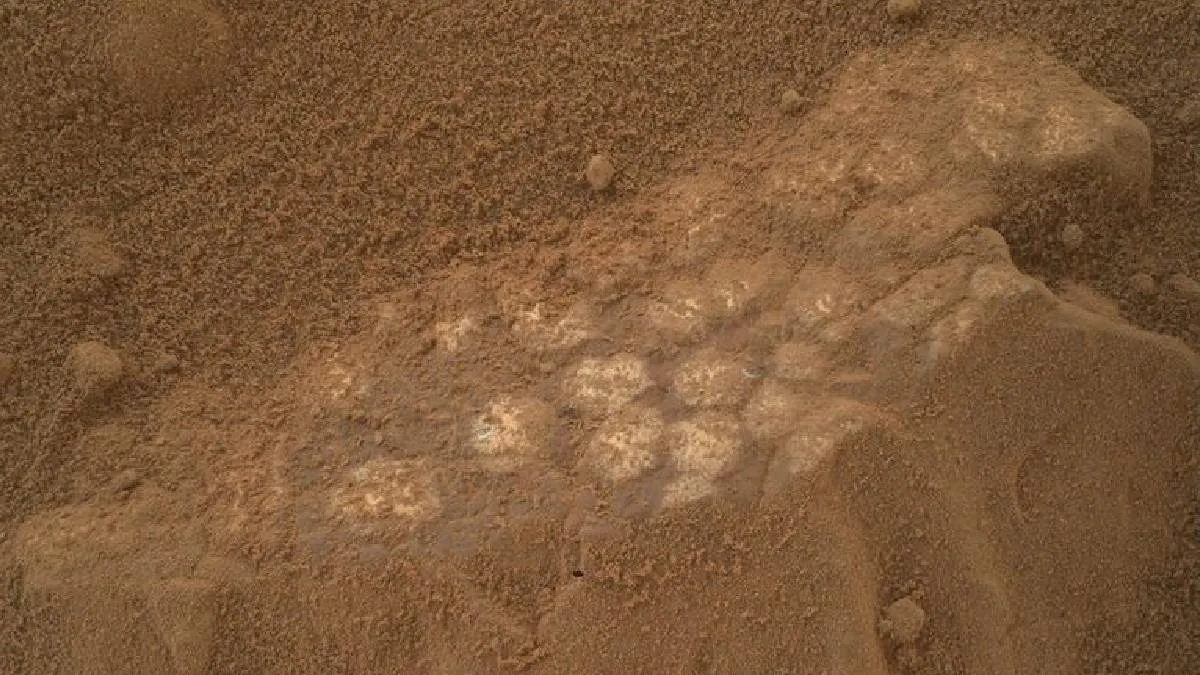
NASA currently operates two rovers on Mars: Perseverance and Curiosity. The Curiosity rover recently approached a site that has intrigued scientists. The site features rock formations that look like eggs, and their origin has sparked a debate about whether they indicate the presence of ancient marine life.
The Boxworks
The site is located in an area known as "The Boxworks," on the slopes of Mount Sharp within Gediz Vallis Ridge. It contains vein-filled fractured rocks, a type the rover has never encountered before. Scientists believe these rocks could hold a record of water that flowed on the Martian surface hundreds of millions of years ago.
By examining these rocks, scientists hope to uncover how the planet experienced extreme environmental changes, evolving from a watery world to its current arid state.
How rover reached there
After a 25-meter drive, Curiosity arrived at the new ridge site. The rover then began several imaging investigations. It used its Mastcam to observe "Laguna Miniques," a potential hollow, and examined several troughs to see how fractures transition from bedrock to regolith.
Mars Hand Lens Imager
Curiosity captured this image using its Mars Hand Lens Imager (MAHLI), located on the turret at the end of the rover's robotic arm. The MAHLI uses an onboard focusing process to merge multiple images of the same target, acquired at different focus positions, to bring all features into focus in a single image.
NASA's Mars rover Curiosity acquired this close-up view of the rock target "Bococo" at the intersection of several boxwork ridges, showing bright millimeter-scale nodules that are likely to be calcium sulfate. The boxy textures seen here resemble formations on Earth that are linked to hydrothermal activity. Such structures could reveal details about the temperature, pH, and fluid history of the region.
ALSO READ: ISRO to launch its first Gaganyaan test mission in December: ISRO chief
