
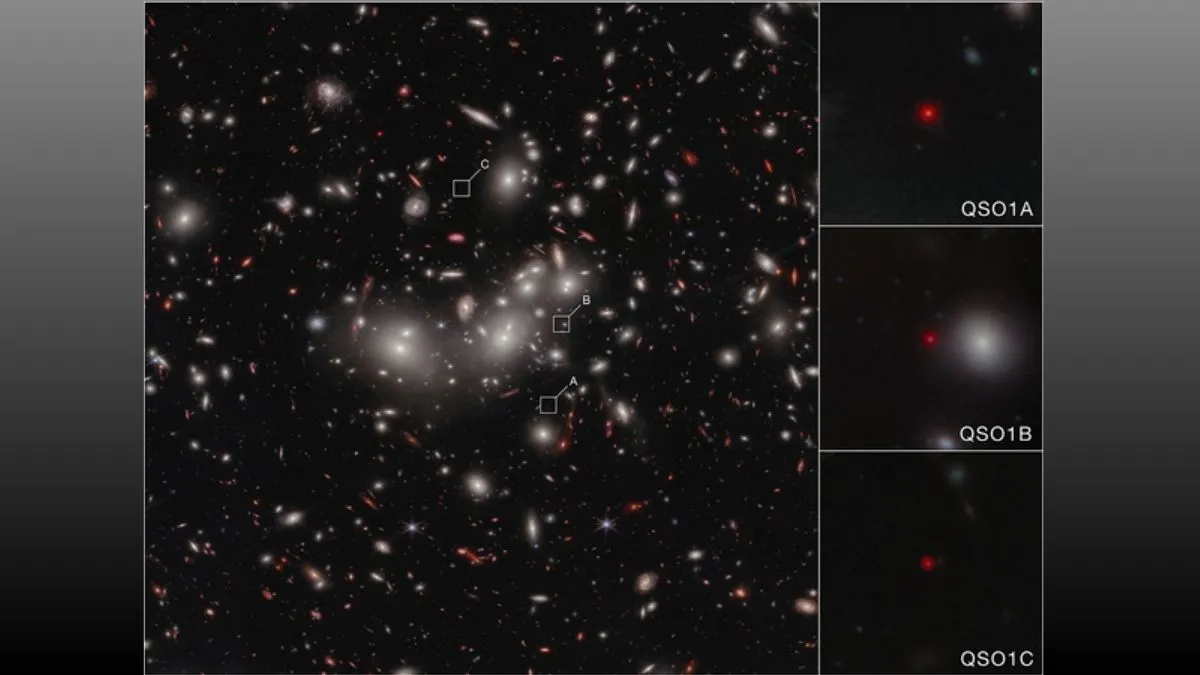
The James Webb Space Telescope just pulled off something huge: it’s measured the mass of the most distant dormant supermassive black hole we have ever found. This monster sits quietly in the core of galaxy MRG-M0138, more than 10 billion light-years away, and weighs as much as six billion Suns.
This is not just another notch in JWST’s belt. Astronomers have been desperate to understand how black holes and galaxies grew up together, especially way back in the early universe. With this discovery, we’re finally getting a closer look at that process.
A window into the early universe
Andrew Newman from Carnegie Science led the research, with Richard Ellis at University College London as the senior author. They published their findings in Science on June 4, 2026. The crazy thing is the light JWST captured started its trip to us nearly 11 billion years ago, when the universe was just a toddler, about three billion years old, give or take.
What really makes this find wild is that both the galaxy and its black hole are dormant. Most big black holes we spot are ravenous, gobbling up matter and lighting up the cosmos as quasars. This one’s sleeping, hard to see, not giving off the usual fireworks.
So how did scientists weigh a black hole that’s dead quiet?
They turned to physics. Since a dormant black hole does not announce itself with bright radiation, the only way to find it is to watch how it tugs on the stars around it. By tracking those stars’ movement and how fast they zip around the galaxy’s centre, using stellar dynamics, they could pin down the black hole’s mass. And honestly, that’s record-breaking stuff. It’s the farthest out we’ve ever applied this stellar dynamics method—about fifteen times farther than before.
Nature's own magnifying glass
But there’s one more twist: nature itself stepped in to help. A massive galaxy cluster lined up between us and MRG-M0138 acted like a gigantic space lens. Its gravity bent and magnified the distant galaxy’s light by almost 30 times, bringing it into JWST’s view with jaw-dropping clarity.
JWST’s Near-Infrared Spectrograph (NIRSpec) then let scientists dissect the galaxy’s light, map out the stars’ motions, and seal the deal on the black hole’s mass.

Now, why did this galaxy and its black hole stopped forming stars?
The research team thinks the answer is an epic past. At some point, this black hole probably became a crazed quasar, sucking in gas and dust like there was no tomorrow and sending out insane amounts of energy. That energy likely blew away much of the galaxy’s star-making gas. When the fuel ran dry, both the black hole and the galaxy shut down, and star formation stopped cold.
A new era of Black hole research
This discovery shows just how far JWST has pushed the limits. We can finally study massive dormant black holes from the universe’s earliest days. And by doing that, astronomers will start piecing together the story of how galaxies and black holes got so big and how they shaped each other over cosmic time.
For a universe that’s been hiding its oldest secrets, this is a pretty clear window into the past.