
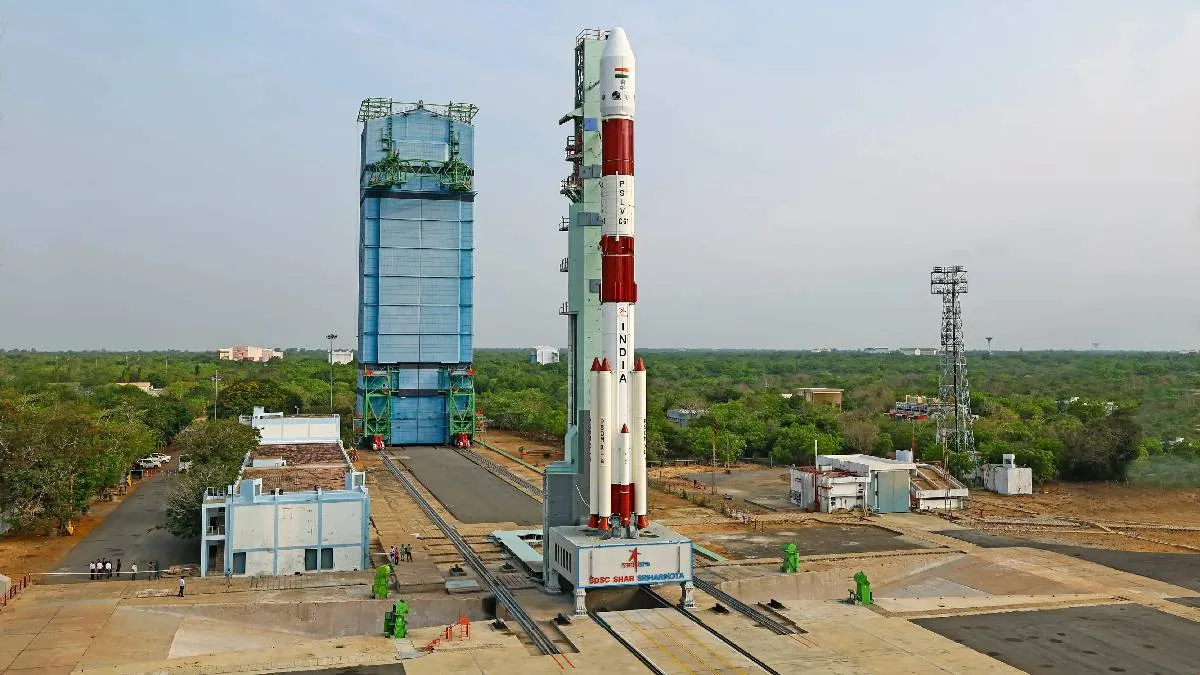
ISRO's most trusted and versatile launch vehicle, the PSLV, reportedly faced an unusual setback recently when it failed to place an earth observation satellite into its intended orbit. With a remarkable record of just three failures in 63 launches, the PSLV was anticipated to succeed once more. It seemed to be on track for the mission before the situation took a turn for the worse. According to the Bengaluru-headquartered space agency, the mission involving the earth observation satellite EOS-09 aboard the PSLV-C61 rocket could not be completed due to a pressure issue in the third stage of the launch vehicle. Known for its adaptability, the Polar Satellite Launch Vehicle has been utilised by ISRO to launch three types of payloads: Earth Observation, Geostationary, and Navigation.
Rare failures of PSLV
With this latest mission unsuccessful, it marked only the third time that the 44-meter tall rocket had failed to deliver, with past failures occurring in September 1993 and August 2017. The first development flight, PSLV-D1, was reportedly unsuccessful as it could not place the remote sensing satellite IRS-1E into orbit. Similarly, in August 2017, PSLV C39, which carried the eighth satellite of the Indian Regional Navigation Satellite System (IRNSS), experienced a technical issue and did not achieve its mission objectives.
The four-stage PSLV rocket, which stands 44.5 meters tall and has a diameter of 2.8 meters, is capable of carrying payloads up to 1,750 kg to a Sun-Synchronous Polar Orbit at an altitude of 600 km. ISRO stated that PSLV has earned the moniker 'workhorse of ISRO' due to its consistent performance in deploying various satellites into Low Earth Orbits (LEO). Due to its unparalleled reliability, PSLV has also been used to launch satellites into Geosynchronous and Geostationary orbits, including those from the IRNSS constellation.
Issue with PSLV-C61
The agency mentioned that the third stage of PSLV is a solid rocket motor, providing high thrust for the upper stages after the atmospheric phase of the launch. Unfortunately, PSLV-C61 encountered a technical glitch in this stage during the recent mission. The Indian Space Research Organisation Chairman, V Narayanan, remarked that the mission aimed at achieving the 101st launch from Sriharikota, and while the vehicle performed normally up to the second stage, the third stage motor started correctly but faced issues during operation that led to the mission's failure. He noted a drop in chamber pressure within the motor casing, resulting in the mission not being accomplished.
Significant missions of PSLV
ISRO highlighted some of the significant missions that the PSLV successfully facilitated, including Chandrayaan-1 in 2008, the Mars Orbiter Spacecraft in 2013, and the Aditya L1 Mission in September 2023, among others. The PSLV is recognised for its capability to place multiple payloads into orbit, employing multi-payload adaptors within the payload fairing. The vehicle's performance and mission flexibility are evident from its successful execution of challenging missions involving multiple orbits and satellites.
ISRO emphasised that the PSLV's history of consecutive successes and its multi-satellite launch capability have solidified its status as a reliable, versatile, and cost-effective launcher in the global market. The PSLV employs six, four, and two solid rocket strap-on motors to enhance the thrust provided by its first stage, with variants including XL, QL, and DL. However, strap-ons are not utilised in the core-only version known as PSLV-CA, as per ISRO's information.
ALSO READ: 3rd stage pressure issue caused Earth observation mission failure: ISRO chief
