
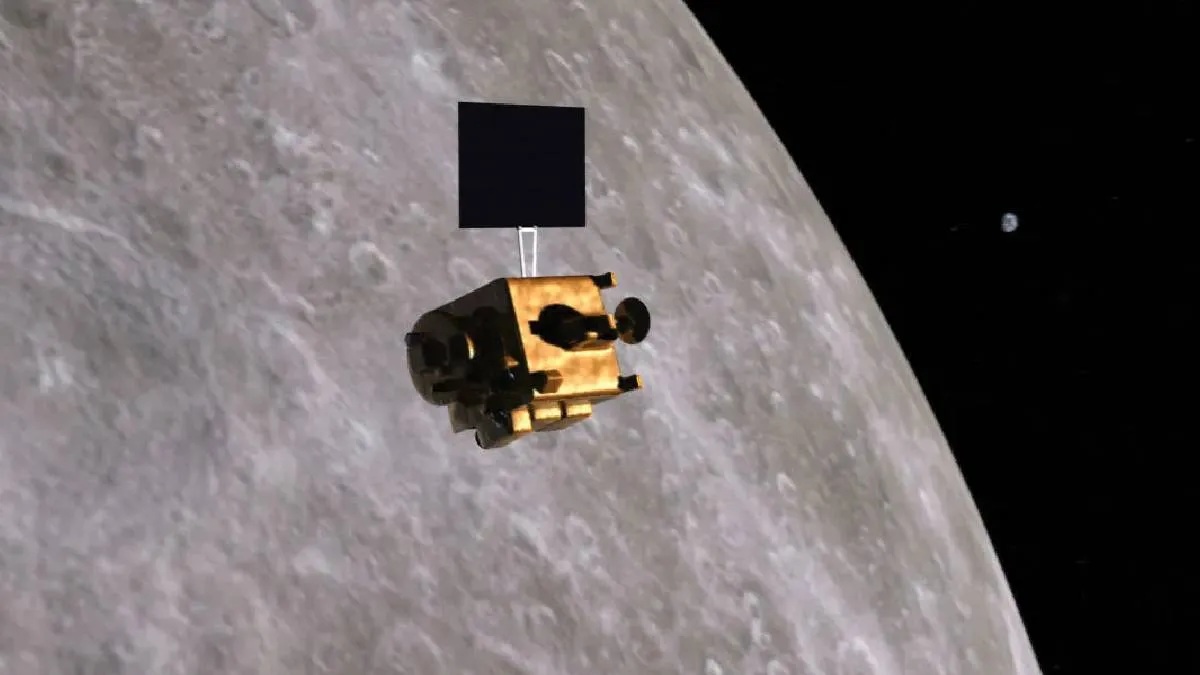
Today, October 22, we celebrate the 17th anniversary of India's Chandrayaan-1 mission, which was launched on this day in 2008. The mission began its journey from the Satish Dhawan Space Centre in Sriharikota and was a significant milestone as it marked India’s first mission to the Moon.
Since this pioneering mission, India's space program has achieved many significant feats, including the Mars Orbiter Mission (MOM), the historic Chandrayaan-3 Moon landing, the launch of the Aditya L1 solar mission, and sending an Indian to the International Space Station.
Mission operations and key discoveries
The Chandrayaan-1 spacecraft successfully orbited the Moon at a primary height of 100km, where it carried out chemical, mineralogical, and photo-geologic mapping. The satellite housed a total of 11 scientific instruments, developed through collaboration between India, the USA, the UK, Germany, Sweden, and Bulgaria.
After successfully completing its major mission objectives, the orbit was raised to 200 km in May 2009. The satellite completed more than 3,400 orbits before communication was lost on August 29, 2009, concluding its operational phase.
Scientific breakthroughs
The mission’s most pathbreaking discovery was the conclusive detection of hydroxyl (OH) and water (H2O) molecules on the lunar surface. Chandrayaan-1 also provided strong evidence for water ice in the permanently shadowed regions of the Moon’s north polar craters.
Furthermore, its high-resolution instruments performed remote sensing in the visible, near-infrared (NIR), low-energy X-ray, and high-energy X-ray regions. These efforts prepared a three-dimensional atlas of both the near and far sides of the Moon and conducted detailed chemical and mineralogical mapping to identify elements such as Magnesium, Aluminium, Silicon, Calcium, Iron, and Titanium, as well as high atomic number elements like Radon, Uranium, and Thorium.
| Payload | Primary function and key results |
| Moon Mineralogy Mapper (M3) | Discovered water/hydroxyl (OH/H2O): Provided the first definitive spectral evidence for the presence of OH and H2O molecules on the sunlit lunar surface, particularly at higher latitudes. This was one of the mission's most significant findings. |
| Moon Impact Probe (MIP) | Detected water in the exosphere: Its mass spectrometer, Chandra's Altitudinal Composition Explorer (CHACE), recorded direct evidence of water vapor (H2O) in the thin lunar exosphere during its controlled descent, a finding announced before M3's publication. |
| Miniature Synthetic Aperture Radar (Mini SAR) | Inferred sub-surface water ice: Used polarised radar to map the lunar poles and provided strong evidence for water ice deposits inside permanently shadowed craters. |
| Terrain Mapping Camera (TMC) | High-resolution 3D mapping: Used for generating a three-dimensional atlas of the Moon. Results include detailed maps of lunar surface features and the detection of potential features like buried lava tubes (possible future human habitats). |
| Hyper Spectral Imager (HySI) | Mineralogical mapping: Used for obtaining spectroscopic data for mineralogical mapping of the lunar surface. It helped in the detection of features like buried lava tubes, complementing TMC data. |
| Lunar Laser Ranging Instrument (LLRI) | Topography and height mapping: Used to generate high-accuracy lunar topography (height) data, which is essential for detailed crater analysis and map generation (results often combined with TMC. |
| Chandrayaan-1 X-ray Spectrometer (C1XS) | Elemental abundance mapping: Mapped the abundance and distribution of major rock-forming elements on the lunar surface, such as Magnesium ( Mg), Aluminium (Al), and Silicon (Si), particularly during solar flare events which excite X-ray fluorescence. |
| Sub keV Atom Reflecting Analyzer (SARA) | Solar wind interaction: Studied the interaction of the solar wind (protons) with the lunar surface and detected the reflection of solar wind protons as neutral hydrogen atoms. |
| High Energy X-ray Spectrometer (HEX) | Trace element mapping (U/Th/Rn): Aimed to map the abundance of Uranium (U), Thorium (Th), and a decay product of Radon (Rn) in the 30-270 keV energy range, which helps understand the transport of volatiles. |
| Near Infrared Spectrometer (SIR – 2) | Mineral composition: Mapped the mineral composition of the lunar surface using near-infrared light to explore the Moon's mineral resources and different crustal layers. |
| Radiation Dose Monitor (RADOM) | Radiation environment: Measured the particle flux and accumulated radiation dose rates in lunar orbit to provide an estimate of the radiation environment around the Moon, crucial for future human missions. |
The genesis and strategic legacy
This anniversary provides an excellent moment to look back at how ISRO successfully accomplished this mission. The concept of India undertaking its first mission to the Moon was first mooted at a meeting of the Indian Academy of Sciences in1999. The idea was subsequently discussed at the Astronautical Society of India in 2000.
Based on these recommendations, ISRO constituted a National Lunar Mission Task Force composed of leading Indian scientists and technologists to assess the mission’s feasibility and focus. The project was seen as an opportunity not only to capitalise on the renewed international interest in lunar exploration but also to provide a necessary thrust to basic science and engineering research within the country. The Government of India formally approved ISRO's proposal for Chandrayaan-1 in November 2003.
Beyond its scientific success, Chandrayaan-1 held strategic value by helping India build the necessary infrastructure for deep space exploration, including the lunar craft, the launch vehicle, and vital ground support systems like the Deep Space Network (DSN) station. This infrastructure proved crucial for subsequent explorations, such as the Mars Orbiter Mission.
The road ahead
Building on this foundational success, India is now confident in its space capabilities and has set the ambitious goal for India's first crewed lunar mission by 2040, a vision that anticipates ISRO having the robust capability to safely transport astronauts to the Moon and back.
ALSO READ: First crewed lunar mission by 2040, Gaganyaan on track, India open to collaborations: ISRO chief
