
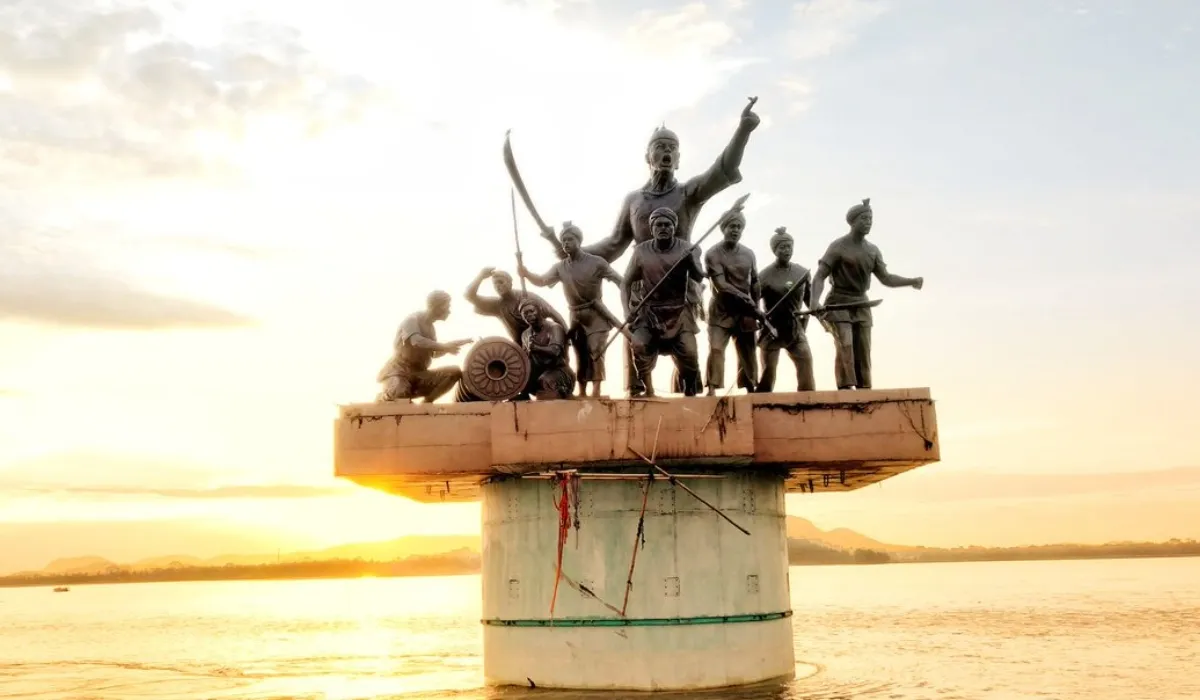
Across Assam today, the chants of “Joi Aai Axom” resonate with pride as the state celebrates Lachit Divas, honoring the legendary Ahom commander Lachit Borphukan. Renowned for his extraordinary courage and naval brilliance, he successfully halted the Mughal Empire's advance into the Northeast. More than 350 years later, his story continues to inspire as a timeless symbol of patriotism, sacrifice, and strategic genius.
Observed annually on November 24th, Lachit Divas commemorates his pivotal role in the 1671 Battle of Saraighat, where he led the Ahom army to a decisive victory against a much larger Mughal force. It is a day to celebrate Assamese pride and the enduring values of courage, unity, and devotion to the motherland.
A leader born to defend the motherland
Lachit Borphukan, the son of Momai Tamuli Borbarua—one of the most capable administrators of the Ahom Kingdom—was raised with a deep sense of duty, discipline, and service. Yet, his rise to greatness did not come from lineage alone; it came from an unshakable conviction that the land and its people were worth every sacrifice.
When the Mughal Empire, under Aurangzeb, intensified its attempts to annex Assam, the Ahom kingdom looked to Lachit for leadership. What followed would become one of the most remarkable military chapters in Indian history.
Turning geography into strategy: The Brahmaputra as a shield
The Mughal imperial army was large, well-equipped, and supported by a formidable cavalry. But Lachit understood one thing they didn't—the Brahmaputra was not just a river; it was a living, breathing ally.
At a time when most Indian battles were fought on land, Lachit revolutionised defensive strategy by transforming the river into a battlefield advantage.
He deployed:
- Swift Ahom war boats were designed for manoeuvrability
- Camouflaged river outposts
- Floating fortifications that could reposition with the tides
- Local boatmen and clans skilled in hydrology
Lachit's use of the terrain was so advanced that modern military scholars consider him one of the earliest practitioners of integrated riverine defence.
The road to glory: The battle of Saraighat
By 1671, the Mughal forces, commanded by the experienced Raja Ram Singh, advanced toward Guwahati. Their plan was simple: crush Ahom resistance and open a gateway to the Northeast. Lachit's answer was anything but simple—it was genius.
Lachit mobilised tribes, villages, and common folk to support the war effort. Assam wasn’t just defending territory; it was defending identity.
The night fortification of the Brahmaputra
To prevent a Mughal surprise attack, massive barricades and embankments had to be built along the riverbanks. When Lachit discovered his own maternal uncle had delayed construction out of negligence, he delivered the harshest but clearest message in military discipline: No one, not even family, is above the nation.
His decision—executing his uncle for dereliction of duty—became legend and a symbol of uncompromising patriotism.
The final stand: A commander who refused to fall
At Saraighat, the Mughals launched a mighty naval assault. Illness had weakened Lachit, but not his resolve. When some Ahom commanders hesitated, believing defeat inevitable, the ailing Borphukan rose from his sickbed, boarded a warboat, and shouted the words that changed the course of history: "My country's honour is at stake. I shall not retreat."
His presence electrified the troops. The Ahom navy surged forward, outmanoeuvring the Mughals with speed and intimate knowledge of the river’s changing currents. By sunset, the Mughal fleet was in disarray. Assam remained unconquered. It would be the only major region of India the Mughals could never annex.
More than a Commander: A legacy of courage and integrity
Lachit Borphukan passed away shortly after the victory, but his spirit became intertwined with the soul of Assam.
A symbol for future generations
Today, Lachit is remembered not just as a warrior but as:
- A beacon of leadership grounded in ethics,
- A strategist ahead of his time,
- A patriot whose courage inspired centuries,
- And a moral compass for anyone who believes duty to the motherland is sacred.
The Lachit Borphukan Gold Medal, awarded annually at the National Defence Academy, ensures his tale inspires India's newest defenders.
Lachit Divas: A promise renewed each year
As Assam celebrates Lachit Divas, schools, universities, and communities recount the stories that shaped the region’s identity.
Children learn about a hero who turned a river into a shield, a kingdom into a family, and a moment of crisis into a golden chapter of resistance.
And in every retelling, the message remains the same: Courage has no equal. Duty has no compromise. And love for the motherland can turn even rivers into fortresses.
