
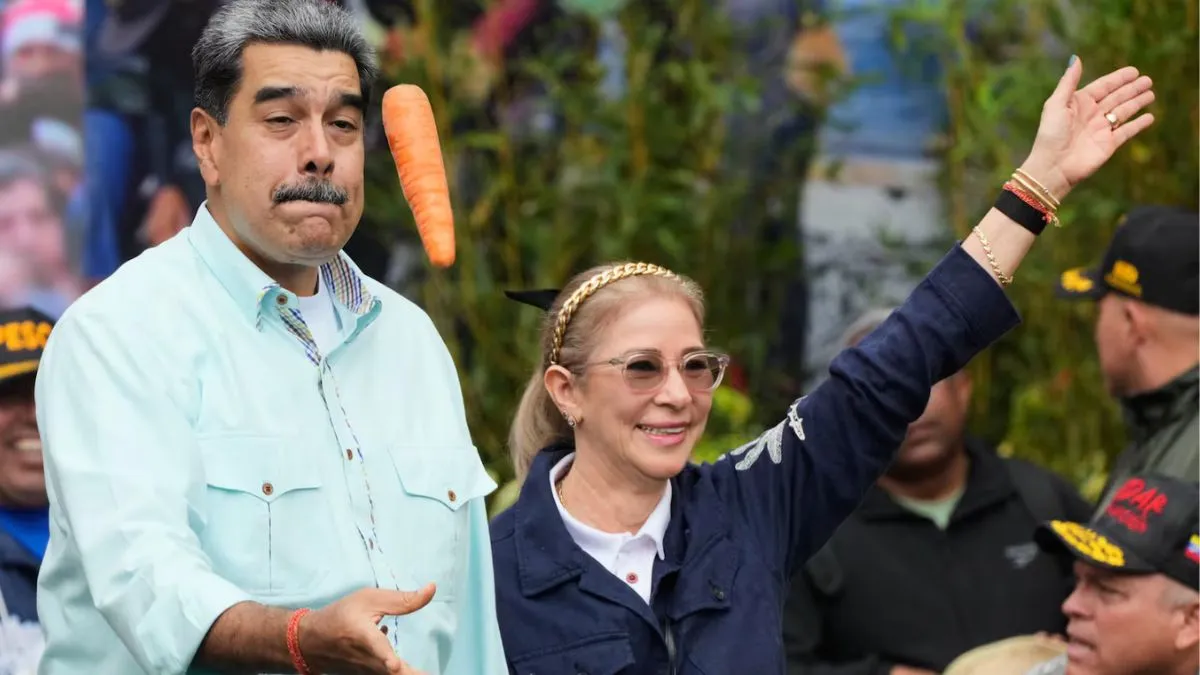
The United States carried out a large-scale military strike on Venezuela’s capital, Caracas, leading to the capture of President Nicolas Maduro and his wife, Cilia Flores.
"This extremely successful operation should serve as a warning to anyone who would threaten American sovereignty or endanger American lives. Very importantly, the embargo on all Venezuelan oil remains in full effect... All political and military figures in Venezuela should understand that what happened to Maduro can happen to them, and it will happen to them if they aren't just, fair, and even to their people. The dictator and terrorist Maduro is finally gone in Venezuela. People are free. They're free again,” said Trump in a press conference after the capture.
Who is Cilia Flores?
Born on October 15, 1956, in Tinaquillo, a small town in northwestern Venezuela, Cilia Adela Flores grew up in modest circumstances. The youngest of six children, she lived in a mud-brick shack with a dirt floor. Her father, a traveling salesman, struggled to make ends meet, and the family later moved to Caracas, Venezuela’s bustling capital, in search of better opportunities.
Flores, who initially studied criminal law at a private university in Caracas, began her professional career as a defense lawyer. She spent nearly a decade working at a private law firm before her political career took off. Flores first rose to prominence as the lawyer of then-Lieutenant Colonel Hugo Chávez, who had led a failed coup in 1992. She became an early supporter of Chávez’s political ideals and helped him transition from military officer to civilian leader, focusing on the country’s poor.
The Caracazo riots of 1989, a series of violent protests triggered by a hike in fuel prices, marked a pivotal moment for Flores. In interviews, she has said that the unrest ignited her “revolutionary calling.” While Flores was not heavily involved in politics at the time, this event deeply influenced her, leading her to support Chávez and later connect with him.
It was during this time that Flores met Nicolás Maduro, who was a union leader in Caracas. Both were in the process of divorcing their respective spouses when they grew closer. Eventually, they married in July 2013 after Chavez’s death. Maduro, who would go on to become Venezuela’s president in 2013, often spoke of Flores’s “fiery character,” marking the beginning of a long political partnership.
Flores’ political trajectory was closely tied to Chavez’s rise. She helped lead Chávez’s successful presidential campaign in 1998 and went on to become a member of the National Assembly in 2000. She was known for her tough, combative style and even publicly referred to opposition lawmakers as “sinners.” Her loyalty to Chavez earned her a position as Attorney General in 2012, a role she held until Chávez’s death in 2013.
After Maduro succeeded Chávez as president in 2013, Flores became the first lady. Initially, she made only modest changes to her role at the Miraflores Palace, but soon, she assumed a much more influential position within the Venezuelan government, acting as a key advisor to Maduro. Many believe that her political savvy and her close relationship with her husband allowed her to wield considerable power behind the scenes.
The United States has long accused Venezuela of being a haven for narcotrafficking and has placed much of the blame for the migration crisis in Latin America on Maduro’s government. The US also claims that Venezuela has become a major drug transit hub, with drugs being smuggled through the country into the US.
The US has designated two Venezuelan criminal groups, Tren de Aragua and Cartel de los Soles, as Foreign Terrorist Organizations. Trump has also linked Venezuela’s economic collapse to a surge in migrants at the US-Mexico border, claiming that Venezuela is “emptying its prisons and insane asylums,” and forcing criminals to migrate to the US.
