
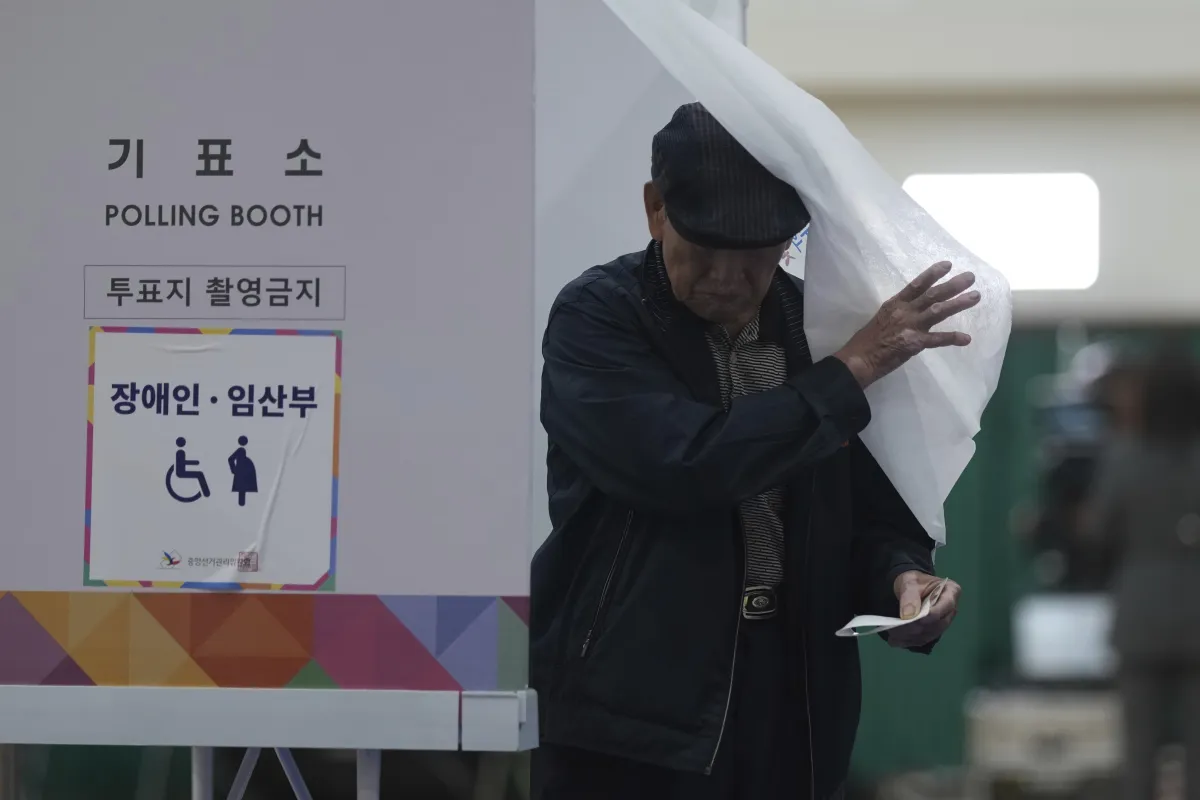
South Koreans headed to the polls on Tuesday to elect a new president, following the dramatic impeachment and removal of former leader Yoon Suk Yeol. The snap election, triggered by Yoon’s controversial declaration of martial law in December, is seen as a pivotal moment in the country’s political history. The vote comes after Yoon Suk Yeol, a conservative president, was ousted from office and now faces a high-profile trial on rebellion charges. His brief imposition of martial law late last year led to widespread protests and a constitutional crisis. The fallout left South Korea in political turmoil, with major implications for its economy and foreign relations.
Liberal candidate Lee Jae-myung of the Democratic Party has emerged as the clear frontrunner, with pre-election polls suggesting he may win comfortably. Lee’s popularity has grown amid public backlash against Yoon’s actions and deep discontent with the ruling conservative bloc. His main rival, Kim Moon Soo of the conservative People Power Party, has struggled to unify his base and attract moderate voters due to ongoing internal feuds and ambiguity over how to handle Yoon's legacy.
Immediate swearing-in
The winning candidate will be sworn in on Wednesday for a full five-year term without the usual transition period. The election commission reported that polls opened at 6 am and will close at 8 pm, with results expected by midnight. As of 8 am, 2.5 million people had already cast their votes, in addition to the 15 million who voted early, over a third of the electorate.
What’s at stake for the next president?
The next president will inherit a host of challenges, including:
- An economy weakened by political instability and external trade pressures
- Managing relations with US President Donald Trump, whose America-first tariffs have hurt South Korean exports
- Re-engaging with North Korea amid stalled diplomacy and nuclear tensions
Final campaign messages: Democracy versus dictatorship?
In his final campaign address, Lee warned that a conservative victory would mean the return of “rebellion forces” and the legitimisation of martial law. “It would be the destruction of democracy and our downfall into a third-world country,” he said.
Kim, a former labour minister under Yoon, accused Lee of seeking unchecked power and compared him to a “Hitler-like dictator.” He warned that a Lee presidency could bring political retaliation and legal protections for himself and his allies.
Lee’s rise: Reformist image with populist undertones
Lee Jae-myung has long been a polarising figure in South Korean politics. Rising from poverty as a child labourer, he built his career on anti-establishment rhetoric and promises to tackle inequality and corruption. Supporters see him as a reformist capable of reshaping South Korea; critics see a populist prone to political opportunism.
While his domestic policies are bold, Lee has adopted a pragmatic tone in foreign affairs. He has committed to strengthening ties with the US and Japan, a stance broadly in line with conservative foreign policy.
No bold foreign policy plans—for now
Both Lee and Kim have avoided making sweeping foreign policy pledges during the campaign, with analysts citing limited room to manoeuvre due to volatile markets and international constraints. Lee has signalled support for Trump’s efforts to resume talks with North Korea but admitted a summit with Kim Jong Un is unlikely in the near future. Experts believe neither candidate is in a position to dramatically alter South Korea’s security or diplomatic posture.
Uncertain prospects for North Korea engagement
North Korea has shown little interest in diplomacy, focusing instead on its alliance with Russia and expanding its nuclear program. While Lee supports re-engagement, analysts caution that South Korea has little leverage. Unlike former liberal President Moon Jae-in, who met Kim Jong Un three times, Lee is not expected to pursue such summits aggressively.
Meanwhile, the country’s economic outlook remains uncertain. The central bank recently downgraded growth projections to just 0.8% for 2025, citing weak domestic demand and Trump’s renewed tariff threats.
(Based on AP inputs)
