
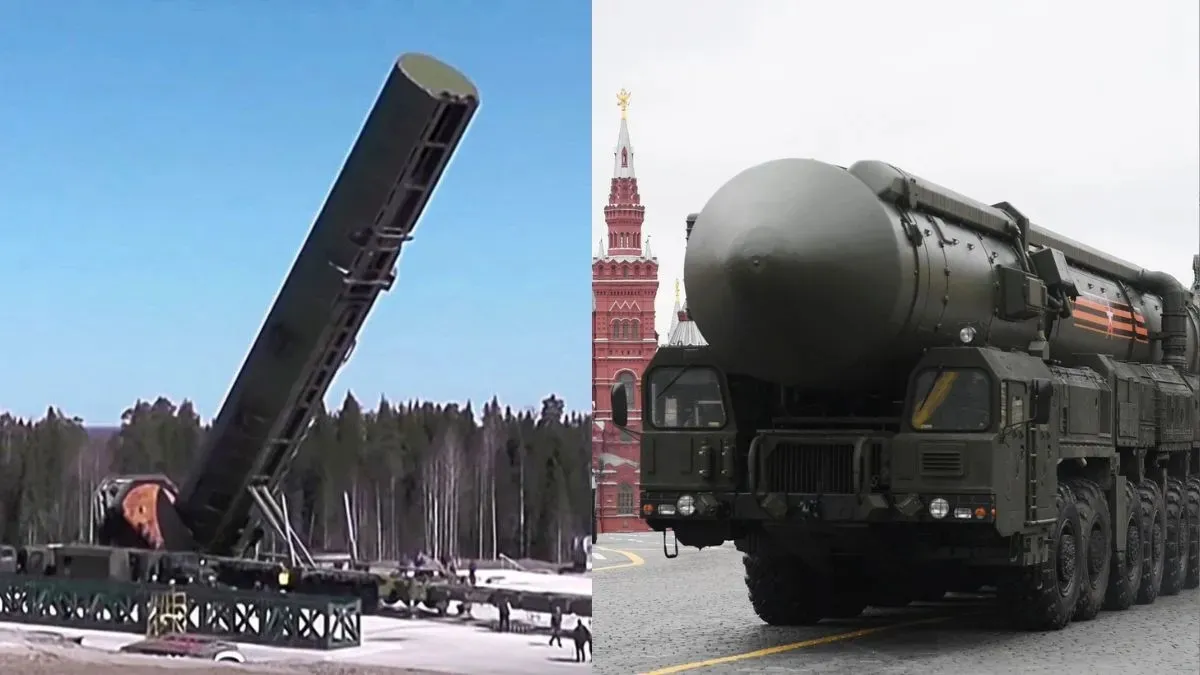
In a significant turn of events, Russia's President Vladimir Putin is reeling from a massive drone attack launched by Ukraine deep inside Russian territory. Ukrainian forces reportedly struck five of Russia's major airbases, located 4,000 kilometers within Russian borders, using a sophisticated drone assault. This unprecedented attack has left Russia scrambling to retaliate with overwhelming force, raising concerns about the possibility of catastrophic consequences if the conflict escalates further. Russia now stands ready to unleash its most destructive weapons, including the "RS-28 Sarmat" and "Satan-2" missiles, which are among the deadliest in the world.
Satan-2 missile: The world's most destructive weapon
Russia's "Satan-2" missile, also known as the RS-28 Sarmat, has earned its infamous name from the West for its sheer destructive potential. This intercontinental ballistic missile (ICBM) is capable of carrying multiple nuclear warheads — up to 15-16 — and is capable of wiping out entire cities.
The updated RS-28 Sarmat missile, considered an advanced version of Satan-2, has an increased range of 13,000 to 16,000 kilometers, making it one of the most powerful missiles in Russia's arsenal. This missile's capacity to cause mass destruction is unparalleled, capable of obliterating several cities with a single strike.
The threat of nuclear devastation
Given the current situation, the fear of the potential use of Russia's nuclear missiles in retaliation is very real. With the Ukrainian drone strikes on five key Russian airbases, the threat of a nuclear response looms large. If Russia were to retaliate with missiles like the RS-28 Sarmat or Satan-2, entire regions could be reduced to rubble. The aftermath of such an attack could not only devastate cities but also threaten global stability, with the potential to annihilate entire populations and render much of the planet uninhabitable.
Russia's arsenal of destructive missiles and weapons
In addition to the Satan-2, Russia possesses a wide range of deadly missiles and military technologies that could escalate the conflict dramatically. These include intercontinental ballistic missiles, cruise missiles, nuclear warheads, hypersonic missiles, and advanced aircraft. Below is an overview of some of Russia's deadliest weapons:
1. Ballistic missiles
- RS-28 Sarmat (Satan-2): A nuclear-capable intercontinental ballistic missile, it is one of the most dangerous weapons in the world. Russia can target almost any part of the globe with this missile.
- Tochka-U: A medium-range ballistic missile, designed to strike enemy strategic positions.
- Iskander-M: A short-range ballistic missile known for its precision in targeting military bases and command centers.
2. Cruise missiles
- Kalibr: A sea-based cruise missile known for its high accuracy, widely used in Russia’s military operations against Ukraine.
- Kh-101: A long-range air-launched cruise missile fired from Russian bombers, it is another deadly weapon in Russia’s arsenal.
3. Nuclear weapons
Russia’s nuclear weapons are both strategic and tactical, giving it immense leverage in global geopolitics. While the use of these weapons would have catastrophic global implications, their presence serves as a tool for Russia to exert pressure during conflict situations.
4. Hypersonic missiles
- Avangard: A hypersonic glide vehicle traveling at 20 times the speed of sound, it can evade most missile defense systems, making it a potent weapon.
- Kinzhal: An air-launched hypersonic missile fired from fighter jets, capable of reaching incredibly high speeds and inflicting devastating damage.
5. Military aircraft and drones
Russia’s air force includes advanced fighter jets like the Sukhoi-57 and Sukhoi-35, both capable of carrying and delivering a variety of missiles and bombs. Additionally, Russian drones play a critical role in reconnaissance and strike operations.
6. Heavy artillery and multiple launch rocket systems (MLRS)
With systems like Tosa-M and Barrage-SM-X, Russia can launch multiple rockets simultaneously, decimating enemy positions and military infrastructure.
Global repercussions of Russian retaliation
Should Russia choose to respond to Ukraine's drone strike with its most powerful missiles, the world could face unimaginable consequences. The RS-28 Sarmat and Satan-2 could erase entire cities, and the use of nuclear weapons would be a direct threat to global security.
Russia’s escalating military buildup and the potential deployment of its most destructive weapons have left the international community on edge. With tensions rising, the threat of an all-out war between Russia and Ukraine — and by extension, NATO — remains a significant concern.
The countdown to global conflict
The world watches with bated breath as both sides brace for what could be the largest and most devastating conflict since the Cold War. With Russia's vast arsenal of nuclear weapons and advanced military technology, the risk of a catastrophic escalation has never been more real. As the situation continues to unfold, global leaders are urged to explore diplomatic solutions to prevent an all-out war that could have devastating consequences for the world.
The coming days will determine whether this conflict can be contained or whether it will spiral into a global crisis that will reshape the world order.
