
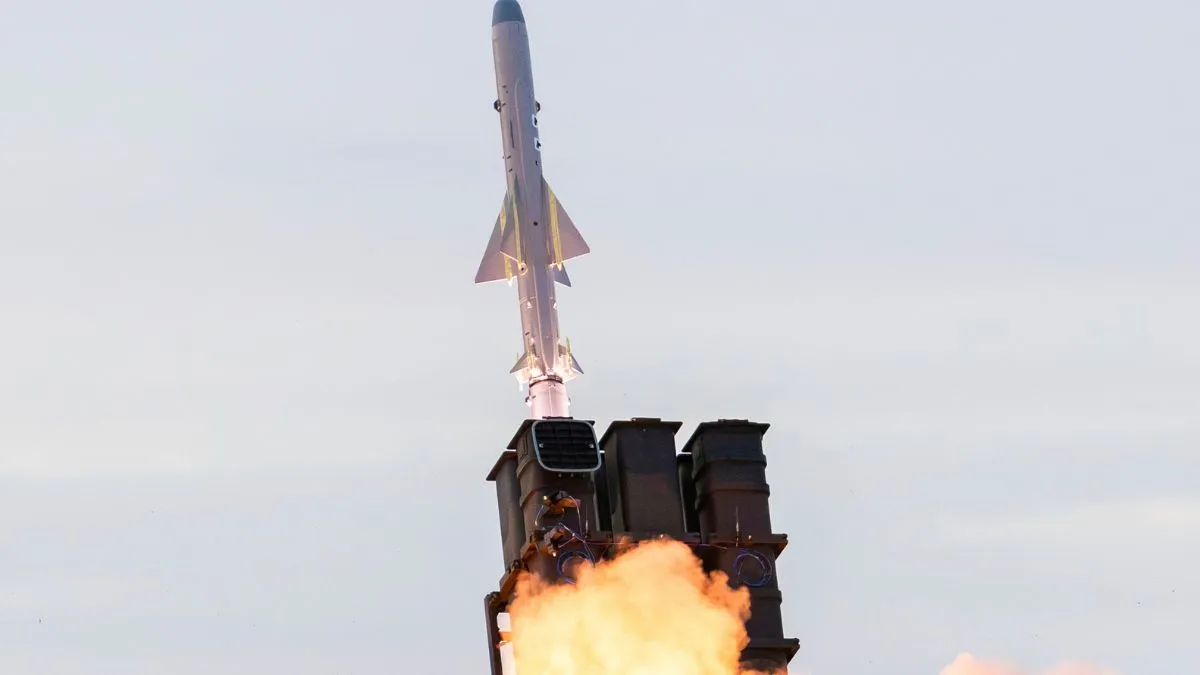
Pakistan on Friday unveiled its new hypersonic anti‑ship missile, designated SMASH, at the World Defense Show 2026 in Riyadh, Saudi Arabia. The missile was showcased by Global Industrial and Defence Solutions (GIDS) and is being presented as a dual‑role hypersonic weapon capable of conducting both maritime and land attack missions.
SMASH is a ship‑launched anti‑ship ballistic missile (ASBM) under Pakistan’s P‑282 designation, with has a range of approximately 350 km.
290 km strike range
The missile has a strike range of 290 kilometers. It follows a semi-ballistic trajectory, attacking at a near-vertical angle while maneuvering during flight. This significantly reduces the enemy’s air defense reaction time.
The first standard carriers of the SMASH missile are the Zulfiqar (Type 22) and Tughril (Type 054A/P) class frigates. It can also be launched from ground-based mobile platforms.
Spy satellite also launched
Relying once again on China, Pakistan has made a major strategic move. Pakistan launched seven satellites into space from its own territory. Among them is Pakistan’s EO-2 “spy” satellite, which could increase concerns for India.
What are Hypersonic anti-ship missiles?
Hypersonic anti-ship missiles are advanced naval weapons that travel at speeds greater than Mach 5 (five times the speed of sound) and are designed to destroy enemy warships, including aircraft carriers and destroyers. Their extreme speed makes them very difficult to detect, track and intercept with traditional missile defense systems.
Unlike conventional anti-ship missiles, hypersonic versions often use advanced propulsion systems such as scramjets or boost-glide technology. Boost-glide vehicles are first launched by a rocket and then glide at hypersonic speeds while maneuvering unpredictably toward their target. This maneuverability increases their survivability against defense systems.
Examples include Russia’s 3M22 Zircon, China’s DF-21D, and India’s BrahMos-II. These missiles significantly enhance a nation’s naval strike capability and are considered game-changing in modern maritime warfare due to their speed, precision, and ability to penetrate advanced naval defenses.
