
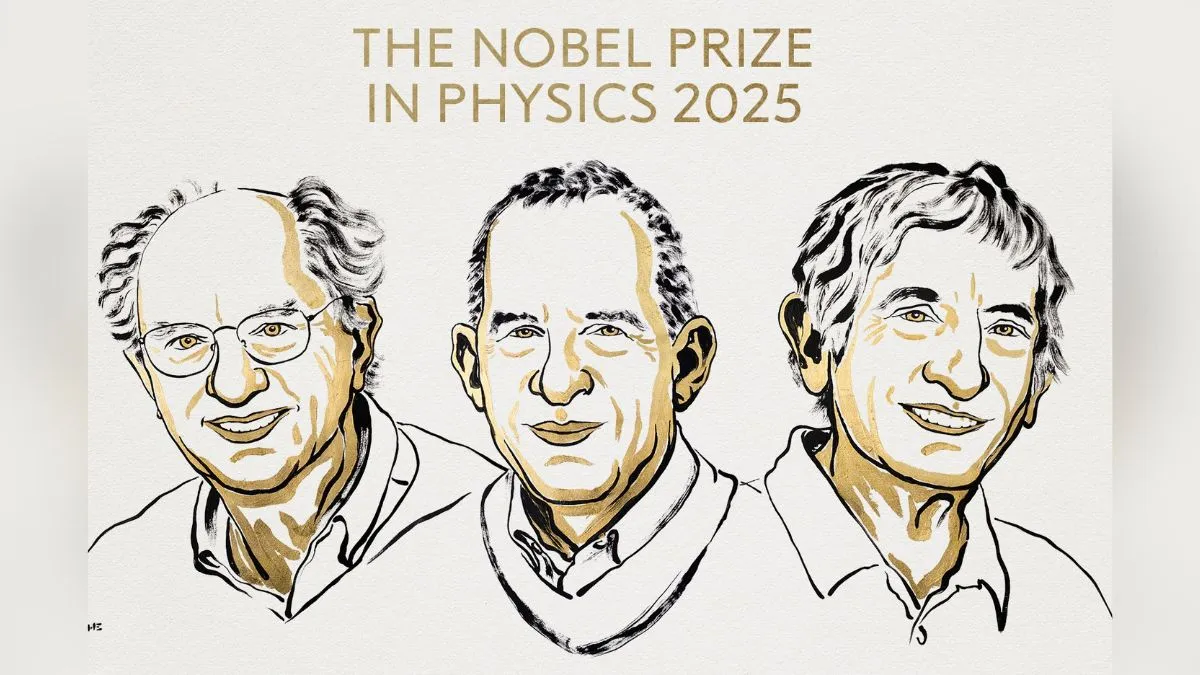
The Nobel Prize 2025 in Physics has been awarded to John Clarke, Michel H Devoret and John M Martinis "for the discovery of macroscopic quantum mechanical tunnelling and energy quantisation in an electric circuit." Awarded by the Royal Swedish Academy of Sciences, the prize includes 11 million Swedish kronor (about $1.2 million). Clarke conducted his research at the University of California in Berkeley; Martinis at the University of California, Santa Barbara; and Devoret at Yale and also at the University of California, Santa Barbara. "To put it mildly, it was the surprise of my life," Clarke told reporters at the announcement by phone after being told of his win.
Clarke also paid tribute to the other two laureates saying that their contributions are just overwhelming. "Our discovery in some ways is the basis of quantum computing. Exactly at this moment where this fits in is not entirely clear to me," he added.
What did the Nobel committee say?
The Nobel committee said that the laureates' work provides opportunities to develop "the next generation of quantum technology, including quantum cryptography, quantum computers and quantum sensors." "It is wonderful to be able to celebrate the way that century-old quantum mechanics continually offers new surprises. It is also enormously useful, as quantum mechanics is the foundation of all digital technology," said Olle Eriksson, Chair of the Nobel Committee for Physics.
Nobel Prize
It is the 119th time the prize has been awarded. Last year, artificial intelligence pioneers John Hopfield and Geoffrey Hinton won the physics prize for helping create the building blocks of machine learning. Earlier on Monday, Mary E Brunkow, Fred Ramsdell and Dr Shimon Sakaguchi won the Nobel Prize in medicine for discoveries about how the immune system knows to attack germs and not our bodies. Nobel announcements continue with the chemistry prize on Wednesday and literature on Thursday. The Nobel Peace Prize will be announced Friday and the Nobel Memorial Prize in economics on October 13.
(With inputs from AP)
