
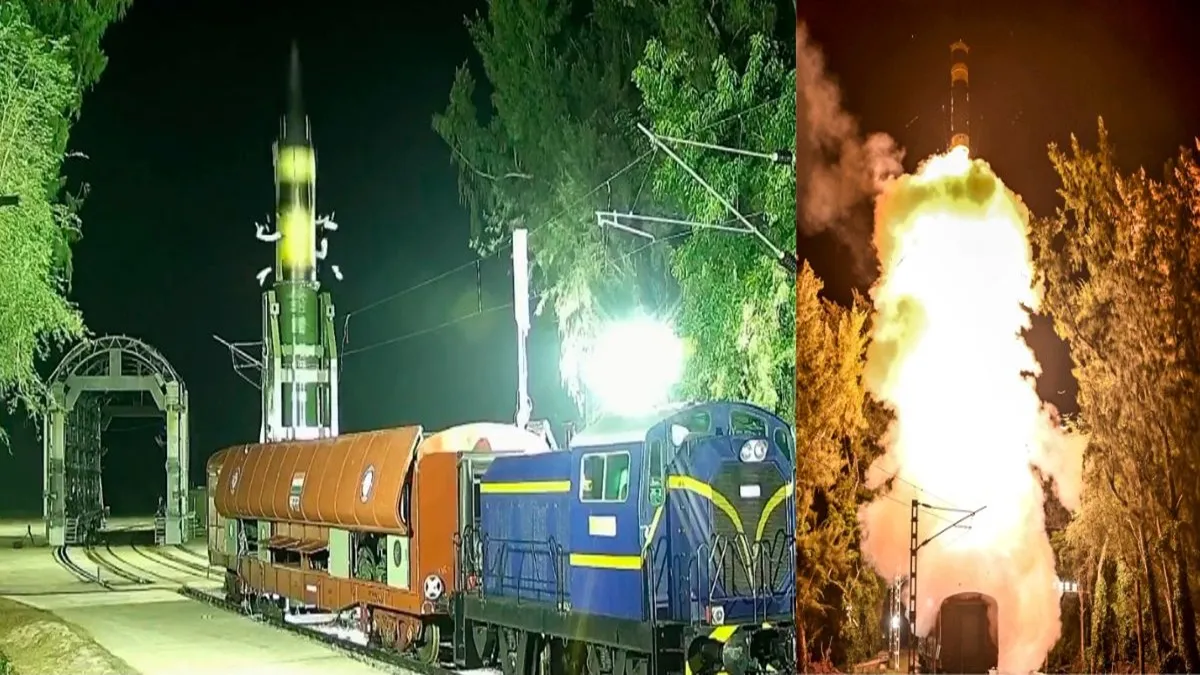
India has successfully test-fired its next-generation Agni-Prime missile with a range of 2,000 km from a specially designed rail-based mobile launcher, marking a significant milestone in the nation's missile capability. The Defence Research and Development Organisation (DRDO), in collaboration with the Strategic Forces Command (SFC), carried out the test under full operational conditions on Wednesday. Defence Minister Rajnath Singh said the successful trial places India among a select group of nations capable of launching such advanced weapon systems from a rail network. According to the defence ministry, the launch was "first-of-its-kind" and conducted using a rail-based system that can move freely across the Indian Railways network without preconditions. This gives the military the flexibility to launch missiles within a short reaction time and from virtually anywhere in the country. With nearly 70,000 km of railway tracks, India's vast network offers unmatched cross-country mobility for deploying the missile system, making it far more versatile compared to road-based launchers.
Why Agni-Prime stands out
The Agni-Prime missile brings multiple advancements that enhance India’s strategic deterrence:
- Canisterization: Stored and launched from sealed containers, the missile can be fired within minutes, ensuring constant readiness.
- Rail-based mobility: Launching from a moving rail platform makes it difficult for adversaries to track and target.
- Strategic ambiguity: The mobility and concealment features ensure adversaries remain uncertain about the missile's exact location, bolstering India's second-strike capability.
- Advanced features: As a new-generation system, Agni-Prime is designed with improved accuracy, reliability and precision.
Strategic significance of rail-based mobility
The rail-based system means missiles can be transported and launched even from remote regions of the country where road access is limited. The presence of train tunnels also allows the military to conceal missiles from enemy satellites until the moment of launch. This not only expands the number of possible launch points but also increases survivability during conflict. In wartime, when adversaries may target conventional military bases, the ability to disperse and conceal missile systems along the railway network gives India a powerful strategic advantage. Experts say this capability is particularly important given the evolving security environment and past instances of Indian military establishments being targeted by drones and missiles from across the border.
ALSO READ: India successfully tests Agni-Prime missile from rail-based mobile launcher: All you need to know
