
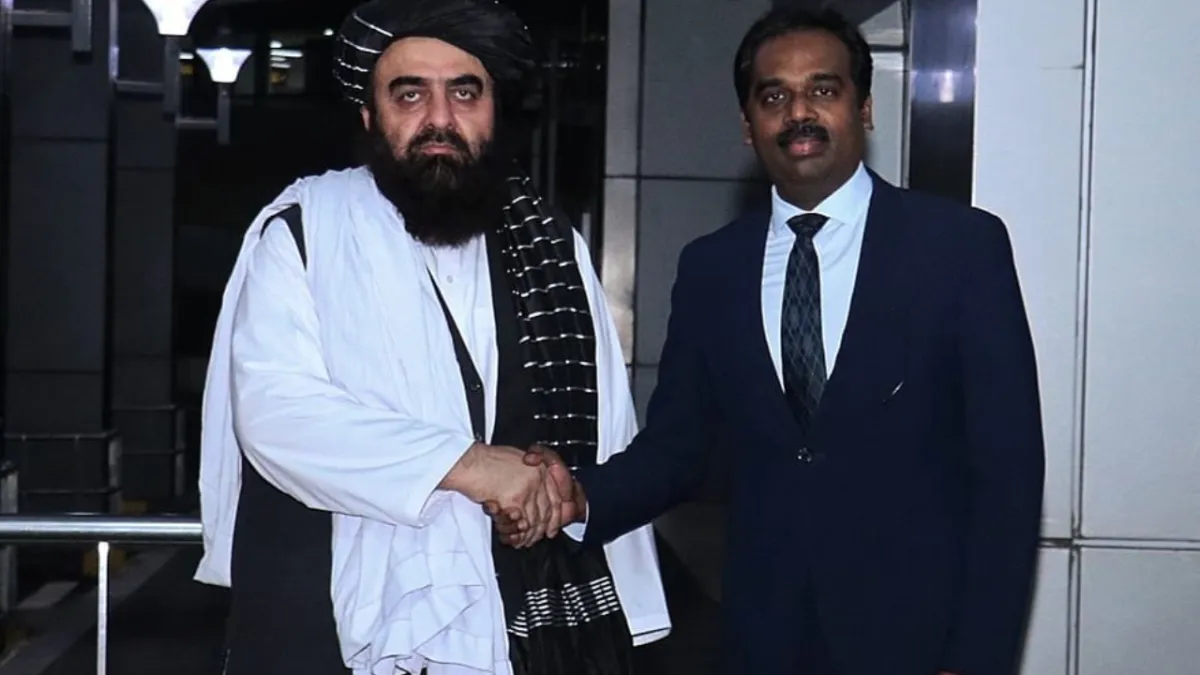
Afghanistan's acting Foreign Minister, Amir Khan Muttaqi, arrived in New Delhi on Wednesday for a week-long visit, which is his first ministerial-level trip to India since the Taliban took control of Kabul in August 2021. The visit is being seen as a key event in India-Afghanistan ties and may yield notable outcomes on the geopolitical front.
The visit was made possible after the United Nations Security Council’s Taliban Sanctions Committee granted a special exemption on September 30, temporarily lifting Muttaqi’s travel ban to allow the trip.
Upon arrival, Muttaqi was received by Ministry of External Affairs (MEA) spokesperson Randhir Jaiswal. "We look forward to engaging discussions with him on bilateral relations and regional issues,” Jaiswal said in a post on X.
Muttaqi is visiting India at the invitation of External Affairs Minister S Jaishankar and is expected to stay until October 16.
Agenda of Muttaqi’s visit
This marks the first official outreach of its kind since the Taliban’s return to power. The visit coincides with the arrival of UK Prime Minister Keir Starmer in Mumbai for trade talks with Prime Minister Narendra Modi.
While no meeting between Muttaqi and Prime Minister Modi has been confirmed, Indian officials are extending full diplomatic protocol to the visiting foreign minister.
During his six-day stay, Muttaqi will hold detailed discussions with External Affairs Minister S Jaishankar and National Security Advisor Ajit Doval, according to people familiar with the matter. His itinerary also includes visits to the Darul Uloom Deoband seminary in Deoband and the Taj Mahal. In addition, he is expected to meet representatives from business circles and the Afghan community based in India.
Muttaqi was originally scheduled to visit New Delhi last month, but the trip was postponed due to restrictions under the UN Security Council sanctions.
India’s evolving engagement with Afghanistan
Although India has not officially recognised the Taliban-led government, Muttaqi’s visit reflects a pragmatic shift in New Delhi’s approach to Afghanistan. Earlier this year, External Affairs Minister Jaishankar said he had a “good conversation” with Muttaqi, appreciating his condemnation of the April 22 Pahalgam terror attack in Jammu and Kashmir.
Muttaqi has been under UN sanctions since 2001, which include a travel ban, asset freeze, and arms embargo. However, the UN Taliban Sanctions Committee, chaired this year by Pakistan, with Russia and Guyana as vice-chairs, granted a temporary travel exemption specifically to facilitate this visit to India.
