
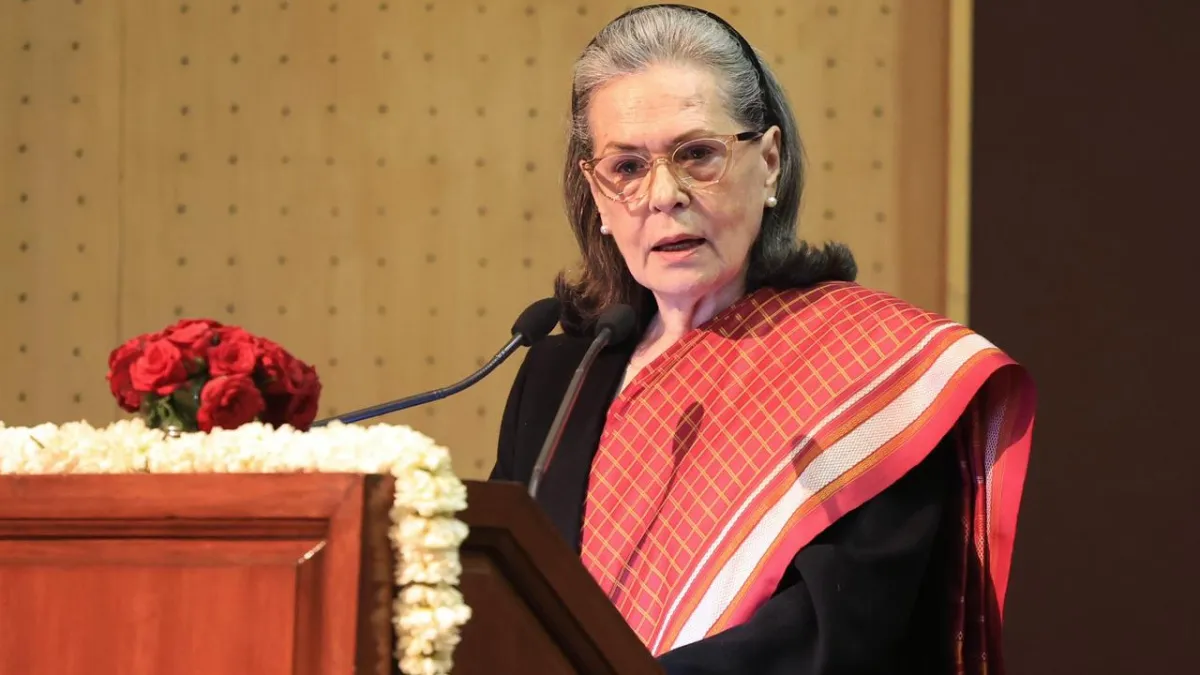
Senior Congress leader Sonia Gandhi has said that the project to vilify Jawaharlal Nehru is the main goal of the ruling establishment today, criticising the BJP for allegedly attempting to erase the first prime minister from the country’s history.
The BJP responded by saying that it was the Congress that had underestimated Nehru’s contribution and claimed they had only highlighted efforts to cover up his "mistakes" rather than disrespect him.
Speaking at Jawahar Bhawan during the launch of the Nehru Centre India, Gandhi alleged a systematic effort to denigrate, distort, demean, and defame Nehru.
"What is not acceptable is the systematic attempt being made to denigrate, distort, demean and defame him," she said.
"The sole objective of this is to not only diminish him as a personality but also his universally recognised role in India's independence struggle and his early decades as a leader of an independent nation challenged by unprecedented problems, but it is also to demolish his multifaceted legacy in a crude and self serving attempt to rewrite history," she said, calling such attempts "totally unacceptable."
She claimed that those behind the project to diminish Nehru belong to an ideology that had no role in the freedom movement or the drafting of the constitution and had fostered an atmosphere that led to Mahatma Gandhi’s assassination.
"Let there be no doubt whatsoever that the project to vilify Jawaharlal Nehru is the main objective of the ruling establishment today. Their goal is not just to erase him; it is actually to destroy the social, political, and economic foundations on which our nation has been founded and built," the Congress Parliamentary Party chairperson said.
Gandhi added that Nehru continues to serve as a beacon of light for millions of Indians and that it is natural for such a monumental figure to have his life and work analysed and critiqued, which she said is entirely appropriate.
She noted that the temptation to separate Nehru from the context of his times and the challenges he faced, and to examine him without that historical background, has become widespread.
