
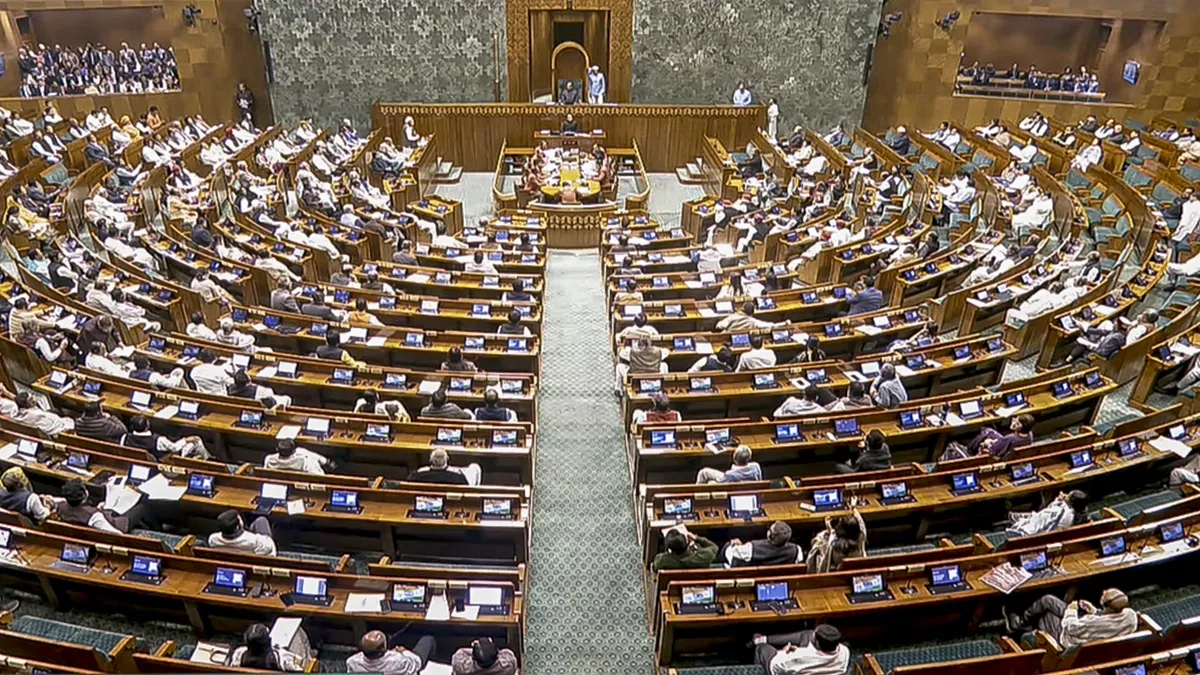
Parliament on Monday approved a bill aimed at imposing a cess on pan masala manufacturing units to generate additional resources for national security and public health. The Rajya Sabha returned the Health Security and National Security Cess Bill, 2025, to the Lok Sabha, which had already passed the legislation on December 5. Under the Bill, a Health and National Security Cess will be imposed over and above the Goods and Services Tax on pan masala manufacturing units. The levy will be based on the production capacity of machines installed in factories. At present, pan masala, tobacco and related products attract 28 per cent GST along with a compensation cess at varying rates. With the compensation cess coming to an end, the GST rate will rise to 40 per cent. In addition, excise duty will continue to apply on tobacco products, while the new cess will specifically target pan masala.
Sitharaman defends government move
Replying to the debate, Finance Minister Nirmala Sitharaman said the proposed cess is meant to support both national and health security. "This cess aims to serve the cause of national security and also health security. It is not going to be on any essential commodities but it is going to be only on demerit goods," she said. She underlined the urgent need for dedicated and credible funding for defence preparedness, especially in an era of high-tech warfare. Sitharaman pointed out that modern conflicts rely on precision weapons, autonomous platforms, space-based assets, cyber operations and real-time battlefield intelligence, all of which involve heavy capital expenditure.
Why steady defence funding matters
Emphasising the fast pace of technological change, the finance minister said constant upgrades are essential. "Technology being such a rapidly growing area, you also have to keep updating the technology which also requires investment that has to be for upgrading as well. I am sure all members will agree with me that in the age of technology one needs to be constantly on the top of what is the latest. We cannot compromise on this front," she said. She added that the country requires a stable revenue stream to keep the armed forces well-equipped and ready. "So this cess actually offers a feasible mechanism to strengthen both citizens' health and military preparedness," Sitharaman said.
GST regime and past tax levels
Sitharaman recalled that under the earlier GST framework, sin or demerit goods attracted both GST and a compensation cess, taking the total tax burden to as high as 88 per cent in some cases and always above 40 per cent. With the shift to the next-generation GST system, the compensation cess has been phased out and GST alone now caps the levy at 40 per cent, she noted.
States to get a share
Addressing concerns raised by members, the finance minister clarified that a portion of the cess will also be shared with states. She rejected claims that states would lose out due to the new levy.
Attack on previous regimes
Sitharaman also took aim at earlier governments, saying defence spending was not prioritised under the Congress-led regimes. She recalled instances where defence ministers had publicly admitted constraints in purchasing equipment. Referring to former Defence Minister A K Antony, she said he had told Parliament, "I can't buy these equipment because I don't have the money." She further said that during the Kargil conflict, troops faced severe shortages.
"In fact, during the Kargil war, soldiers were left without boots, the snow boots which are so required there… We were not even having enough ammunition to fight a 30 day or a 17 day intense warfare. So, defence was no priority of the earlier regime. But since Prime Minister Modi has come, we have absolutely kept defence as a top priority," Sitharaman said.
Parliament's role protected
Clarifying concerns about taxation powers, Sitharaman said the authority to raise or double tax rates arises only in emergency situations and is subject to parliamentary approval. The provision for prior sanction has been incorporated into the Health Security se National Security Cess Bill, 2025 itself. "These are well-laid-out procedures ensuring Parliamentary scrutiny. This law follows the same process. There is nothing discretionary, arbitrary or bypassing Parliament," she said.
No reduction in state funds
Countering Opposition allegations, Sitharaman noted that states received Rs 18.54 lakh crore as tax devolution during the UPA years, compared to Rs 71 lakh crore over ten years of the NDA government. She also pointed out that various cesses existed before 2014, including levies on crude oil, road infrastructure and calamity relief. Highlighting the Pradhan Mantri Gram Sadak Yojana, she said that while Rs 12,000 crore came from the Road and Infrastructure Cess in 2024-25, Rs 13,327 crore was actually disbursed to states. "The states have received their share," she said.
ALSO READ: Right to Disconnect Bill explained: What is it and its chances of becoming law
