
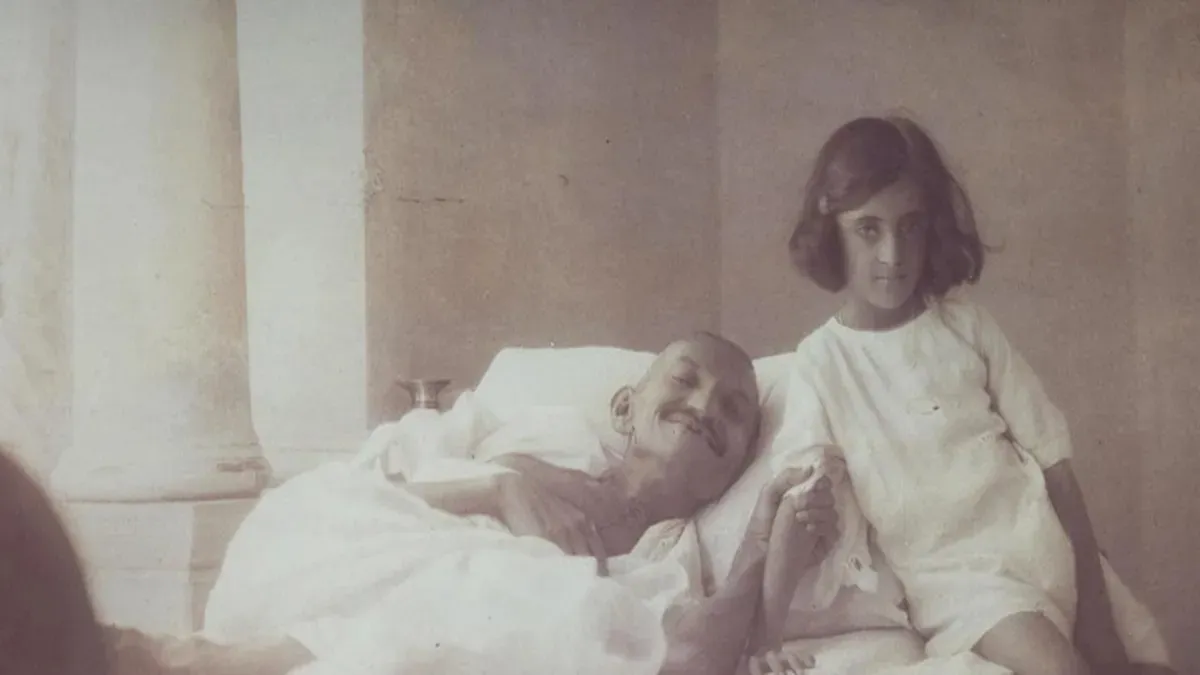
As India marks the 108th birth anniversary of Indira Gandhi, the country's first and only female Prime Minister, here's a look at one of the most fascinating tales from her childhood. Indira was the only child of the first Prime Minister, Jawaharlal Nehru, and Kamala Nehru. Indira Gandhi was raised in a political and social environment that brought her close to national politics from an early age. Her mother’s resilience and her father’s towering political career shaped her personality and future leadership.
Indira Gandhi was known not only for her political acumen but also for her extraordinary inner strength. Having witnessed major political movements since childhood, she received informal political training within her own home. Over the years, she emerged as one of India's most powerful leaders—capable of taking tough decisions while leading her party through challenging times. Many of the country's defining decisions were taken under her leadership.
Why did Indira Gandhi set her doll on fire?
When Indira Gandhi was a young girl, she had a doll that she adored deeply. Reportedly, her doll was made in England. Inspired by Mahatma Gandhi's call for Swadeshi, which encouraged Indians to boycott foreign goods, Indira decided to make a personal sacrifice. Despite having a foreign-made doll that she cherished, Indira, who was only 5 years old, set the doll on fire as an act of rebellion and solidarity with the national movement.
She later led the Vanar Sena (Monkey Brigade), a group of children who secretly carried messages between freedom fighters, as the British rarely suspected children.
Indira was called a 'Dumb Doll'
Indira entered politics early and interacted closely with many of India's top freedom fighters. Despite this, she faced criticism in her initial years as Prime Minister. She took office in January 1966, two weeks after the sudden death of Lal Bahadur Shastri. Though not the Congress's first choice initially, she soon emerged as the most popular leader of her era and went on to become India's second-longest-serving Prime Minister.
Her early years were difficult. During the 1969 Union Budget speech, she faltered, prompting socialist leader Ram Manohar Lohia to call her a "dumb doll." The remark deeply affected her. Determined to prove her critics wrong, she reshaped her political strategy, travelled nearly 36,000 miles across the country, connected directly with the masses, and gave one of India's most iconic slogans: "Garibi Hatao" (Remove Poverty).
Indira Gandhi
Born on November 19, 1917, to India's first Prime Minister Pandit Jawaharlal Nehru and Kamala Nehru, Indira Gandhi served as the first and only woman prime minister from January 1966 to March 1977 and again from January 1980 until her assassination in October 1984.
She was the second longest-serving Prime Minister after Nehru and was well-known for path-breaking economic and social reforms, including the nationalisation of banks. She also abolished the privy purses of the erstwhile princely states.
Indira Gandhi, who was hailed as one of the tallest world leaders, was assassinated by her own Sikh bodyguards at her residence on Akbar Road on October 31, 1984. This came after Operation Bluestar was executed at Amritsar's Golden Temple, wherein Gandhi ordered the Indian Army to confront Sikh separatists who had taken shelter at the holy shrine.
Also known as the 'Iron Lady of India,' Indira Gandhi was actively involved in the freedom movements, including starting the 'Bal Charkha Sangh' and 'Vanar Sena' to support the Congress during the Civil Disobedience movement and fight against the British forces.
Under her, India fought the 1971 Indo-Pakistan war, which eventually secured the creation of an independent Bangladesh. Indian forces supported Bangladesh's 'Mukti Vahini'. In 1967, a military conflict broke out between India and China, leading to the deaths of multiple Chinese and Indian soldiers and resulting in the withdrawal of Chinese forces from Sikkim. 8 years later, in 1975, Sikkim was incorporated into the Indian union after a referendum called for it.
