
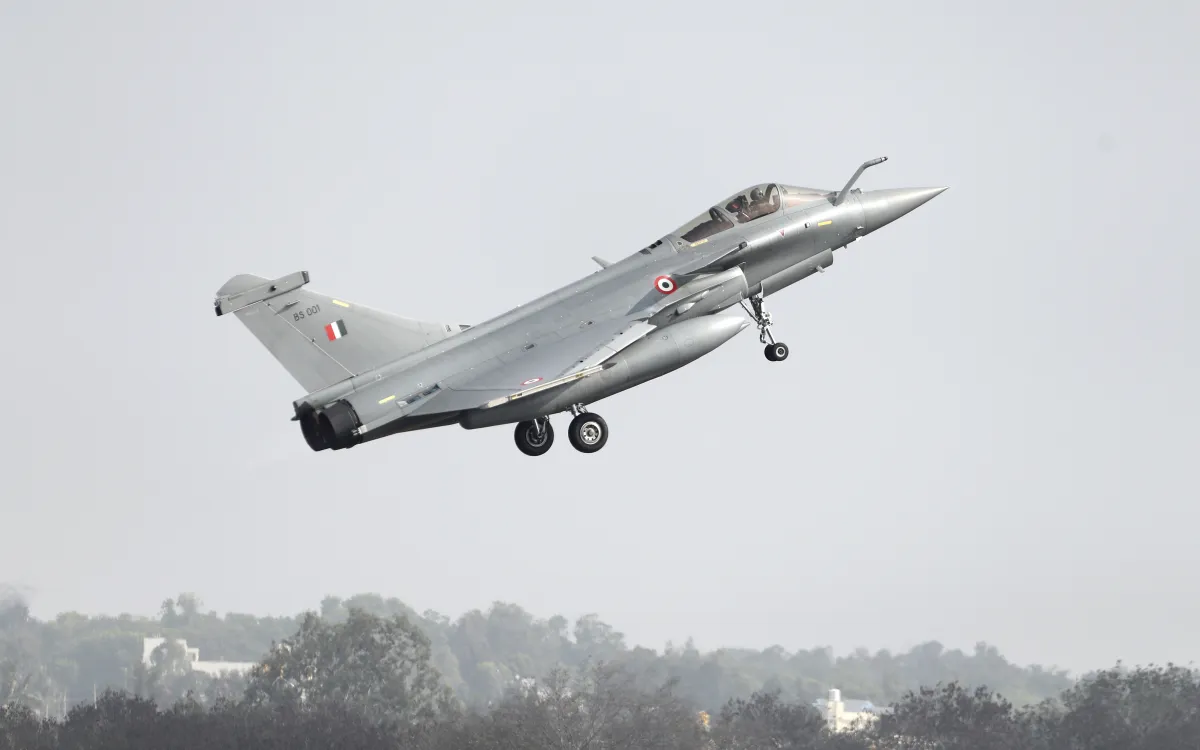
The Indian Air Force (IAF) has overtaken China to become the third most powerful air force in the world, according to the World Directory of Modern Military Aircraft (WDMMA) rankings. The US Air Force continues to remain on top of the list, following by Russia.
Meanwhile, the Chinese Air Force is at the fourth spot on the list.
The list said that the TruVal Rating (TVR) of the USAF stands at 242.9. Russia's TVR is 114.2 and India's rating is 69.4. Meanwhile, the TVR of China, Japan, Israel, France and the United Kingdom (UK) is 63.8, 58.1, 56.3, 55.3 and 55.3, respectively.
Pakistan, on the other hand, has a TVR rating of 46.3.
India overtakes China
The WDMMA report said IAF's 31.6 per cent aircraft are dedicated fighters, 29 per cent are helicopters and 21.8 per cent trainers. Though People’s Liberation Army Air Force (PLAAF) of China has 52.9 per cent fighters and 28.4 per cent trainers, the IAF is a 'balanced unit', the WDMMA report noted.
At present, the IAF operates 4.5 generation aircraft such as Dassault Rafales, Sukhoi Su-30 MKIs and Tejas, fourth generation MiG-29 and Dassault Mirage 2000. India is also planning to includes indigenous aircraft like LCA-Mk1A, LCA-Mk2, MRFA and AMCA.
Meanwhile, China operates fifth generation J-20 and J-35, and 4.5 generation jets such as J-10C and J-16.
What is TruVal Rating and why does it matter?
The WDMMA has framed this metric to rank the strength of air forces around the world. It has several parameters such like quantity of aircraft, capabilities, support and readiness, and fleet effectiveness to analyse the overall strength of an air force.
According to the information available on WDMMA website, it uses a formula which takes into account values related to total fighting strength of the various air services of the world. "The formula produces the 'TruVal Rating' (TVR) helping to definitively separate each power based on - not only overall strength - but modernization, logistical support, attack and defense capabilities an so on. In this way, a power is not simply assessed on its total quantity of aircraft but rather its quality and general mix of inventory," it said.
"Greater weight is given to categories generally overlooked by some powers, namely special- mission, dedicated bomber force, CAS, training, and on-order units. Beyond this is a focus on local aero-industry capabilities, inventory balance (general mix of unit types), and force experience," it added.
