
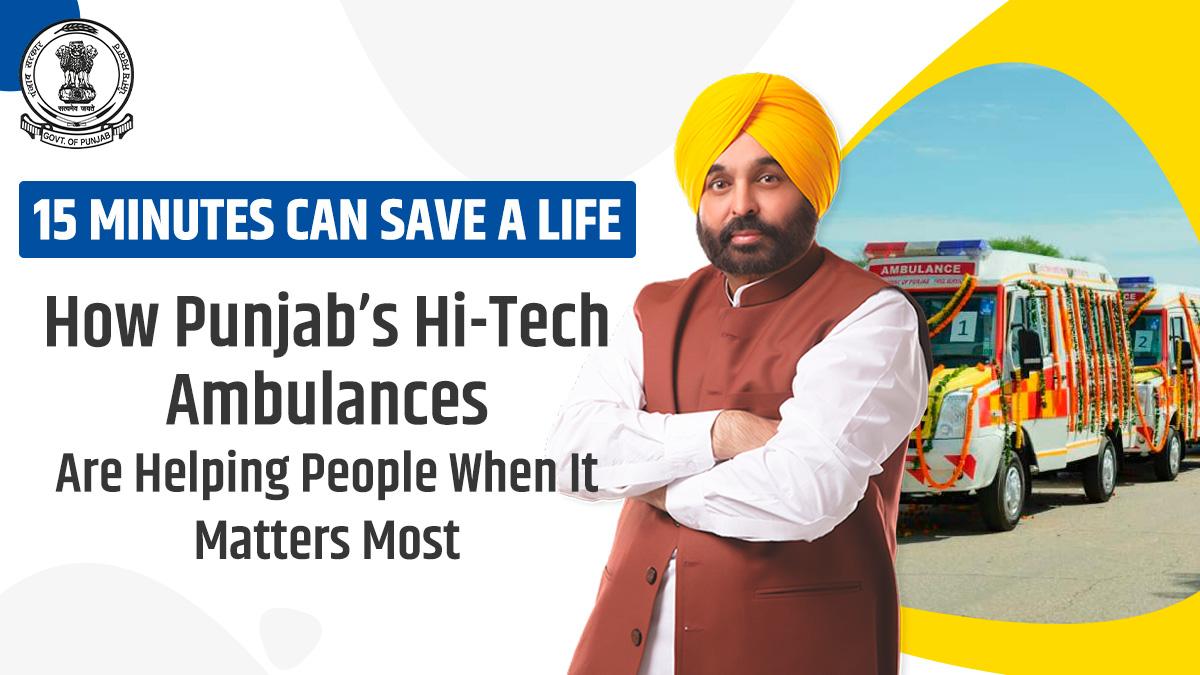
For millions of people living in Punjab, a medical emergency doesn't translate to panic and delay. Merely a phone call away, a hi-tech ambulance reaches one's doorstep within minutes. In 2025, Punjab strengthened its emergency healthcare sector with hi-tech ambulances.
For the public, the most welcomed move was the 108 toll-free helpline, which is available 24/7. One call triggers an entire response chain, control rooms, GPS tracking, paramedics, ambulances, and hospitals working in sync. Punjab has now deployed 371 ambulances, including 46 newly inducted hi-tech vehicles flagged off recently by Health and Family Welfare Minister Dr Balbir Singh. Seven of these have been dedicated as 'Child Memorial Ambulances' in Samana (Patiala), honouring children who lost their lives in a tragic road accident earlier this year.
Emergency care where hospitals can't reach
One of the biggest challenges in Punjab’s healthcare system has long been distance. Many villages are far from tertiary hospitals, and in emergencies, every extra kilometre can cost lives. Delayed medical attention, whether during accidents, heart attacks, or pregnancy-related complications, has often proven fatal.
The introduction of hi-tech ambulances has begun to close this gap. Unlike traditional ambulances, these vehicles function as mobile intensive care units. Equipped with oxygen support, cardiac monitors, defibrillators, ventilators, emergency drugs and trauma kits, they allow treatment to begin immediately, not after reaching a hospital.
For people living in remote areas, this has been a game-changer. Well-trained paramedics now reach villages quickly, stabilise patients on the spot, and continue treatment while en route to hospitals.
Faster response, even in traffic-choked cities
In cities like Ludhiana, Amritsar and Jalandhar, traffic congestion often stands between patients and timely care. To address this issue, the hi-tech ambulances in the state of Punjab are equipped with tracking systems that have GPS capabilities and are connected to central control rooms.
This ensures that ambulances take shortcuts and reach their patients within a very tight time frame, 15 minutes in cities and 20 minutes in the countryside, so far so good on the benchmark front since this is among the fastest in the nation.
Punjab CM Bhagwant Singh Mann welcomed the move
In 2024, the Chief Minister of the province of Punjab, Bhagwant Singh Mann, flagged off 58 hi-tech ambulances in the administrative centre of Chandigarh. This highlights the emphasis the government places on
"These ultra-modern ambulances have been mandated to reach needy patients within 15 minutes in urban areas and 20 minutes in rural areas," CM Mann said at the launch. He added, "The 58 hi-tech ambulances have been purchased for Rs 14 crore and are equipped with life-saving drugs and ultra-modern equipment. These ambulances will act as a catalyst to provide primary treatment so that lives are saved well in time."
Not just vehicles, but trained hands behind the wheels
Technology alone doesn't save lives; people do. Each hi-tech ambulance is staffed with trained emergency medical technicians and paramedics who regularly undergo training in trauma care, cardiac emergencies, maternal health, and paediatric response. This ensures that equipment is used effectively when seconds matter. The ambulances also work in close coordination with the Sadak Surakhya Force (SSF), particularly in road accident cases. This joint response has significantly reduced fatalities by ensuring immediate on-site medical aid and faster evacuation. The scale of impact so far
Since its inception in 2011, the 108 Ambulance Service has served over 30 lakh citizens across the state. "The 108 service is the backbone of our emergency healthcare system. With these new ambulances, we are ensuring that no call for help goes unanswered," said Dr Balbir Singh.
When floods tested the system, it delivered
Perhaps the strongest proof of the system’s resilience came during Punjab's recent floods. In September 2025, as roads disappeared under water and villages were cut off, the state converted boats, tractors, and makeshift floats into 'boat ambulances'. Medicines were delivered, patients were transported safely, and even under these extreme conditions, four children were born safely. These ambulances, equipped with essential medicines and advanced medical equipment, were stationed strategically in the flood-hit areas to provide emergency care. It was healthcare improvisation at its most humane, and it worked.
Chief Minister Mann has summed up the government’s approach clearly: "Our government's only goal is to protect the life of every Punjabi. Whether it's a road accident, a heart attack, or a natural disaster like a flood, Punjab's ambulance service stands with the public in every difficult time."
In a country where access often decides outcomes, Punjab's hi-tech ambulances are quietly rewriting what emergency care can look like: faster, closer, and far more human.
