
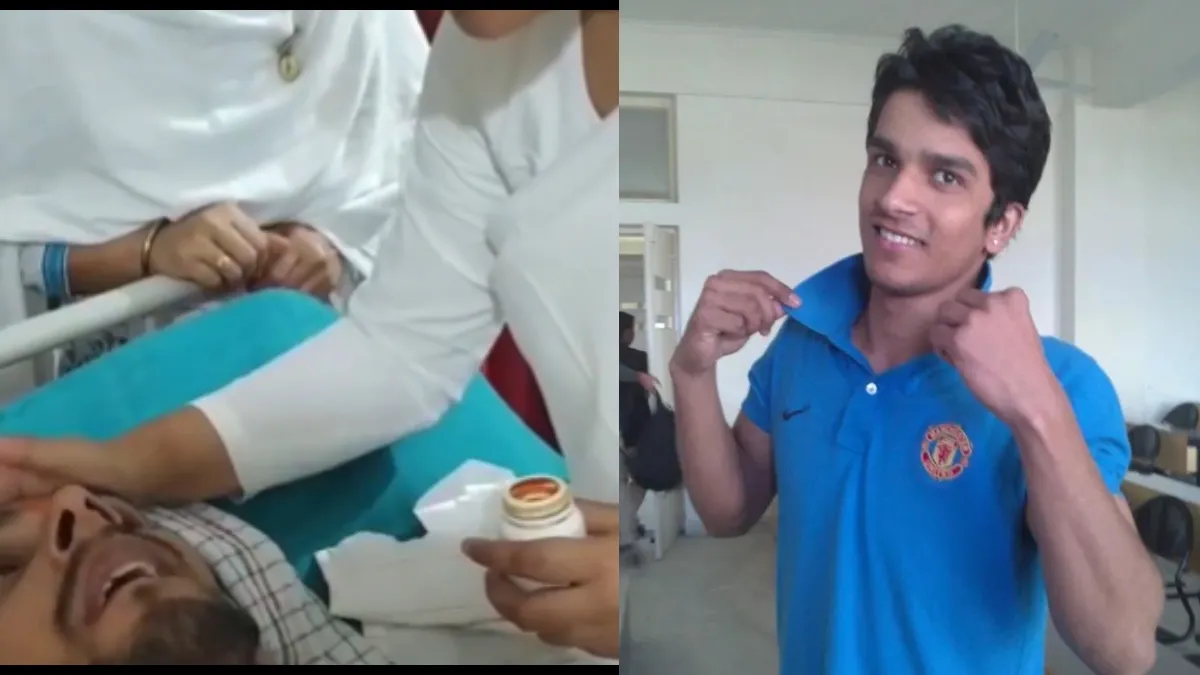
In a deeply emotional moment, the family of 32-year-old Harish Rana, who has been in a permanent vegetative state for 13 years, bid him farewell after the Supreme Court permitted passive euthanasia. Rana was shifted from Ghaziabad to AIIMS Delhi on Saturday following the top court's order. Doctors will now gradually withdraw life support under medical supervision in an effort to end his prolonged suffering.
Passive euthanasia is the intentional act of letting a patient die by withholding or withdrawing life support or the treatment necessary to keep him alive.
Here's the video
A 22-second emotional video that surfaced online shows Rana's family spending their final moments with him. In the video, his mother sits beside him, visibly devastated. A member of the Brahma Kumaris is seen applying a tilak on his forehead while gently speaking to him. "Forgive everyone, apologise to everyone. It's time to go now, okay?" she says while stroking his head.
According to reports, the Rana family has connections with the Brahma Kumaris, a social-spiritual organisation that helped them find legal assistance to pursue the euthanasia plea.
Rana, who was a student of Panjab University, suffered head injuries after falling from the fourth floor of his paying guest accommodation on August 20, 2013 and has been in a coma since.
After years of medical treatment and fading hopes of recovery, Rana's parents approached the Supreme Court seeking permission for passive euthanasia. The court recently allowed the plea, bringing an end to the family's long legal and emotional battle.
India's first case of passive euthanasia
In its first-ever order allowing passive euthanasia, the top court permitted the withdrawal of artificial life support to 32-year-old Rana noting that prospects of his recovery are negligible.
A bench of justices J B Pardiwala and K V Viswanathan of the Supreme Court, who pronounced the landmark judgment for Harish Rana, praised his parents, saying, "To love someone is to care for them not just in times of joy, but in their saddest and darkest hours."
The court added that throughout the adjunction of this matter, they have been gripped by "profound sadness".
"The issues in this matter have once again brought to the fore the fragility and transient nature of the life we live, and how swiftly the tide can turn for the worse. For the past thirteen years, the applicant has lived a life defined by pain and suffering. A suffering made all the more cruel by the fact that, unlike most of us, he was stripped of the ability to even give voice to his anguish.
"However, while this case highlights how unforgiving life can be, it is easy to lose sight of another vital fact. We note with immense respect that the applicant's parents and siblings have stood as unyielding pillars of support.
They have exhausted every effort to care for him and continue to do so with unwavering dedication. We can only place on record our deepest appreciation for their boundless love, endurance, and kindness in the face of such adversity," the bench said.
Also Read: SC allows passive euthanasia for Harish Rana, who is in coma for 13 years, in landmark verdict
