
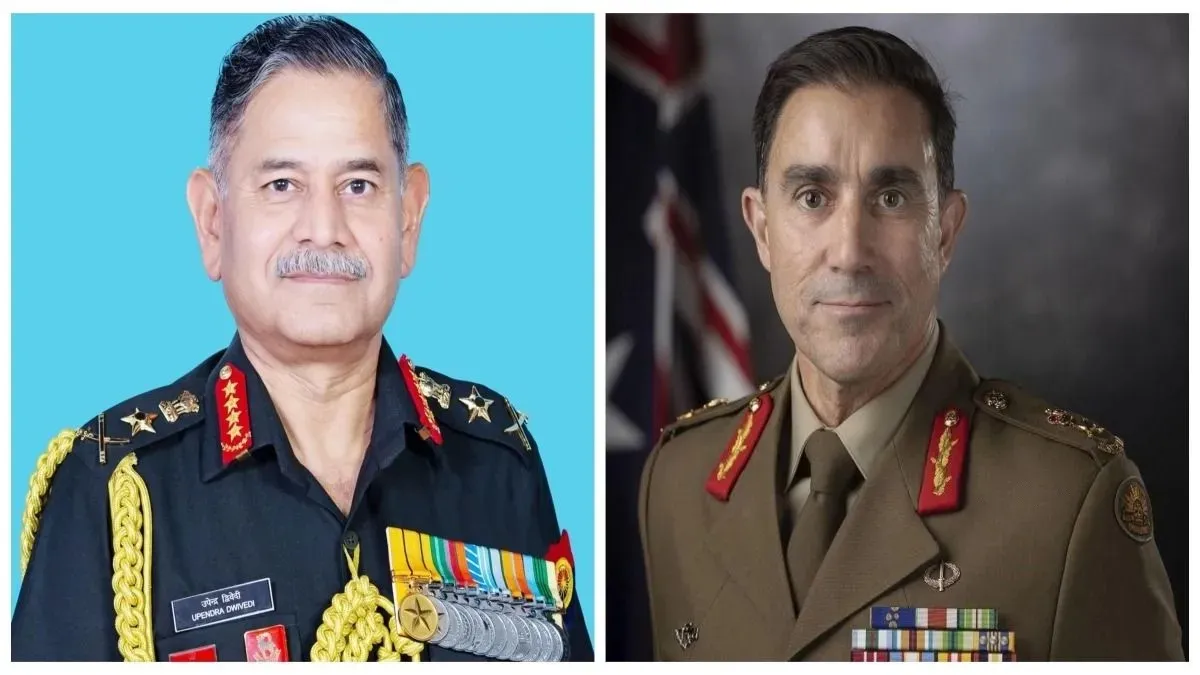
In the world of defence diplomacy, some of the strongest partnerships begin not on the negotiation table, but in the classrooms and barracks of military academies. When officers from friendly nations train together, they gain far more than tactical expertise—they build connections that transcend politics, strategy, and time.
Reunion of commanders: A living example
This enduring bond will be on full display as Lieutenant General Simon Stuart, Chief of Army, Australian Army, visits India from 10–14 August 2025. His visit is more than a formal diplomatic event; it marks a heartfelt reunion with General Upendra Dwivedi, Chief of the Army Staff, Indian Army. Their professional relationship began at the United States Army War College in 2015, where the seeds of cooperation and mutual respect were sown. Over the years, their shared academic experience has blossomed into a foundation of trust and understanding between the two armies—a living testament to the lasting value of alumni networks in defence diplomacy.
India’s alumni network: Building bridges across borders
India’s esteemed military institutions, Indian Military Academy (IMA), National Defence College (NDC), Defence Services Staff College (DSSC), and National Defence Academy (NDA), have a rich tradition of training officers from partner nations. Many of these foreign alumni now lead their own militaries, acting as “ambassadors in uniform” for India’s professional ethos.
- Sri Lanka: 8 senior officers, including current and former Chiefs.
- Nepal: 9 senior officers.
- Bangladesh: 6 senior officers.
- Malaysia: 6 senior officers.
- Bhutan: 2 senior officers.
- Nigeria: 3 senior officers.
- Australia: 2 senior officers.
Notable examples include the Sri Lankan Army Chief, an IMA and School of Artillery alumnus, and the Sri Lankan Chief of Defence Staff, a graduate of NDC. Chiefs and senior commanders from nations as diverse as France, Tanzania, South Korea, New Zealand, Namibia, Kenya, Fiji, and Thailand are part of this global alumni community.
A two-way exchange: Global perspectives for Indian officers
This exchange is reciprocal. Indian officers have themselves trained at prestigious institutions worldwide, from the Army War College in the USA to the Royal College of Defence Studies in the UK and the Ecole de Guerre in France. Field Marshals KM Cariappa and SHFJ Manekshaw, icons of Indian military history, were shaped by their time at the Imperial Defence College, UK. General Upendra Dwivedi’s experience at Army War College, USA, further reflects this tradition.
Such global exposure equips Indian officers with broader strategic perspectives, operational best practices, and an international vocabulary for tackling common security challenges.
Formalising alumni connect: Strategic soft power
Recognising the diplomatic potential of these bonds, the Indian Army has begun to formalise Alumni Connect initiatives. This includes maintaining databases of alumni, organising reunions, and fostering ongoing professional engagement through think tank collaborations- like the Centre for Land Warfare Studies (CLAWS) and its five-year MoU with the Australian Army Research Centre (AARC). Digital platforms such as the “Friends for Life” portal are also being explored to ensure that these relationships remain strong, even as time passes.
From barracks to negotiation tables
In an era marked by complex security challenges where cooperation and competition are delicately balanced, Alumni Connect is more than a sentimental recollection—it is a strategic enabler. Officers who once shared formative training environments are now key decision-makers, guiding joint operations and shaping defence policy. The trust and mutual respect built in fatigues forms the most resilient bridge, facilitating candid dialogue and seamless cooperation.
Enduring influence
As India aims to assume a larger role in regional and global security, from the Indo-Pacific to UN peacekeeping, the quiet but powerful influence of alumni ties will remain central to its military diplomacy. Lieutenant General Stuart’s visit embodies this tradition, weaving personal history into the tapestry of national strategy. In the words of soldiers, trust built in fatigues lasts a lifetime- and in the language of diplomacy, sometimes even longer.
