
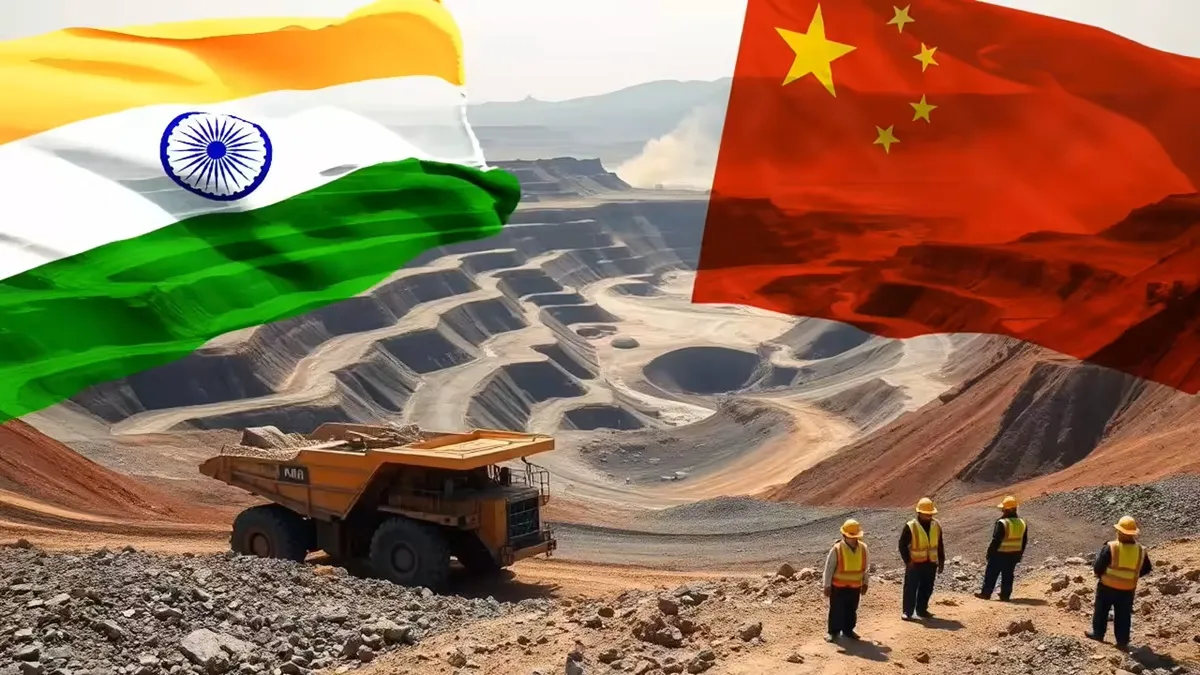
India has announced a Rs 1,345 crore incentive scheme to develop domestic production of rare-earth magnets in a bid to reduce its heavy reliance on China and build a resilient supply chain for strategic and clean-tech industries. The scheme unveiled by the Ministry of Heavy Industries is currently under inter-ministerial consultation and will soon be sent to the Cabinet for final approval.
Rare earth magnets particularly neodymium-iron-boron (NdFeB) types, are vital components in electric vehicle motors, wind turbines, mobile electronics and defence applications. With China currently producing more than 90 per cent of the world's magnets, India's initiative is seen as both an industrial and strategic move to counter supply risks and geopolitical dependencies.
Why this matters now
The timing of India's push comes amid mounting global concern over China's export controls on critical materials. In late 2023, China introduced strict licensing norms for exports of rare-earth elements and finished magnets requiring documentation to ensure non-defence use and non-re-export to countries like the US.
India which imported over 80 per cent of its rare earth magnets from China in 2023-24, has felt the pressure of these curbs. Prices have fluctuated and availability remains uncertain. For a country scaling up its electric mobility, defence modernisation and electronics manufacturing, this reliance has become a serious vulnerability.
What the scheme offers
The Rs 1,345 crore scheme will initially support two selected manufacturers to set up integrated magnet production facilities in India. These units will be eligible for financial incentives covering capital investment and production-linked support.
"We are interested in magnets. Anybody who gives us magnets will get an incentive," said Kamran Rizvi, Secretary, Ministry of Heavy Industries, confirming that the draft policy has been formally circulated for feedback.
The plan targets production of around 4,000 tonnes of neodymium and praseodymium-based magnets over seven years. Local sourcing will be a key condition: companies must use at least 50 per cent domestic raw materials in year one, scaling up to 80 per cent by year five.
Industry lines up to participate
The announcement has drawn immediate interest from leading Indian manufacturers. Mahindra & Mahindra, which is expanding its electric SUV portfolio has expressed interest in setting up or partnering for domestic magnet production. Uno Minda, a major auto components supplier and Sona Comstar, a key EV parts maker are also exploring investments.
Officials indicated that initial bids will cover output of 500 to 1,500 tonnes per annum, with long-term procurement commitments expected from downstream industries such as automotive and electronics.
Sona Comstar was the first company to publicly announce plans to enter the magnet segment while Mahindra is reportedly open to collaborations or joint ventures to secure long-term supply.
India's reserves underused but promising
India holds the world's third-largest reserves of rare-earth elements estimated at 6.9 million tonnes but has explored and processed only a fraction. Less than 20 per cent of this potential has been tapped, largely due to the absence of large-scale refining and magnet-making infrastructure.
To close that gap, the scheme will be implemented in coordination with Indian Rare Earths Ltd (IREL), a PSU under the Department of Atomic Energy. IREL will supply refined neodymium-praseodymium oxides to eligible manufacturers, creating an integrated supply chain from mining to finished magnets.
While imports from Vietnam and Japan will continue in the short term, the long-term focus is on full localisation.
Global backdrop and strategic stakes
Rare-earth magnets are not just industrial components they are critical to energy transition, digital infrastructure and military capability. India's move mirrors a global push by countries like the US, Japan and the EU to reduce their exposure to Chinese dominance in critical minerals.
China has previously restricted exports of gallium, germanium and graphite materials widely used in semiconductors and EVs citing national security concerns. These actions have been seen as responses to Western curbs on Chinese access to advanced chipmaking technologies.
India's scheme is part of a broader plan to invest Rs 3,500 - Rs 5,000 crore over the coming years to develop domestic capabilities in rare earths and other high-value materials.
