
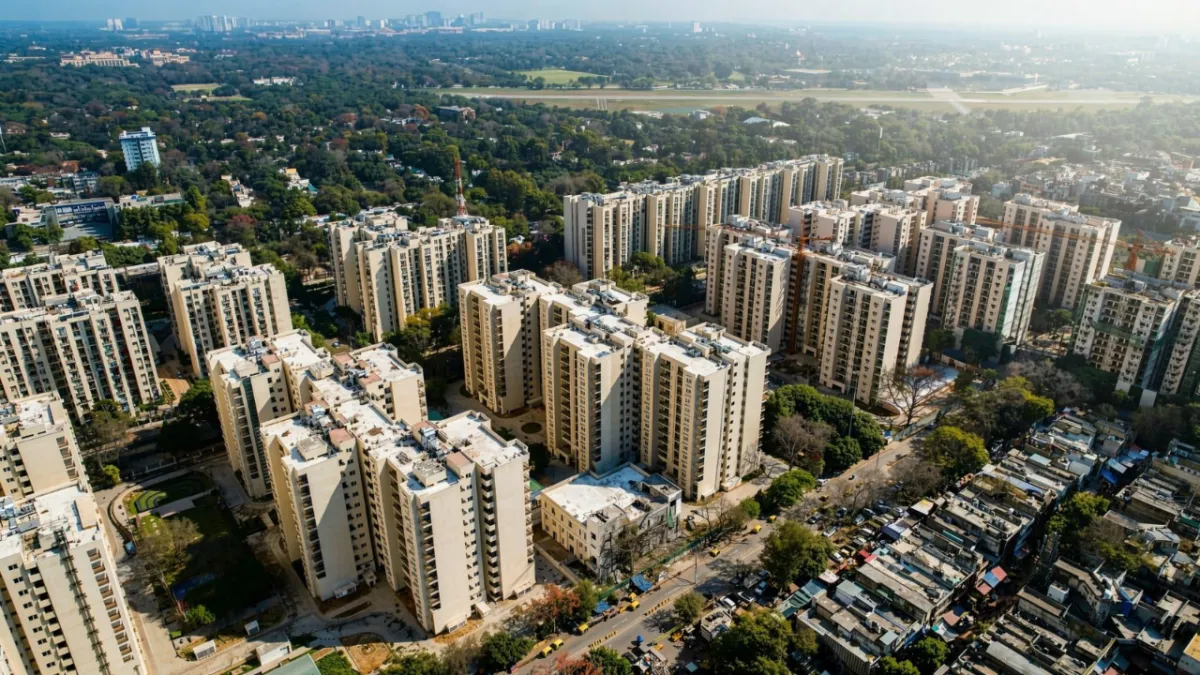
The Government of India is redeveloping seven ageing government housing colonies in Delhi under a self-financing model that does not require funding from the public exchequer.
The redevelopment project covers Sarojini Nagar, Netaji Nagar, Nauroji Nagar, Kasturba Nagar, Thyagraj Nagar, Sriniwaspuri and Mohammadpur, spread across about 537 acres in the national capital.'
Rebuilding homes for central government employees
Many of the existing residential quarters in these colonies had become old and structurally unsafe over time, with nearly 40 per cent declared uninhabitable. At the same time, the government has faced a shortage of more than 20,000 homes for central government employees.
The project is being implemented by the Central Public Works Department (CPWD) under the Ministry of Housing and Urban Affairs. It aims to replace decades old low rise government quarters with modern high-rise residential complexes equipped with improved infrastructure and amenities.
Many of the existing quarters in these colonies were built between the 1950s and 1970s and had become structurally weak and outdated. The government simultaneously faced a shortage of more than 20,000 houses for central government employees in Delhi.
Under the redevelopment plan, the old quarters will be demolished and replaced with modern apartment complexes, increasing the housing capacity significantly. The new development is expected to provide more than 21,000 residential units for government staff.
On March 8, Prime Minister Narendra Modi will inaugurate 2,722 newly built flats and lay the foundation stone for 6,632 additional flats under the General Pool Residential Accommodation redevelopment plan across Sarojini Nagar, Netaji Nagar, Kasturba Nagar and Sriniwaspuri.

A self-sustaining model
The project has been designed with a self-sustaining financial model.
Instead of using taxpayer funds, the government plans to develop and monetise a small portion of land, about 69.41 acres or 12.9 per cent of the total project area, for commercial and residential use.
Revenue generated from this limited land monetisation is expected to exceed Rs 35,100 crore, which will cover the estimated redevelopment cost of around ₹32,800 crore.
According to the government, the model ensures that the entire project will be completed without burdening the government budget, while also creating the potential to generate a surplus of more than Rs 2,300 crore.
Apart from housing, the redeveloped colonies will include supporting urban infrastructure such as schools, healthcare facilities, commercial areas, community centres, parking spaces and green areas. The plan also includes improved road connectivity, better drainage systems and upgraded water and power supply networks.
Also read: Are home buyer preferences reshaping housing in 2026? Find out here