
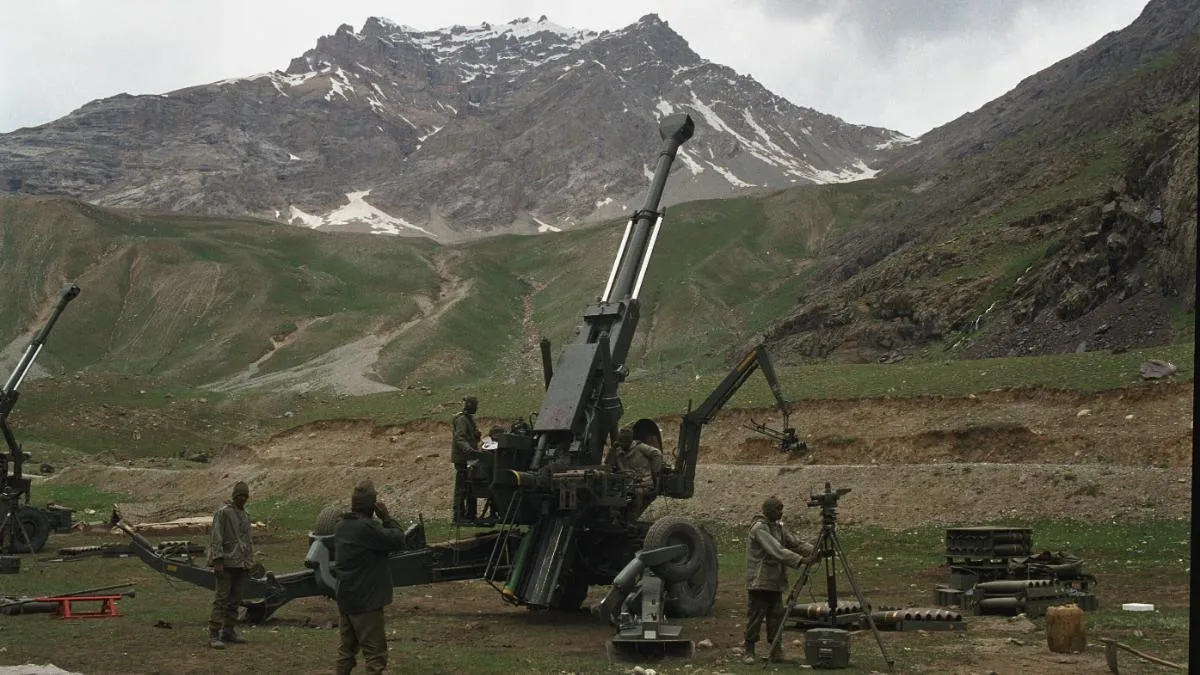
The Kargil War, fought between May and July 1999, remains a historic chapter in India’s military legacy — a tale of grit, sacrifice, and strategic brilliance. Triggered by Pakistan’s incursion into Indian territory in the treacherous heights of the Himalayas, the war saw Indian forces recapture key peaks and assert control along the Line of Control (LoC). While the bravery of Indian soldiers played a defining role in this victory, a handful of key weapons also proved decisive on the battlefield.
Weapons that turned the tide in Kargil
1. Bofors FH-77B Howitzer:
The Swedish-made 155mm Bofors artillery gun was the undisputed hero of Kargil. Capable of firing up to 27 km at steep angles, it pounded Pakistani positions at Tololing, Tiger Hill, and Point 4875 with deadly accuracy. Its rapid fire rate helped Indian forces neutralize enemy bunkers in high-altitude terrain.
2. Mirage-2000 Fighter Jet:
The Indian Air Force’s Mirage-2000 aircraft proved a game-changer under ‘Operation Safed Sagar’. Equipped with Israeli laser-guided bombs, these jets carried out pinpoint strikes on enemy hideouts in mountainous areas, breaking the enemy’s morale and supply lines.
3. SAF Carbine and AK-47:
In close-quarter combat, especially on rocky ridges, Indian soldiers relied on lightweight, rapid-fire SAF carbines and the rugged AK-47 rifles. These weapons were instrumental during hand-to-hand engagements in harsh terrain.
4. Mortars and Rocket Launchers:
Over 250,000 artillery shells and 5,000 bombs were fired during the war. Mortars and multi-barrel rocket launchers supported infantry advances by softening enemy defenses in elevated positions.
5. Israeli Support:
Israel assisted India with critical supplies like laser-guided munitions, UAVs such as the Heron drone, and essential ammunition — a support that played a pivotal role in intelligence gathering and precision strikes.
The evolution of Indian firepower
Twenty-six years later, India’s military arsenal has undergone a transformation. Post-Kargil, modernization became a top priority, with a focus on self-reliance and next-gen warfare. Here’s how today’s weapons compare to those from 1999:
Artillery Upgrade
- Dhanush Howitzer: Indigenous upgrade of Bofors, with a 38 km range and digital fire control.
- M777 Ultra-Light Howitzers: Airlifted to high altitudes, ideal for mountain warfare.
- K9 Vajra: A self-propelled howitzer with a 50 km range and automated systems.
Advanced Fighter Fleet
- Rafale Jets: Armed with Meteor and SCALP missiles, superior to Mirage-2000.
- Tejas Mk-1A: Indigenous light combat aircraft with modern avionics and high-altitude capability.
- Drones: Heron TP, Rustom-2, and SWITCH UAVs now offer real-time surveillance and precision strikes.
Small Arms Modernization
- SIG Sauer Rifles: Replacing legacy rifles with greater accuracy and durability.
- M4A1 Carbines: Night-vision equipped, used in special ops.
- ASMI Machine Pistol: An Indian-developed lightweight weapon for close combat.
Missiles and Rocket Systems
- Pinaka MBRL: Indigenous system with 75 km range, replacing older rocket tech.
- BrahMos Cruise Missile: World's fastest supersonic missile with 400 km range, vital in 'Operation Sindoor'.
- Akash Missile: Key air-defense system in India’s layered shield.
Intelligence & Communication
- Advanced Drones & Satellites: For surveillance and high-altitude intelligence.
- Network-Centric Warfare: Enabling digital, cyber-integrated command systems.
Lessons and legacy
The Kargil War taught India the importance of surveillance, high-altitude combat readiness, and rapid modernization. The K. Subrahmanyam Committee post-Kargil recommended overhauls in intelligence, weapon systems, and military coordination. Two decades later, India has not only upgraded its hardware but is also moving toward indigenous, tech-driven defense capabilities.
Today, weapons like Rafale, BrahMos, and Dhanush symbolize a more self-reliant and strategically advanced India — far stronger than it was in 1999.
