
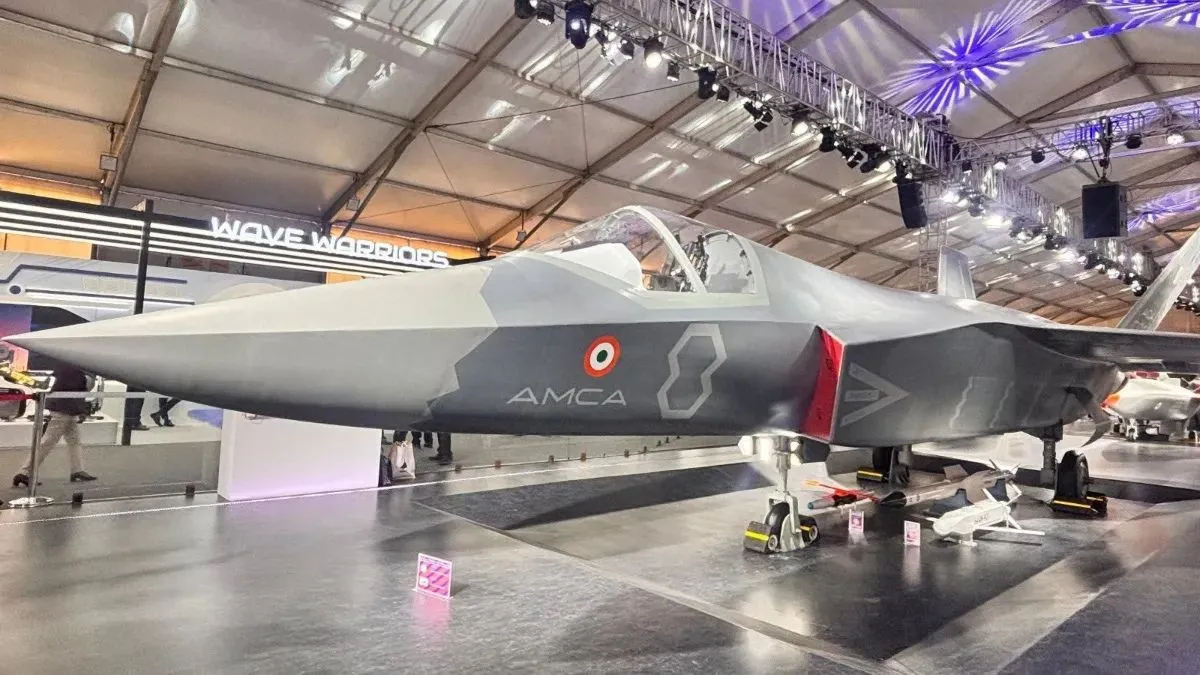
India has shortlisted three major private sector companies—Tata Group, Larsen & Toubro (L&T), and Bharat Forge—to develop the country’s fifth-generation fighter jet under the Advanced Multirole Combat Aircraft (AMCA) programme, according to reports.
State-run aerospace major Hindustan Aeronautics Limited (HAL) has been excluded from the project, marking a significant shift toward private sector leadership in one of India’s most ambitious defence initiatives.
The shortlisted firms are expected to submit their detailed technical and commercial proposals within the next three months, after which one company will be selected as the lead integrator for the programme.
The selected entity will work in tandem with Aeronautical Development Agency (ADA) of the DRDO to push the project through.
The government has already earmarked Rs 15,000 crore for the development and construction of AMCA prototypes. However, the overall project cost is expected to be substantially higher as the programme moves into full-scale production.
In the initial phase, the Indian Air Force plans to induct around 120 AMCA fighter jets.
As outlined in the proposal, the prototypes were planned to be developed by 2030, with the induction of the first AMCA squadron into the Indian Air Force targeted for 2035.
About the proposed fighter jet
The Advanced Medium Combat Aircraft (AMCA) is India’s indigenous fifth-generation stealth fighter, designed to deliver advanced air dominance and deep-strike capabilities. Built with a low-observable airframe, internal weapons bays, and radar-absorbent materials, AMCA emphasises reduced radar signature and high survivability in contested airspace.
The aircraft is planned to feature supercruise capability, advanced avionics with sensor fusion, an AESA radar, and integrated electronic warfare systems for superior situational awareness.
Designed for multirole operations, AMCA will support air-to-air combat, precision ground attack, and network-centric warfare. High maneuverability, advanced flight control systems, and next-generation propulsion are central to its performance goals.
