
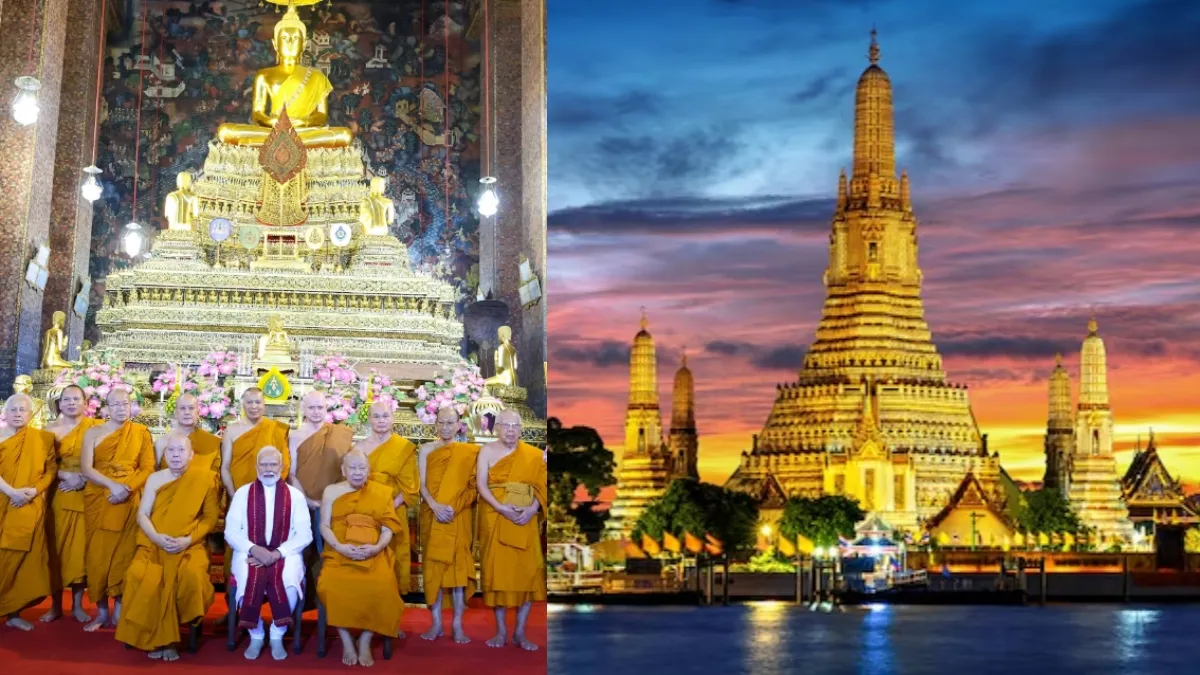
Prime Minister Shri Narendra Modi, accompanied by the Prime Minister of Thailand, Paetongtarn Shinawatra, visited Wat Phra Chetuphon Wimon Mangkhalaram Rajwaramahawihan, popularly known as Wat Pho, on April 4. The Prime Minister paid homage to the Reclining Buddha and offered ‘Sanghadana’ to senior Buddhist monks. The Prime Minister also presented a replica of the Ashokan Lion Capitol to the shrine of the Reclining Buddha.
Wat Pho is situated in the centre of Bangkok's old town district, on the riverbanks of the Chao Phraya River. It is among the oldest and largest temples in Bangkok, covering 20 acres of land. The temple compound contains many decorative buildings, magnificent statues, and lovely gardens, which make it a sight to see.
The History Behind Wat Pho
Wat Pho was constructed in the 16th century under the rule of King Rama I. It had initially been referred to as Wat Photaram and was used as a school as well as for traditional Thai medicine. The subsequent kings expanded the temple and made improvements, and King Rama III added buildings and sculptures to the complex.
One of the most striking aspects of Wat Pho is the giant reclining Buddha statue that stands at 46 meters in length and 15 meters in height. This statue was constructed during King Rama III's reign and is gilded with gold leaf, hence the splendor. The reclining Buddha symbolises Buddha's entrance into Nirvana, a state of supreme enlightenment.
Significance of Wat Pho Temple
Wat Pho is of immense importance to locals and tourists alike. Locals consider it a temple of worship and a hub for traditional medicine. The temple contains a vast repository of traditional Thai medicines and herbs, which are even used by monks for healing.
Additionally, Wat Pho is also referred to as the origin of ancient Thai massage. The temple provides massage courses for individuals who are interested in mastering this ancient healing technique. Several tourists visit Wat Pho for a traditional Thai massage, which is said to enhance blood flow, reduce stress and improve overall well-being.
Visiting the temple complex
Wat Pho is open every day from 8:00 AM to 6:30 PM, and foreigners pay an entrance fee of 300 baht (approximately $9.50). Modest clothing is necessary to enter the temple, so dress accordingly and cover your shoulders and knees. If you are not wearing proper clothing, you can rent a sarong at the entrance for a nominal fee.
One must remove their footwear before entering the temple as an act of respect. Around the statue, one finds 108 bronze bowls symbolising the 108 auspicious characters of Buddha. When you put a coin in each bowl, it is said to bring you prosperity and good fortune.
In addition to the reclining Buddha, Wat Pho also contains over 1,000 images of Buddha, which is one of Thailand's largest collections. The posture and facial expression of each image vary, symbolizing distinct periods of Buddha's life.
ALSO READ: Active volcanos to no personal tax; facts about Vanuatu, whose citizenship Lalit Modi has taken
