
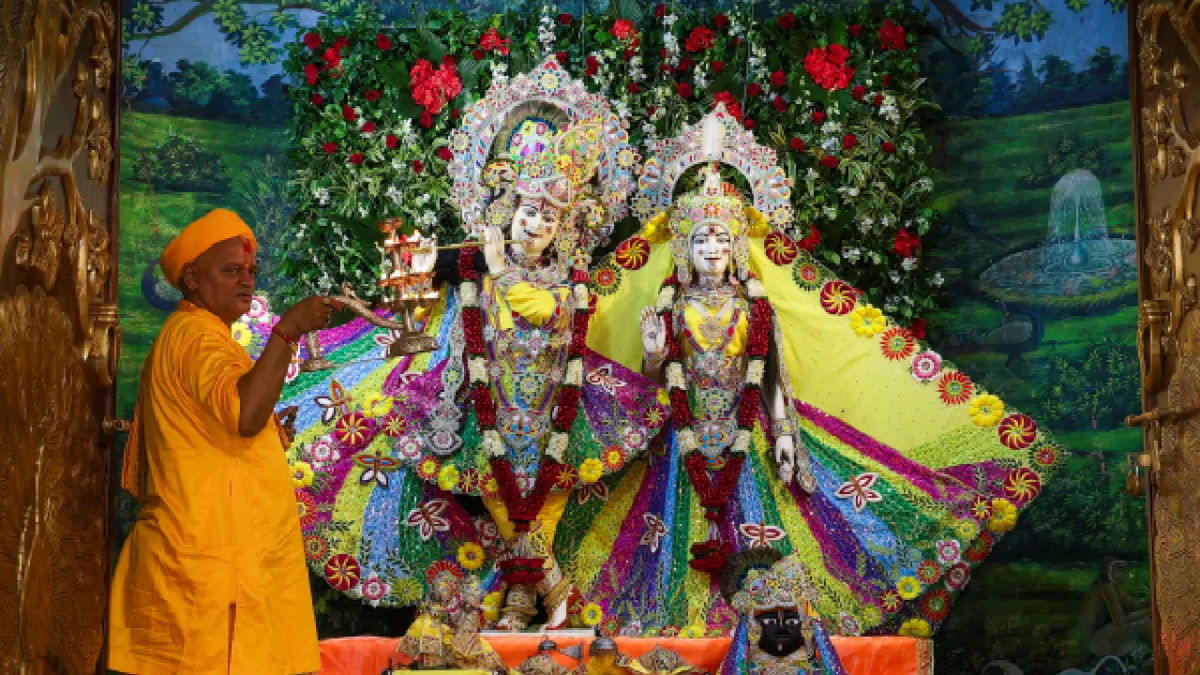
Festivals keep our ancient Itihasa alive. Until recently, it was common for celebrations in Bhartiya households to involve reading, “katha”, a story that brought to life the journey of many remarkable figures.
Krishna is one such person whose stories still resonate in every household. Beyond black and white, Krishna thrives in the Grey. Playful yet profound, his leela continues to inspire generation after generation. This Janmashtami, we look at some deeper truths reflected in various aspects of Krishna’s life.
Is Krishna's Raas Leela A Dance Party?
Krishna is widely known for his Raas Leela, but there are many misconceptions about what it truly means. Some imagine Raas Leela as nothing more than a dance party, perhaps even the ancient equivalent of clubbing or a discotheque.
Sadhguru unravels the deeper essence of Krishna’s Raas Leela. He describes: “The word Raas literally means ‘Juice.’ The biggest problem with people in their life is, they don’t have juice, they have hormones…So, raas means the juice of life. Not of the body, but of life. Because the body's juices will vary. It will fluctuate from time to time. But he’s talking about the juice of life.“
But what about the dance that happened on the bank of the Yamuna river in Braj? Sadhguru explains, “So the dance that happened on full moon night was referred to as ‘Raas’. Because this dripped of life. This is not a hormonal party in the night. This is not a party of drunkards. This is not a party of lustful people. This is a party of people who are dripping with life – the ecstasy of life. So this was referred to as the raas.”
Seen in this light, Raas Leela becomes a metaphor for spiritual exuberance- a reminder that joy at its peak is not about indulgence, but about transcendence.
Krishna’s Brahmacharya
Seen narrowly, Krishna can be mistaken for just a romantic figure. Yet, at sixteen, after meeting his guru Sandipani, his life took a turn as Krishna took up Brahmacharya.
Sadhguru notes, “When we say Krishna, most people only think of butter, girls and flute. But we must understand that his butter business was only till he was six or eight years of age. And all his girl business was only till he was sixteen years of age. At the age of sixteen when his guru Sandipani made him realize what is the purpose of his life, first of all, he left Vrindavan, never again came back to see any of his relatives, or the girls or boys of his area. That was the end of it.”
“From sixteen to twenty-one, he lived as a brahmachari, he took sanyas, went through severe sadhana. After that, his entire life was committed to marry political life… political process and the spiritual process.”
Krishna’s discipline during this period reveals another side of him- the ability to step away from personal attachments for a larger purpose.
What about Radha?
Sadhguru also sheds light on Krishna’s bond with his beloved Radhe, how her very name became synonymous with his.
“Today if we say Krishna, we say Radhe Krishna. Radhe comes ahead of Krishna because their love, their intimacy, their romance caught the imagination of a whole culture in the entire subcontinent in such a way that we don’t say Krishna Radhe, we say Radhe Krishna.”
Krishna’s Last Conversation with Radha
Sadhguru also shares anecdotes of one of his last conversations with Radha, saying, “At the age of sixteen when he was leaving, he said, ‘I played this flute for you, now I’m going and not coming back. So as an offering to you, for the love that you are, I’m going to give this flute to you and never again play the flute again.’ And he never again played the flute. From then on it was Radha who played the flute.”
In this, Krishna embodies vairagya- the strength to part from what is dearest, in service of a greater mission.
Why is Krishna depicted as blue-skinned?
Like many Hindu deities, Krishna is often depicted with blue skin. This naturally raises a question: how could a human being be blue in colour? What kind of pigmentation could make this possible? Sadhguru unravels the mystery behind Krishna’s blue hue.
He says, “Blue is the color of all-inclusiveness. You will see in existence, anything that is vast and beyond your perception generally tends to be blue, whether it is the ocean or the sky…It is based on this that so many gods in India are shown as blue-skinned. Shiva has blue skin, Krishna has a blue skin, Rama has a blue skin. It is not that their skin was blue. They were referred to as blue gods because they had a blue aura.
He further explains, “Krishna being blue-bodied need not necessarily mean his skin color was blue. Maybe he was dark-skinned, but people who were aware saw the blueness of his energy, so they described him as blue. There are many disputes about who Krishna is and what he is but his all-inclusiveness is one thing that no one can deny. So the theme of blue remained common, and in every corner of the country, Krishna is seen as blue.”
Across every phase of his life, Krishna showed that joy, love and discipline can exist in perfect balance. These stories, and the deeper truths they hold, continue to guide us, reminding us that life’s highest beauty lies in living fully. As Sadhguru’s insights reveal, Krishna was not just a figure of devotion, but a timeless blueprint for how to be utterly human and utterly divine.
Written by Pritesh Kamath
