
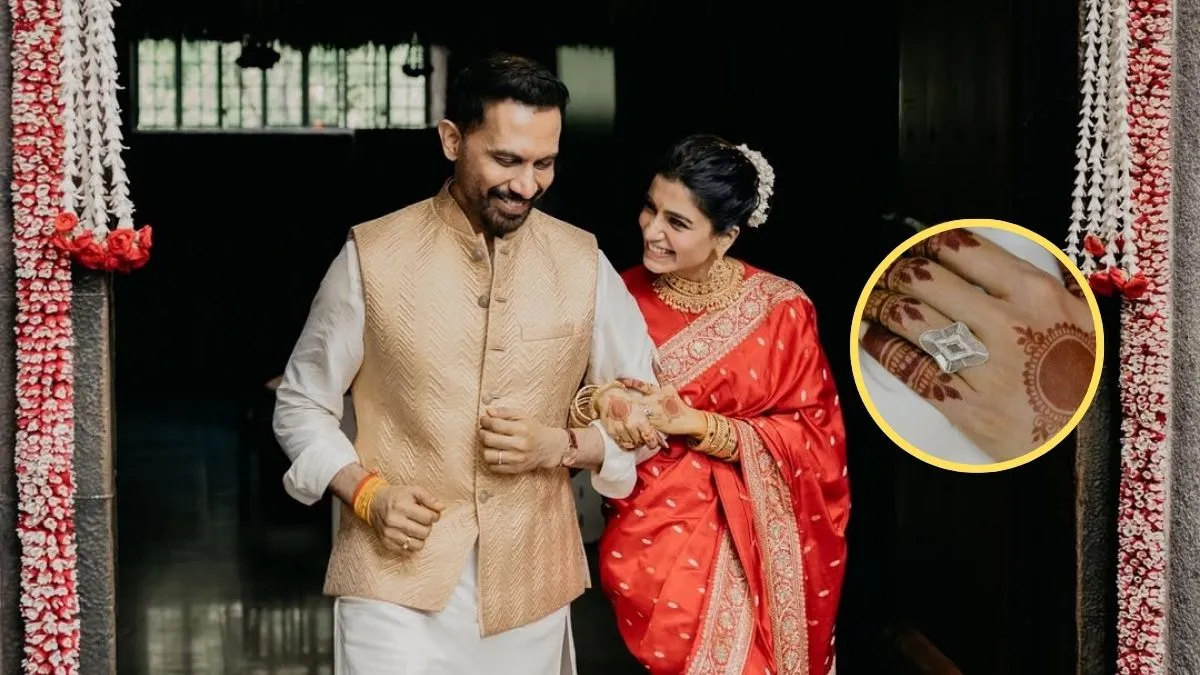
Samantha Ruth Prabhu’s wedding to filmmaker Raj Nidimoru took place not in a palace or ballroom, but at the Linga Bhairavi Temple within the Isha Yoga Centre, a choice that signalled privacy, stillness, and a certain disregard for spectacle. Only a small circle of thirty guests attended, enough to witness but not overwhelm.
In this setting, jewellery became not a social signal, but a private vocabulary, quiet, deliberate, and deeply personal. Samantha's wedding ring has caught everyone's attention for all the right reasons. This ring is surely as unique as Sam herself!
Samatha's wedding ring: Theatre without theatrics
At first glance, her wedding ring resists the usual engagement tropes. It is large, yes, but not loud; its presence is architectural rather than ornamental. The diamond, sizable, emerald-like in silhouette, sits in a sculptural, contemporary setting that favours geometry over tradition. It belongs to an academy of stones that are engineered not merely for brilliance, but for form, posture and personality.
As per Celebrity Jewellery Expert, Priyanshu Goel's Instagram story, "The centre is a lozenge portrait-cut diamond of around 2 ct, and around it sit eight custom portrait-cut diamonds shaped like petals. It looks effortless on her hand, but the engineering behind it is extremely complex. Only a few workshops in the world cut and assemble portrait diamonds at this level."
The jeweller rumoured behind the stone
Celebrity fashion page, Diet Sabya, Samantha's ring is from Theodora, a Greek jeweller known for his one-of-a-kind pieces and near-cult secrecy. His work, often seen only on select clients or in the privacy of trunk shows, is described as gem-centric, contemporary and slightly provocative, the kind of artistry that seduces the individual rather than the audience. Whether the ring was indeed created by him remains unconfirmed, but the aesthetics line up with his coded signature:
Big stones, minimal fuss, absolute confidence.
Gold that remembers its history
The rest of the bridal jewellery leaned into heritage rather than innovation, with layered gold necklaces, traditional bangles, and temple-style motifs. Against a vivid red saree, they didn’t shout so much as glow with cultural memory. South Indian bridal gold has always celebrated richness, but here it was tempered by spiritual sobriety; this wasn’t the gold of opulence, but of continuity.
The contrast between the avant-garde diamond and the classical metalwork did not clash. It conversed elegantly. The ring spoke of the future, the gold honoured the past.
The overall effect was a study in duality, tradition without theatricality, luxury without ostentation, individuality without rebellion. The bride chose jewellery that did not prove wealth, but expressed taste. The ring, especially, rejected the predictable grammar of celebrity engagement pieces. It wasn’t designed to trend; it was designed to endure.
In an industry increasingly obsessed with visibility, her jewellery offered a more nuanced philosophy of luxury: one that prioritises craft, intention and emotional resonance over surface dazzle.
