
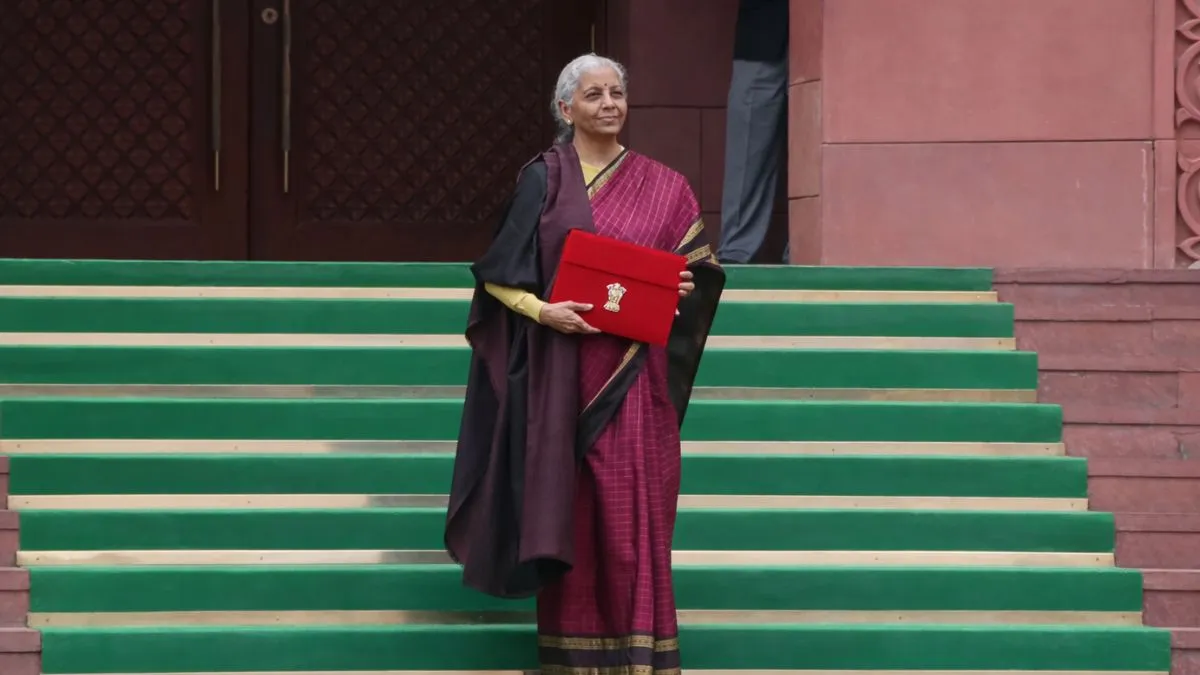
On the morning of her ninth consecutive Union Budget presentation, Union Finance Minister Nirmala Sitharaman arrived at Kartavya Bhavan draped in a handwoven Kanchipuram silk saree. The saree reads as a deep maroon–burgundy base, with a subtle checkered weave running through it. The border and pallu are darker, almost plum or wine-toned, which gives it that elegant, serious-but-stately vibe.
With this saree, Nirmala paid tribute to Tamil Nadu’s timeless weaving legacy. Let's decode the Kanchipuram look.
Kanchipuram saree chosen for the moment, not the spotlight
The deep maroon Kanchipuram silk was rich but restrained; its real appeal is in the texture and craft rather than flair. On a day defined by policy, accountability and long-term vision, the saree felt less like attire and more like an extension of the occasion, dignified, serious, and enduring.
Sitharaman’s Budget Day looks have never leaned towards spectacle. Instead, they follow a consistent language of respect for institutions, for craft, and for the communities behind India’s textiles.
The legacy of Kanchipuram silk

Woven in Tamil Nadu for over four centuries, Kanchipuram silk sarees are among India’s most revered handloom traditions. Known for their high-quality mulberry silk, real zari borders and architectural motifs, these sarees are traditionally worn during milestones, weddings, ceremonies, and moments of collective importance. Temple-inspired patterns, checks, and contrasting borders are cultural markers, reflecting the region’s history, faith, and artistic vocabulary. To wear a Kanchipuram saree is to wear a textile shaped by time.
Kanchipuram and Kanchivaram are often used interchangeably, and in practice, they refer to the same silk saree tradition. Kanchipuram is the formal, geographical name derived from the temple town in Tamil Nadu where the sarees are traditionally woven, while Kanchivaram (also spelled Kanjeevaram) is the more commonly used, commercial term that gained popularity through retailers and everyday usage. The weaving technique, silk quality, and zari craftsmanship remain identical in both—pure mulberry silk, rich gold-toned zari, and distinctive contrasting borders, making the difference one of nomenclature rather than design or authenticity.
Nirmala Sitharaman's personal connection to Tamil Nadu
For Sitharaman, there was also a personal connection to the choice. Tamil Nadu is her home state, and Kanchipuram silk sarees are one of the most identifiable cultural contributions that the state has made to the rest of India. Sitharaman’s decision to wear a handwoven saree from the region was to ground a national moment is noteworthy.
Over the years, Sitharaman’s Budget Day wardrobe has quietly evolved into a form of textile storytelling. Each saree has highlighted a different region, craft, or weaving tradition, offering consistent visibility to India’s handloom ecosystem without turning it into a performance. There is intention, but no exhibitionism. The clothes never overshadow the occasion; they accompany it. In a political landscape where clothing is often scrutinised for symbolism, Sitharaman’s sartorial choices remain steady in their restraint. The Kanchipuram saree did not compete with the speech or the setting.
Also read: Nirmala Sitharaman’s saree choices across nine Budgets celebrate Indian textile traditions