
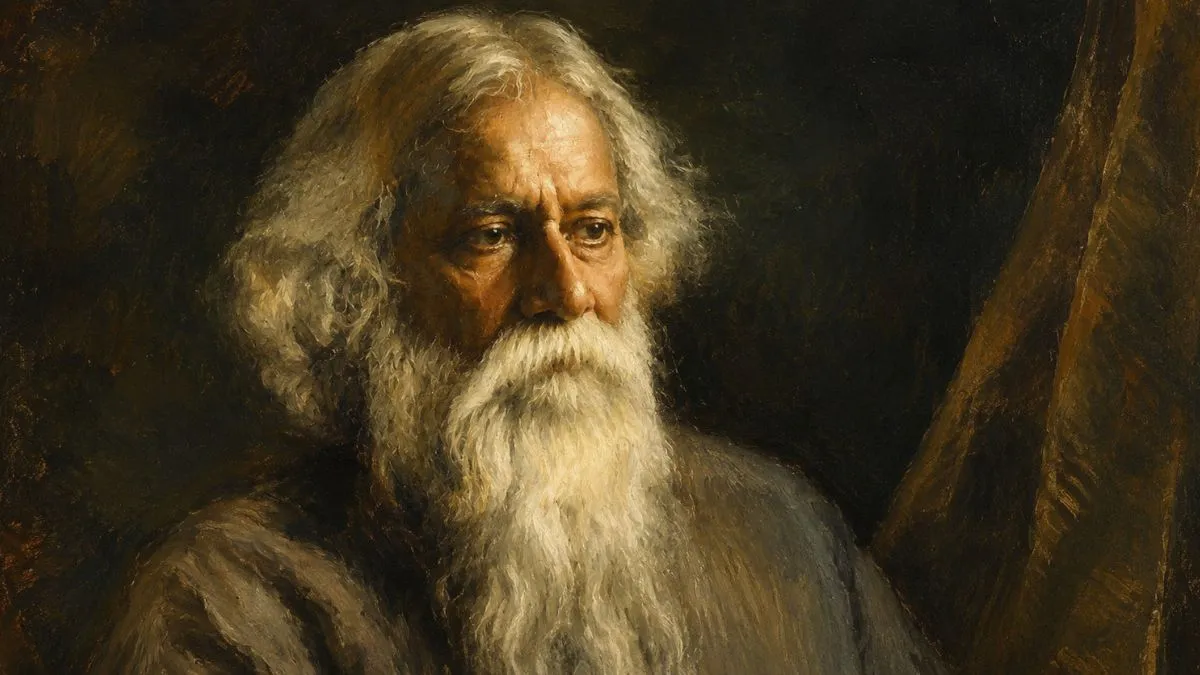
Every year, the birth anniversary of Rabindranath Tagore is observed with music, poetry recitals and cultural programmes across India. Schools organise performances, literature lovers revisit his writings and Bengali households often spend the day immersed in Rabindra Sangeet. The celebrations feel quiet in some places. Grand in others. But they always carry emotion.
What confuses many people, though, is the date itself. Some celebrate Rabindra Jayanti on May 7, while many in West Bengal and the Bengali diaspora mark it on “Pochishe Boishakh”. In 2026, that falls on May 9. So naturally, people keep asking the same question every year. Why are there two separate dates for the same celebration?
Why Rabindranath Tagore’s birth anniversary is observed on two dates
The reason lies in the use of two different calendar systems.
According to the Gregorian calendar, Rabindranath Tagore was born on May 7, 1861 at the Jorasanko mansion in Calcutta, now Kolkata. Because of this, the Government of India, educational institutions outside Bengal and many international organisations officially observe his birth anniversary on May 7 every year.
However, the traditional Bengali calendar tells the story differently.
In the Bengali almanack, Tagore was born on the 25th day of Boishakh, the first month of the Bengali calendar. This day is known culturally as “Pochishe Boishakh”, which literally translates to the 25th of Boishakh.
That is why Bengal and Bangladeshi communities often prioritise the Bengali calendar date over the Gregorian one.
Why Pochishe Boishakh falls on May 9 in 2026
Unlike the English calendar, the Bengali calendar follows solar cycles. Because of this, dates do not align perfectly every year.
Pohela Boishakh, which marks the Bengali New Year, usually falls on either April 14 or 15 in the Gregorian calendar. Since the starting point shifts slightly, the 25th day of Boishakh also changes when converted into English calendar dates.
In 2026, Pohela Boishakh was celebrated on April 15. Counting 25 days forward places Pochishe Boishakh on May 9 this year.
As a result, most large-scale Rabindra Jayanti celebrations in West Bengal, Tripura and Bangladesh are taking place on May 9.
Cultural events including poetry readings, musical performances and dance tributes are also expected to peak on this date.
Rabindranath Tagore Jayanti 2026 dates
In 2026, the 165th birth anniversary of Rabindranath Tagore is being observed on:
- May 7 according to the Gregorian calendar
- May 9 according to the Bengali calendar’s Pochishe Boishakh observance
Why Pochishe Boishakh holds deep cultural importance
Rabindra Jayanti is not viewed merely as a birthday celebration in Bengali culture. For many people, it represents literature, art, music and a larger cultural identity shaped deeply by Tagore’s work.
Fondly called “Gurudev” and “Kabiguru”, Tagore transformed Bengali literature and artistic expression during the late 19th and early 20th centuries.
Some of his most influential contributions include:
- Rabindra Sangeet, a collection of more than 2,000 songs still deeply woven into Bengali life
- Writing the national anthems of both India and Bangladesh
- “Gitanjali”, the poetry collection that earned him the Nobel Prize in Literature in 1913
- Founding Visva-Bharati University in Santiniketan, an institution that challenged colonial approaches to education
Even though the dates differ, the feeling behind the celebration remains exactly the same. Whether people marked the occasion on May 7 or are celebrating Pochishe Boishakh on May 9, the day continues to honour Tagore’s ideas around creativity, humanism and intellectual freedom.
