
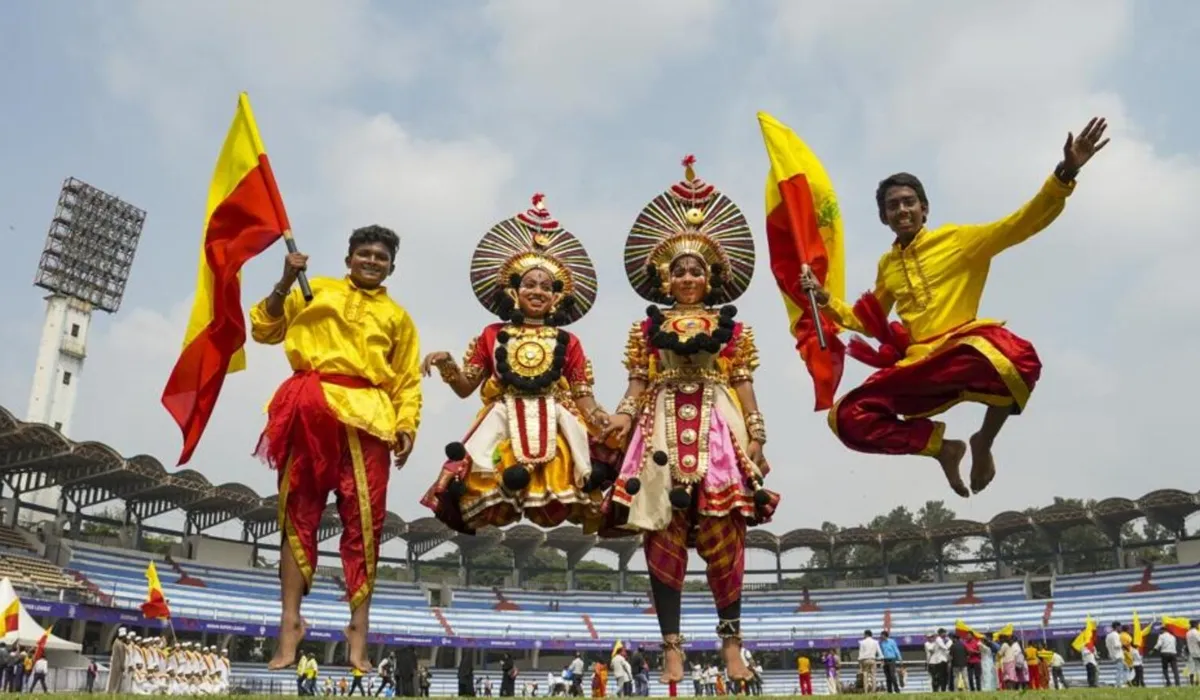
As Karnataka celebrates Rajyotsava Day, it is also a moment to reflect on the identity of its people — the Kannadigas. The term “Kannadiga” refers to those who speak Kannada, one of India’s oldest living languages and the cultural heartbeat of Karnataka. Rooted in history, language, and pride, this identity has evolved over centuries of rich political, literary, and artistic legacy.
The origins of Kannadiga identity
Kannada, a Dravidian language, traces its origins back over 2,000 years. Early inscriptions, such as the Halmidi inscription (c. 450 CE), provide the first written evidence of the language. Over time, Kannada developed a sophisticated script and an extensive body of literature that earned it recognition as a Classical Language of India.
The people who spoke this language naturally came to be called Kannadigas, unified by their tongue and shared cultural practices long before political boundaries existed. Historically, Kannada-speaking regions were scattered across various kingdoms — the Kadambas, Gangas, Chalukyas, Rashtrakutas, Hoysalas, and Vijayanagara Empire — each contributing to the growth of Kannada art, architecture, and governance.
The formation of modern Karnataka
For centuries, Kannada-speaking regions remained divided under different rulers and British presidencies. It was only on November 1, 1956, through the States Reorganisation Act, that these regions were merged to form the state of Karnataka (then called Mysore State). This linguistic unification marked the birth of a modern Kannadiga identity, celebrated every year as Karnataka Rajyotsava.
The day is not just about geography — it symbolises the pride, unity, and shared culture of more than 70 million Kannadigas around the world.
The roots of culture and tradition
Kannadigas take immense pride in their diverse heritage — from the classical literature of Pampa and Ranna, to Carnatic music legends like Gangubai Hangal and Mysore Vasudevachar, and the enduring influence of Kuvempu’s universal humanism.
Cultural symbols like Yakshagana, Dollu Kunitha, and Kambala reflect the vibrancy of Karnataka’s folk traditions. The red and yellow Kannada flag, hoisted proudly on Rajyotsava Day, stands as a mark of linguistic unity and regional pride.
Interesting facts about Kannadigas
- Kannada is among the oldest Dravidian languages, predating Tamil and Telugu in inscriptional history.
- Karnataka is home to seven Jnanpith Award winners, the highest for any Indian state.
- The Vijayanagara Empire made Kannada and Sanskrit twin languages of administration and culture.
- The state anthem, “Jaya Bharata Jananiya Tanujate,” penned by Kuvempu, embodies the essence of being a Kannadiga — proud, inclusive, and deeply rooted in Indian identity.
A living legacy
Today, being a Kannadiga is about more than language — it is about belonging to a civilisation that values art, innovation, tolerance, and intellect. As Karnataka marks another Rajyotsava, the celebration is as much about the past as it is about the promise of the future — a state and a people who continue to embody the spirit of “Elladaru Iru, Enthadaru Iru, Endendigu Nee Kannadavagiru” — Wherever you are, however you are, forever be a Kannadiga.
