
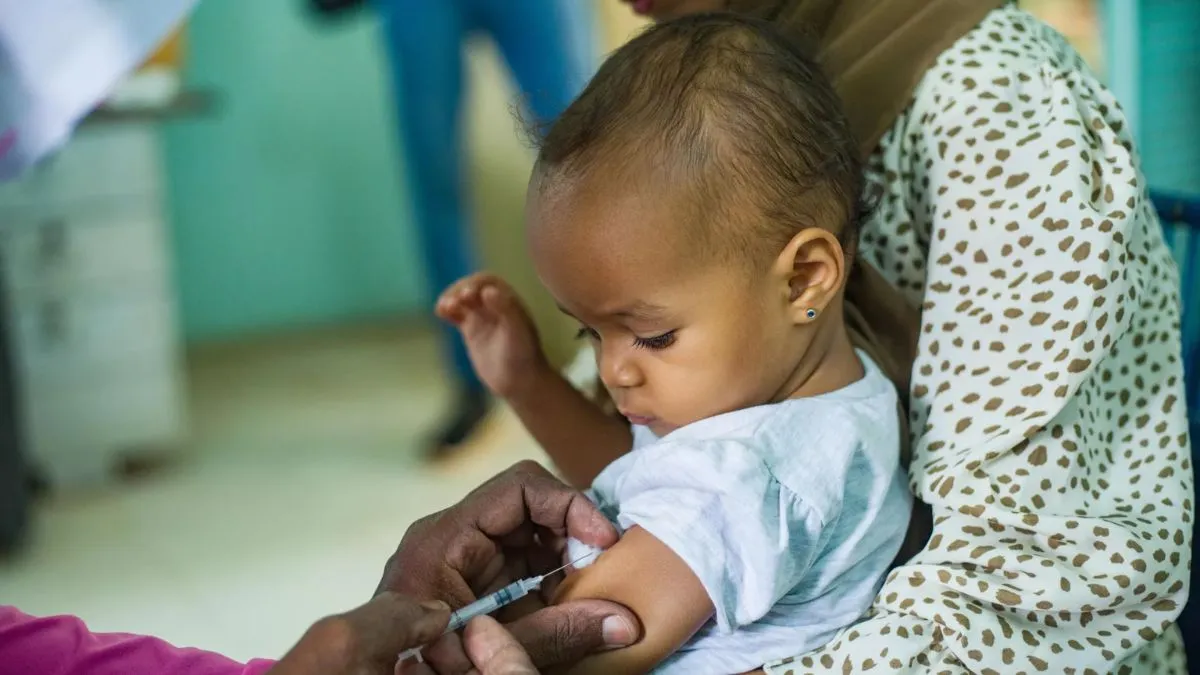
A recent study published in The Lancet journal said that India was among the eight countries where more than half of the world's unvaccinated children lived, as of 2023.
An international team of researchers forming the 'Global Burden of Disease (GBD) 2023 Vaccine Coverage Collaborators' updated global, regional, and national estimates of routine childhood vaccine coverage from 1980 to 2023 for 204 countries and territories.
The study gave the global estimates of current vaccine coverage. It said that the in the same year, there were 15.7 million children, 1.44 million in India, who had received no doses of the diphtheria, tetanus, and pertussis vaccine in their first year.
The researchers said that in 1980, 53.5 per cent of children who had never received a routine childhood vaccine, or 'zero-dose' children, lived in just five countries; India, China, Indonesia, Pakistan, and Bangladesh
Dr Jonathan Mosser from the Institute for Health Metrics and Evaluation (IHME), University of Washington, US, which co-ordinates the GBD study said that routine childhood vaccinations are among the most powerful and cost-effective public health interventions available. Dr Mosser said, "Despite the monumental efforts of the past 50 years, progress has been far from universal. Large numbers of children remain under- and un-vaccinated."
The senior author said that persistent global inequalities, challenges due to the COVID-19 pandemic, and growth of vaccine misinformation and hesitancy have all contributed to faltering immunisation progress. The trends increase the risk of outbreaks that can be prevented through vaccinations, including measles, polio, and diphtheria.
The study highlights "the critical need for targeted improvements to ensure that all children can benefit from lifesaving immunisations," Dr Mosser said.
The team analysed data pertaining to 11 vaccine-dose combinations recommended by the World Health Organization (WHO) for all children globally. Between 1980 and 2023, vaccine coverage was found to have doubled the world over against diseases, such as diphtheria, tetanus, whooping cough (pertussis), measles, polio, and tuberculosis.
Children who had never received a routine childhood vaccine -- zero-dose children -- further fell by 75 per cent fall, "from 58.8 million in 1980 to 14.7 million in 2019, before the COVID-19 pandemic", the researchers said.
However, progress has stalled or reversed since 2010 in many countries.
Measles vaccination rates fell in 100 of 204 countries between 2010 and 2019, while 21 of 36 high-income countries experienced declines in coverage for at least one vaccine dose against diphtheria, tetanus, whooping cough, measles, polio, or tuberculosis, the researchers said.
They added that an "accelerated progress" would be needed to achieve the 2030 target of halving the number of zero-dose children, compared to 2019 levels, with only 18 of 204 countries and territories estimated to have already met this target as of 2023.
Two-thirds (65 per cent) of the children never having received a vaccine dose but would need to be vaccinated between 2023 and 2030 live in sub-Saharan Africa (4.28 million) and South Asia (1.33 million), the team said.
"As of 2023, more than 50 per cent of the 15.7 million global zero-dose children resided in just eight countries (Nigeria, India, Democratic Republic of the Congo, Ethiopia, Somalia, Sudan, Indonesia, and Brazil), emphasising persistent inequities," the authors wrote.
(With PTI inputs)
Disclaimer: Tips and suggestions mentioned in the article are for general information purposes only and should not be construed as professional medical advice. Always consult your doctor or a dietician before starting any fitness programme or making any changes to your diet.
ALSO READ: World Vitiligo Day 2025: Understanding the symptoms, causes and complications of the condition
