
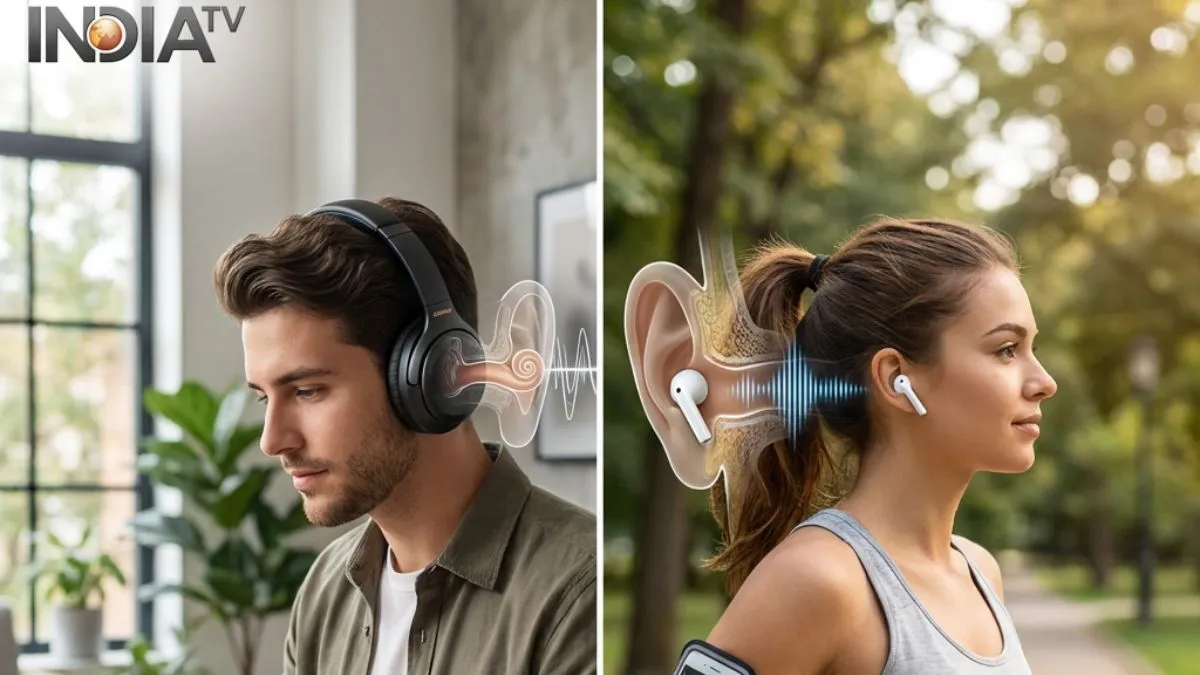
Whether you're listening to music during a commute, attending online meetings or watching videos late at night, chances are you're using either headphones or earbuds. But have you ever wondered whether your preferred listening device could be affecting your hearing?
Hearing specialists say it's not about picking one device over the other. Both headphones and earbuds can harm your hearing if you use them incorrectly. But they think certain choices could be better for you in the long run.
Why earbuds may pose a greater risk
Dr Harsh Suri, an ENT expert at Continental Hospitals, points out that earbuds fit right into your ear canal. This means they're close to the eardrum.
This close contact lets sound waves hit the ear harder for longer. Over time, this could up your risk for hearing issues like loss, tinnitus (that's ringing in the ears), discomfort, infections, or wax buildup. What makes it worse is how the sound feels muffled, making people crank up the volume without noticing. So, they seem louder, but you might be pushing your ears too hard.
Why headphones are generally considered safer
Over-ear headphones sit outside the ear canal and stay farther from the eardrum compared to earbuds.
According to Dr Suri, this makes them a much better choice for long listening sessions.
Anup Anand, who co-founded Anand Hearing Care, agrees. He says these types of headphones usually offer better noise cancellation, both passive and active. This is handy because you don’t have to crank up the volume to hear your audio when there's lots of background noise, like on the train or in an office.
Here’s the thing: Headphones aren’t totally risk-free.
Experts warn that no listening device is completely harmless. For example, Jeevan Kasra, the chairman at Steris Healthcare, states that turning the volume way up for a long time can definitely cause hearing damage with any kind of device.
Once the delicate hair cells in your inner ear get damaged, they won't grow back. That’s why it's important to keep the volume in check, no matter what you’re using to listen to your tunes.
What makes hearing loss particularly concerning is that it often develops gradually. Many people do not notice a problem until communication difficulties, ringing in the ears or hearing fatigue become more obvious.
The 60/60 rule every listener should know
All three experts emphasise one simple guideline for safer listening: the 60/60 rule.
This means:
- Keep volume at no more than 60% of the maximum level
- Listen for no longer than 60 minutes at a stretch
- Take regular breaks between listening sessions
Following this rule helps reduce cumulative noise exposure and gives the ears time to recover.
Daily habits may also be damaging your hearing
Daily routines might actually be hurting your ears without you realising it. It's not just about those personal audio devices; experts warn that regular exposure to stuff like traffic noise, loud concerts, intense gaming sessions, bustling entertainment places, and boisterous work environments adds up too.
Headphones and earbuds get a lot of flak, but it’s more about usage than the type. Most hearing experts will tell you that over-ear cans usually offer some benefit since they rest outside your ear canal and can use lower volumes. Still, at the end of the day, the main concern is how loudly and for how long you listen, whether you’re using earbuds or big headphones.
To safeguard your hearing, you need to keep the volume down and give yourself regular breaks. And here’s the kicker: hearing loss isn’t just an issue for the older folks. What you do now matters for your ears later on.
