
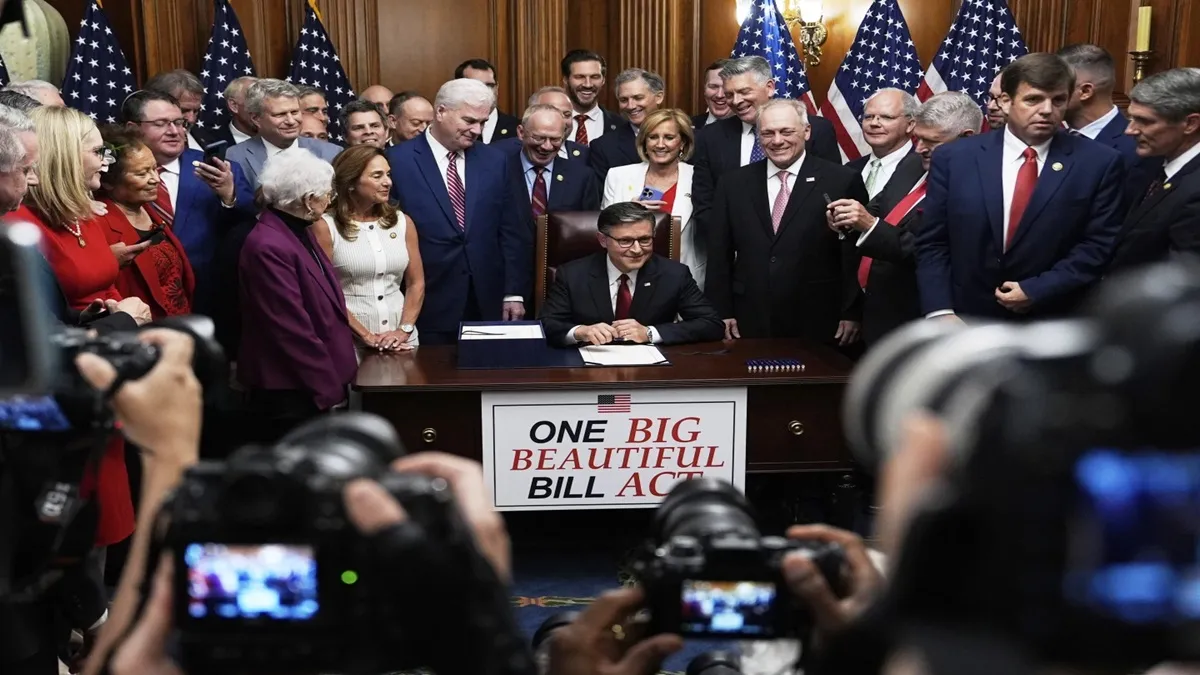
On the Fourth of July, US President Donald Trump is set to sign the ‘One Big Beautiful Bill’ ’into law, a sweeping tax-and-spending package that could shape the economic course of his second term. Dubbed the “One Big, Beautiful Bill”, the legislation had been stuck in weeks of gridlock before finally clearing Congress by a narrow vote. While the law makes major changes to US tax policy and federal spending, one specific provision has drawn particular attention in India: a new tax on certain overseas money transfers. After intense negotiations, the remittance tax initially proposed at 5 per cent has been pared down to 1 per cent in the final version, offering significant relief to millions of Indians living in the US.
What the remittance clause says
The final text of the law states that a 1 per cent tax will be levied on certain cross-border remittance transfers, defined as payments made using cash, money orders, cashier’s cheques, or similar instruments. The tax must be paid by the sender at the time of transfer.
Importantly, bank transfers and digital payments funded through debit or credit cards issued by US banks are exempt from this tax.
The new rule covers all US residents who are not American citizens including H-1B and H-2A visa holders, students on F-1 visas, and Green Card holders. In effect, this applies to a large portion of the Indian diaspora in the US, currently estimated at around 4.5 million, including over 2.9 million Indian-born immigrants, according to the Migration Policy Institute. The tax takes effect from January 1, 2026.
Why this matters to India
India is the largest recipient of remittances in the world, according to the World Bank. In 2023 alone, India received USD 129 billion in personal remittances, with more than a quarter of that around USD 36 billion coming from the United States.
In states such as Kerala, Uttar Pradesh, Bihar and Punjab, monthly remittances help families meet essential needs such as food, school fees, medical expenses, weddings and even home construction. In several districts, this income plays a role similar to a welfare net. However, the narrow scope of the new rule affecting only cash-based or physical transactions means its real-world impact may be limited, particularly among middle-class professionals who rely on digital banking services.
From 5 per cent to 1 per cent: What changed
When the bill was first introduced in the US House of Representatives in May, it included a controversial 5 per cent tax on all outbound remittances using cash or equivalents. That figure was trimmed to 3.5 per cent in the House version, before being further slashed to 1 per cent in the final draft cleared by the Senate on June 27.
The shift came after pressure from immigrant groups, Indian-American organisations, and even some Republican lawmakers from states with large immigrant populations. Lawmakers reportedly warned that a high remittance tax would disproportionately hurt law-abiding, tax-paying non-citizen workers who contribute significantly to the American economy.
For NRIs and students, a mixed outcome
The revised law means that most bank-based digital remittances including those sent through banks like SBI USA, ICICI Bank, or services like Remitly, Wise and Western Union (if funded by a US-issued card or account) will remain unaffected.
For students, who often rely on cash-based services for smaller transfers, and for low-wage workers on seasonal visas who may not have access to full banking services, the tax could be an added burden. Even so, a 1 per cent charge is far less than what was originally feared.
Beyond remittances: The bigger bill
While the remittance provision may be the most relevant to Indians, the broader legislation marks a dramatic reshaping of US federal priorities.
The new law includes:
- Extended tax cuts for individuals and businesses, including deductions on tips and overtime wages (until 2028)
- Increased defence and border funding, including over USD 46 billion for new border security infrastructure and thousands of new immigration officers
- A USD 25 billion allocation for a missile defence system dubbed the ‘Golden Dome’
- A new programme giving USD 1,000 savings accounts to every newborn
- Tighter eligibility rules for food assistance (SNAP) and Medicaid
- Reduction or rollback of clean energy tax credits and EV incentives
Democrats have criticised the bill, warning that it could push millions off public health insurance and widen income inequality. The non-partisan Congressional Budget Office has projected that as many as 12 million Americans could lose Medicaid coverage within a decade. The Trump administration disputes those figures.
What next for Indian families?
With the bill set to be signed into law, the countdown has begun for its implementation in January 2026. NRIs, students and Indian families will need to adapt primarily by routing their remittances through exempted banking channels.
