
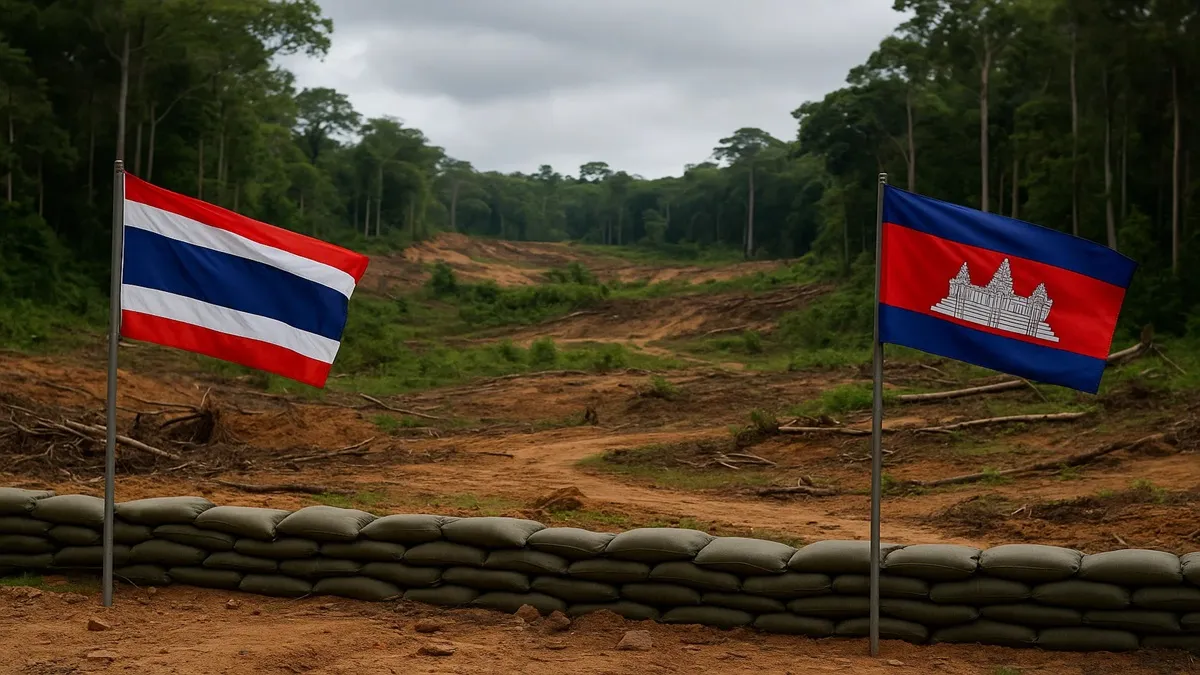
A border clash that killed a Cambodian soldier in late May has reignited long-standing tensions between Thailand and Cambodia, threatening regional stability and triggering political upheaval in Bangkok. The incident occurred in a contested section of their 820-km shared frontier where a definitive demarcation remains elusive despite years of bilateral talks. What began as a military standoff has since spiralled into a diplomatic and political crisis. With nationalist rhetoric intensifying on both sides and formal border crossings now sealed, China has offered to mediate calling for “friendly dialogue” and positioning itself as a neutral party ready to play a “constructive” role.
Why is the border contested?
The root of the dispute lies in colonial-era mapping. When France controlled Cambodia as part of French Indochina, its 1907 maps placed several ancient Khmer temple sites including Preah Vihear and Ta Muen Thom on Cambodia’s side of the border. Thailand, then Siam accepted these maps for decades but later challenged them, especially as territorial disputes became politically charged.
In 1962, the International Court of Justice (ICJ) awarded Preah Vihear temple to Cambodia, a ruling Thailand accepted formally but continued to contest in practice. Between 2008 and 2011, a series of clashes around the temple and other disputed areas killed over 30 soldiers on both sides and displaced thousands of civilians.
Despite a 2000 memorandum of understanding to settle the issue bilaterally via a Joint Boundary Commission, progress has stalled. Cambodia has now returned to the ICJ asking for a ruling on four disputed zones.
Thailand has rejected the court’s jurisdiction arguing that the matter must be resolved through bilateral mechanisms.
Skirmish near Chong Bok adds fuel to the fire
Tensions flared again on May 28, when a Cambodian soldier was killed during an exchange of fire near the Chong Bok-Mom Bei area- a patch of disputed forestland. The incident followed reports earlier in May that Cambodian troops had been digging trenches in the same area. Though local commanders initially defused the situation, the fatal clash upended efforts at de-escalation.
The clash came just weeks after a video surfaced of Cambodian personnel singing patriotic songs at the Ta Muen Thom temple which sits on the disputed border prompting a sharp response from Thai troops and igniting outrage on social media in both countries.
On 23 June, the Thai army closed all official border crossings with Cambodia indefinitely, citing rising security concerns after the May skirmish. Bilateral border trade estimated at around USD 5.1 billion in 2024, with Thailand holding a surplus of nearly USD 3 billion, according to previous trade trends has now come to a standstill, hitting local economies on both sides.
Why China is getting involved now
With both sides unwilling to back down, China has entered the picture. On the sidelines of the ASEAN Foreign Ministers’ meeting in Kuala Lumpur, Chinese Foreign Minister Wang Yi held separate talks with his Cambodian and Thai counterparts. In both meetings, he urged restraint and said Beijing was prepared to “uphold an objective and fair position” and facilitate dialogue.
Wang also raised concerns about growing cross-border crime, urging stronger cooperation to combat online fraud, illegal gambling, counterfeiting, and trafficking, activities known to operate across the Thailand-Cambodia border.
Beijing’s offer to mediate is seen as part of its broader effort to expand influence within Southeast Asia and prevent instability that could threaten regional infrastructure and investment under its Belt and Road Initiative.
A leaked call and a suspended prime minister
In Thailand, the border clash has become entangled with domestic politics. On June 15, Prime Minister Paetongtarn Shinawatra held a phone conversation with former Cambodian prime minister Hun Sen, during which she appeared to criticise her own military and adopt a conciliatory tone.
The call was leaked three days later and quickly became a national scandal. On July 1, the Constitutional Court suspended her from office while it considers whether her remarks breached ethical standards. She has until July 15, to submit a written defence.
Interior Minister Anutin Charnvirakul resigned on the same day, taking his Bhumjaithai Party, the second largest in the coalition, into opposition. The Pheu Thai-led government is now left with a slim majority and an uncertain future.
Hun Sen’s role and the end of an old alliance
Though he handed power to his son Hun Manet last year, Hun Sen remains Cambodia’s most influential political figure. Once close to the Shinawatra family having called Thaksin his “godbrother”, Hun Sen has now publicly severed ties.
Since the leaked call, he has made a series of provocative statements, predicting Paetongtarn’s downfall and criticising the Thai military. His apparent shift may be linked to Thailand’s growing scrutiny of Cambodia’s alleged role in cross-border scam operations.
A June report by the US Institute of Peace estimated that online scam centres operating in Cambodia could be generating as much as USD 12.5 billion annually equivalent to nearly half of the country’s official GDP. Thai officials have accused Cambodian authorities of protecting these operations and are stepping up efforts to cut off support — including halting electricity and fuel exports.
Nationalism on both sides
For both countries, the dispute has become a political tool. In Thailand, nationalist critics of the Shinawatra family have long accused them of compromising sovereignty. The leaked call has revived such claims particularly among military-aligned factions and conservative politicians.
In Cambodia, the government has used the crisis to fuel nationalist sentiment. With no viable political opposition left after the dissolution of the Cambodia National Rescue Party in 2017, Hun Sen’s Cambodian People’s Party has turned to external conflict to consolidate support.
Cambodia has also urged its citizens working in Thailand to return, promising jobs and assistance. However Thai officials have said there are no plans to expel workers. An estimated 500,000 Cambodian nationals are legally employed in Thailand, though the actual figure may be closer to one million.
Can the ICJ resolve the dispute?
Cambodia’s decision to seek intervention from the ICJ faces significant obstacles. Thailand has rejected the court’s jurisdiction over the current disputes and even if the ICJ were to take up the case any ruling would be unenforceable without Bangkok’s consent.
