
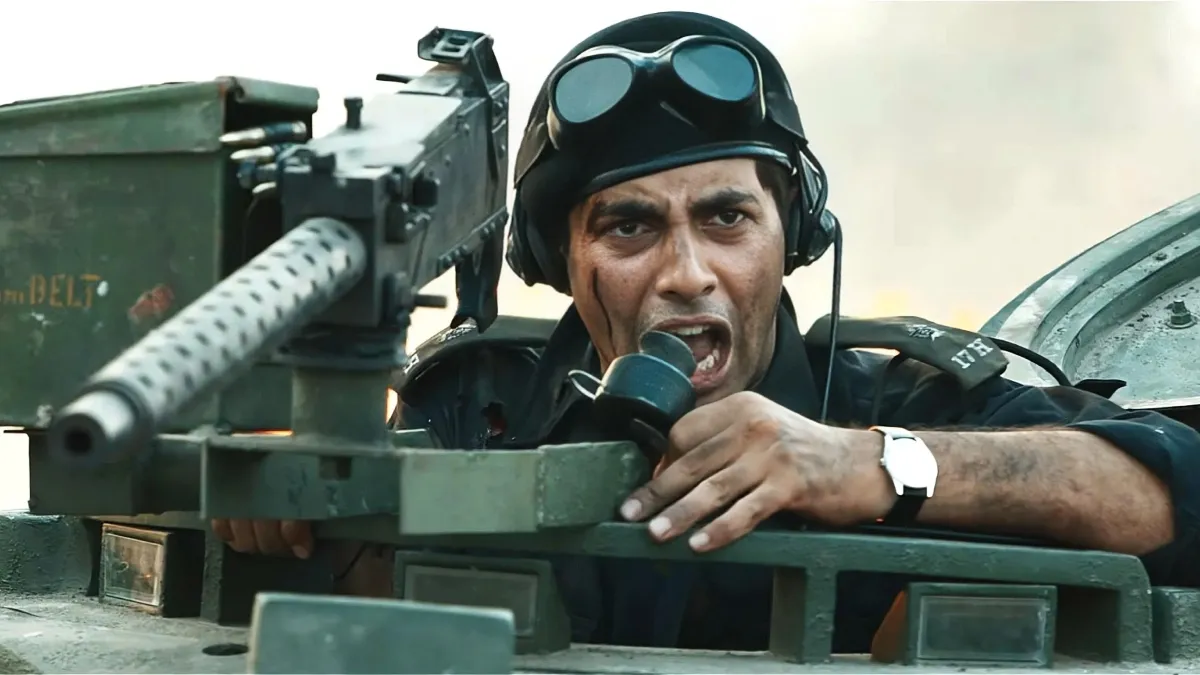
The story of the bravery of Indian Army Second Lieutenant Arun Khetarpal has been brought to life with the Bollywood film Ekkis, which released today. The kind of courage this brave young man displayed in the 1971 Indo-Pakistan war is unparalleled. Martyr Khetarpal's bravery was so extraordinary that he was posthumously awarded the Param Vir Chakra, India's highest military honor.
For the unversed, he is the youngest Indian to receive this award for his bravery at the Battle of Basantar. Read further to know everything about martyr Arun Khetarpal.
Arun joined the National Defence Academy in 1967
It seems that it was Arun Khetarpal's destiny to serve in the Indian Army. He was born on October 14, 1950, in Pune into a distinguished military family. His great-grandfather was in the Sikh Army and fought against the British, while his grandfather served under the British Army in World War I. His father, Lieutenant Colonel (later Brigadier) ML Khetarpal, was also part of the Indian Army. Thus, three generations of his family served the country in the army.
Arun Khetarpal spent his early years at the prestigious Lawrence School, Sanawar, located in the Kasauli hills of Himachal Pradesh. He excelled in both academics and extracurricular activities, demonstrating his skills in sports and leadership roles. In June 1967, he joined the National Defence Academy and continued his rigorous training at the Indian Military Academy (IMA). On June 13, 1971, Arun Khetarpal graduated from the IMA and received his commission in the 17 Poona Horse Battalion. Arun Khetarpal and the Battle of Basantar
Just a few months after receiving his commission, the 1971 Indo-Pakistani War broke out, and it was here that Arun Khetarpal's bravery came to the fore. Soon, he and his battalion were called into action against Pakistan. Khetarpal and the 17 Poona Horse battalion were tasked with establishing a bridgehead across the Basantar River. The Basantar River is a tributary of the Ravi River, flowing through Shakargarh in northern Punjab and is just a few miles from the main road connecting India's Punjab to Jammu and further into Kashmir. Controlling this road was a crucial strategic objective for the Pakistani army, as it would force the Indian army to divert troops from East Pakistan to India's western borders.
When Arun Khetarpa' refused to return back
On December 15, 1971, the Indian Army captured the bridgehead, but the next morning they faced the Pakistani tank regiment, the 13 Lancers. The area beyond the bridgehead was heavily mined by the Pakistanis. However, Khetarpal's regiment, under the leadership of Lieutenant Colonel Hanut Singh, crossed the minefield. The army described the battle, stating, 'Arun Khetarpal attacked continuously and aggressively until all resistance was completely eliminated and he advanced towards the direction of our squadron. When the enemy tanks began to retreat after their initial attacks, he pursued the enemy tanks and destroyed one of them.'
Then Pakistan launched another attack with a dozen tanks, during which Khetarpal once again destroyed four enemy tanks. However, his tank, named Famagusta, was hit directly and caught fire. When his senior officer ordered him to retreat, Khetarpal refused, saying, 'No sir, I will not abandon my tank. My main gun is still working, and I will take these bastards down.' He was subsequently martyred in a direct confrontation with the enemy.
Arun Khetarpal's bravery prevented Pakistan from advancing further, and a ceasefire was declared on all fronts on December 17. Many believe that if Khetarpal had not sacrificed his life in this heroic act, Pakistan would have succeeded in separating Jammu and Kashmir from the rest of India.
Honouring the hero's valour
For his indomitable courage in battle, young Second Lieutenant Arun Khetarpal, only 21 years old, was awarded the Param Vir Chakra. He still holds the distinction of being the youngest recipient of India's highest military honor. His citation reads: 'Second Lieutenant Arun Khetarpal laid down his life, but through his extraordinary valor, he secured victory in the battle; the enemy did not achieve the success they desperately needed. Not a single enemy tank was able to advance.'
Letter from Indira Gandhi to the family
Just days after he sacrificed his life for the country, India's then Prime Minister Indira Gandhi wrote a handwritten letter to Arun Khetarpal's family: 'On behalf of the people of India and myself, I send a message of condolence and sorrow. The entire nation shares your grief and sorrow. Millions of your countrymen are deeply grateful for this sacrifice made in the defense of the country, and we pray that you find peace and solace.'
Even today, the Indian Army continues to honour Khetarpal. The parade ground at the National Defence Academy is named after him. His name is also inscribed on the auditorium and main gate of the Indian Military Academy (IMA). The Centurion tank, Famagusta JX 202, was restored by the Army and is currently preserved at the Armoured Corps Centre and School in Ahmednagar.
Read Ikkis movie review here: Dharmendra's silent grief anchors this powerful story, Agastya Nanda holds his ground
