
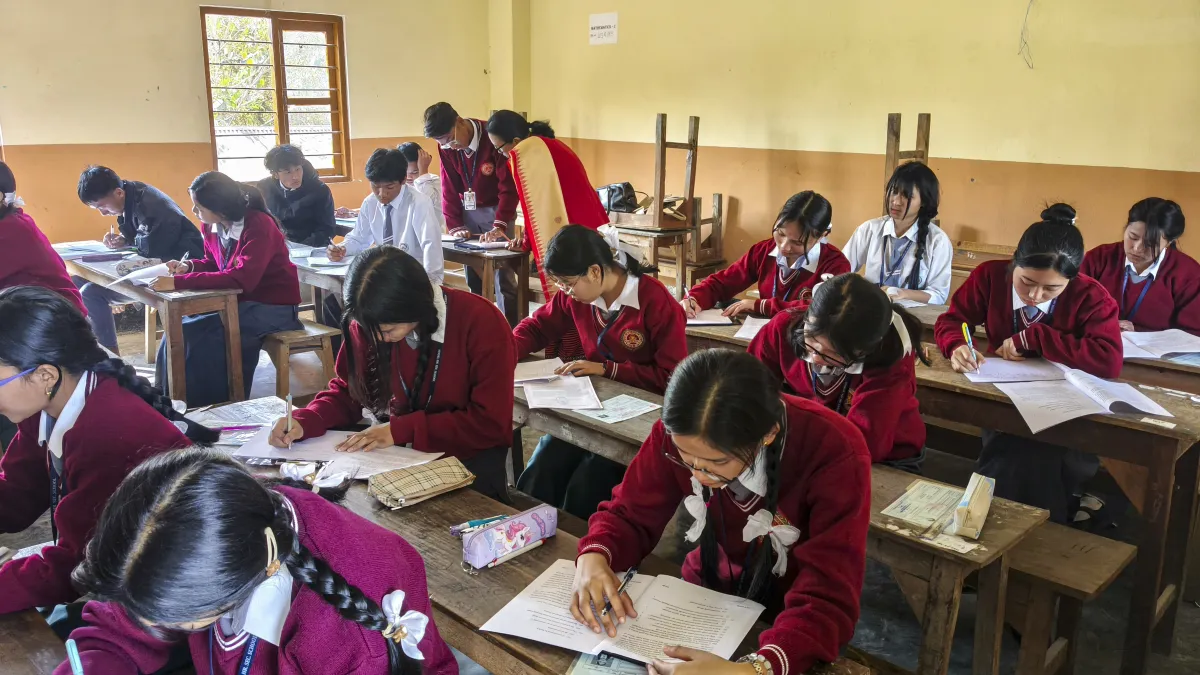
The Central Board of Secondary Education (CBSE) Class 10 Science paper was held today, February 25. The CBSE 10th Science paper held between 10:30 am to 1:30 pm. The students reported that effective time management played a crucial role in successfully attempting the examination, particularly while solving Physics numerical and interpreting complex diagrams. Chemistry and Biology were largely concept-based and closely aligned with NCERT content, making them relatively comfortable for well-prepared candidates. CBSE 10th Science Analysis 2026 Live: 'Paper includes a mix of competency-based and moderate questions'
“Physics required greater concentration and careful attention to detail; however, with thorough preparation, it proved to be manageable,” students shared. The paper was overall considered balanced, with a mix of conceptual and application-based questions, allowing students to perform well with consistent practice and clear understanding of fundamentals, reviewed Principal Alka Kapur, Modern Public School, Shalimar Bagh.
CBSE 10th Science Analysis 2026: Students and teachers' reactions
Warsha Sawant, TGT Science, Seth Anandram Jaipuria School Lucknow - "Question paper was largely direct and NCERT/Exemplar-based, with minimal emphasis on higher-order or application-based questions. The overall difficulty level was easy to moderate, making it accessible to students with basic conceptual understanding.
Physics:
Easy to moderate difficulty.
Direct questions from ncert and exemplar. The question paper was balanced between theory and numerical.
Chemistry
Easy to moderate. Balanced question paper, question from ncert and exemplar. Experiment based questions were incorporated.
Biology
The question paper was of moderate difficulty. Most of the questions were directly based on the NCERT syllabus and were similar to the sample papers. A significant number of questions were memory-based, with many repeated or closely related PYQs.
The case study questions were clear and self-explanatory, making them easy to attempt. Several questions were diagram-based and straightforward, which helped students score well. Overall, the paper was student-friendly, and well-prepared students who had thoroughly revised NCERT content and previous years’ questions were able to attempt the paper confidently."
Kaberi Buragohain, TGT- Science, Modern English School, Kahilipara, Guwahati, Assam - "The Class 10 Science Question Paper 2026 is well-structured and maintained a good balance, making it moderate in difficulty—neither too easy nor too tough. The paper followed the usual CBSE pattern and was based on conceptual understanding and competency-based questions that were simple to comprehend.
The question paper was completely based on NCERT and mainly tested basic concepts and fundamental understanding rather than tricky or application-based problems. This indicates that the exam focused on assessing students’ core knowledge while also including questions that encouraged critical thinking.
The expected average score is likely to be high this year, as students who prepared NCERT thoroughly would perform well. Though the number of numerical problems was comparatively fewer, making the paper manageable to complete within the given time.
The MCQs were based on conceptual clarity, and most of them were straightforward. The case-based questions were also moderately set. Overall, the CBSE Class 10 Science Question Paper 2026 was comparatively more moderate than the previous year’s paper and can be considered a scoring paper for well-prepared students."
Parvathy V - PGT Physics and Academic coordinator, Jain International Residential School (JIRS), Bengaluru - "The paper was as per the latest pattern with 3 sections: Section A- Biology for 30 marks, Section B- Chemistry for 25 marks and Section C- Physics for 25 marks. The paper had a total of 39 questions . The paper was a mix of straightforward questions and concept- based questions. It followed the revised pattern, focusing on competency based learning and application of concepts.
Section A (Biology)
The paper is well-balanced and thoughtfully designed. It covered all major concepts from the syllabus, giving students a fair chance to show their understanding and clarity of concept. It is a mix of straightforward and thought-provoking questions, all of which are scoring with proper preparation. It not only tested the knowledge effectively but also ensured critical thinking.
Overall, it was a well-structured, student- friendly, scoring paper.
Section B( Chemistry)
The Chemistry section was commendably straightforward, with all three question sets featuring nearly identical questions. The paper was direct and comprehensive, covering all marks levels, thereby rendering it readily accessible to students. A thorough understanding of the NCERT textbook is likely to have greatly benefited students in tackling the exam.
Section C( Physics)
Physics section was mildly difficult. The MCQ is easy to attempt.The 2 and 3 marks were moderate while the case study urges students to connect and apply. The 5 marks question on electricity in set 1 and 2, requires attentive calculation while in set 3, it is straight application of the formula."
Shikha Sharma, HOD SCIENCE, Silverline Prestige School - "The paper includes a good mix of competency-based and moderate questions, which assesses the application of knowledge. The paper was average, and the questions were mainly CBSE sample paper-based.
A few questions were direct and easy to answer. The MCQs and competency-based questions were also of average difficulty and tricky too, ensuring a balanced assessment. Students finished the paper well in time and were satisfied with the level of the paper. Overall, all the sets were easy to moderate."
Shikha Nath, Science Teacher, KIIT World School, Gurugram - "The Science question paper was moderate and well-balanced, with an overall difficulty level ranging from easy to average. It was designed to be accessible to a wide range of students, catering to varying levels of preparedness.
This question paper consisted of 39 questions divided into three sections:
Section A – Biology, Section B – Chemistry, and Section C – Physics.
Section A – Biology:
The Biology section focused on conceptual clarity and understanding of key topics from the NCERT syllabus. The questions were a balanced mix of knowledge-based and application-based, enabling students to demonstrate their understanding effectively. The MCQ section was quite doable and easy, with most questions being direct and not very tricky.
Section B – Chemistry:
The Chemistry section was well-structured and primarily based on NCERT concepts. Reasoning-based questions tested students’ analytical thinking and clarity of fundamental concepts. The MCQ section was quite doable and easy, with most questions being direct and not very tricky.
Section C – Physics:
The Physics section assessed students’ conceptual understanding and problem-solving skills. Numerical questions were straightforward and formula-based, allowing well-prepared students to score well. Although a few MCQs were slightly tricky, they were completely from the NCERT syllabus and required careful reading along with strong conceptual clarity.
The entire paper was strictly based on the NCERT curriculum, which helped students stay focused on the prescribed text and concepts. The structure of the paper ensured that both knowledge and application-based questions were included.
The paper tested students’ conceptual understanding, critical thinking abilities, and their skill in articulating scientific concepts clearly and coherently.
As per student feedback, the difficulty level was moderate, and most students found the paper to be well-balanced in terms of question types and topics. The distribution of marks was even, allowing students to attempt every section comfortably. Students were able to complete the paper well within the allotted time, which reflects the fair design of the examination."
